Section
Reading Evolutionary Trees
Reading evolutionary trees: common misreadings, the main branches of plant life, classification diagrams vs phylogenetic hypotheses. No tree-building math.
3 entries
-
Start here
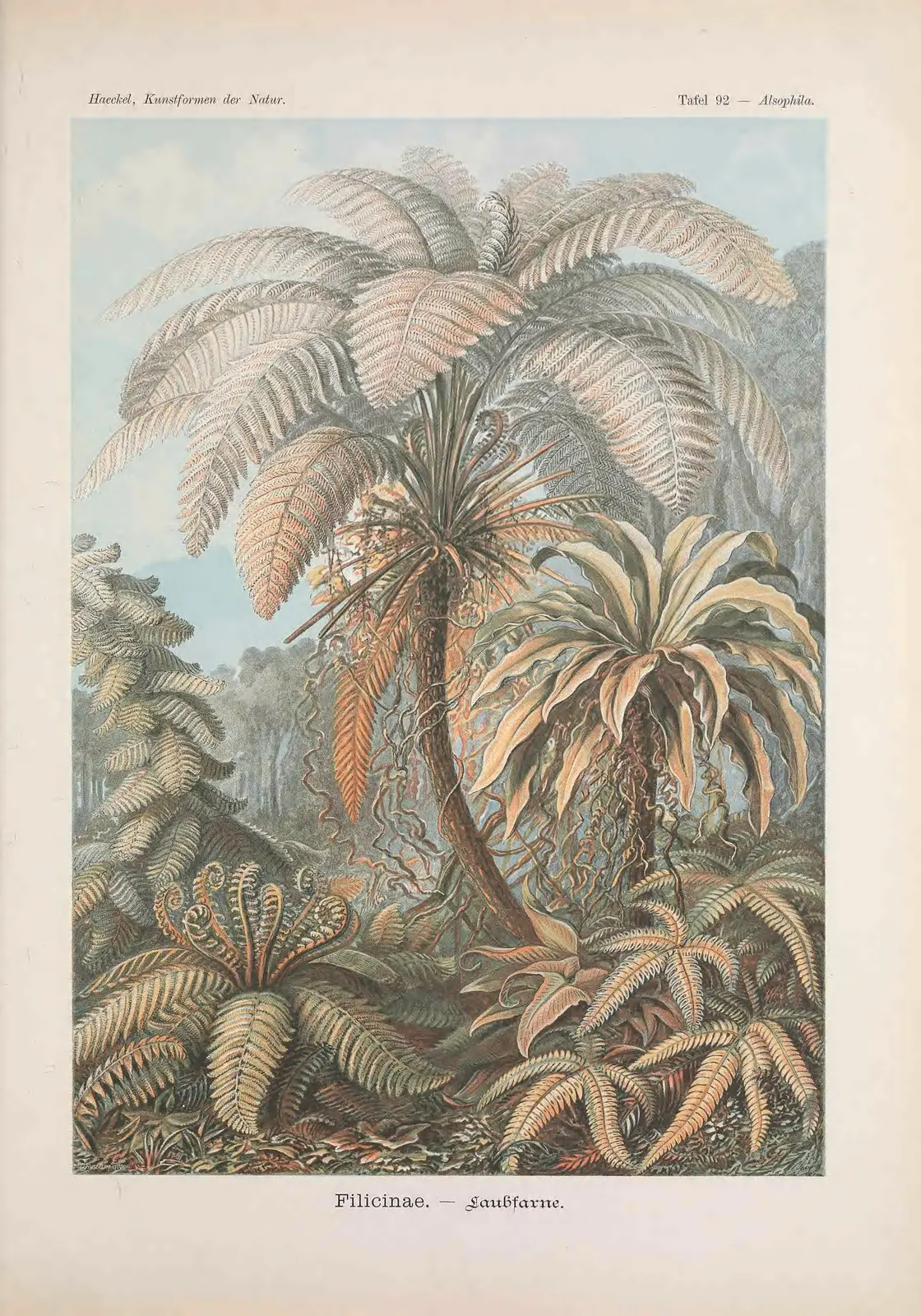
Ladder of Progress: Mosses Have Evolved as Long as Roses
The ladder of progress puts mosses on a low rung and roses at the top. On the tree of land plants, both lines have evolved for the same time since they split.
Image credit
"Kunstformen der Natur (Tafel 92) BHL47388457" by Ernst Haeckel (Biodiversity Heritage Library) — https://commons.wikimedia.org/wiki/File:Kunstformen_der_Natur_(Tafel_92)_BHL47388457.jpg — Public domain (Ernst Haeckel d. 1919; the Vienna printing firm Angerer & Göschl named on the plate is a company credit, treated as an anonymous contribution; published in "Kunstformen der Natur" between 1899 and 1904; US: published before 1931; EU: more than 70 years after Haeckel's death and after publication; the Biodiversity Heritage Library scan is a faithful reproduction) -
How to Read a Phylogenetic Tree: Tip Order Means Nothing
Read a phylogenetic tree by where its lines meet, not by the order of its tips. Five steps, from shared ancestors to clades, practised on a tree of six plants.
Image credit
"Silhouette d'arbre en hiver" by Philippe hirou — https://commons.wikimedia.org/wiki/File:Silhouette_d%27arbre_en_hiver.jpg — CC BY 4.0 (https://creativecommons.org/licenses/by/4.0/) -
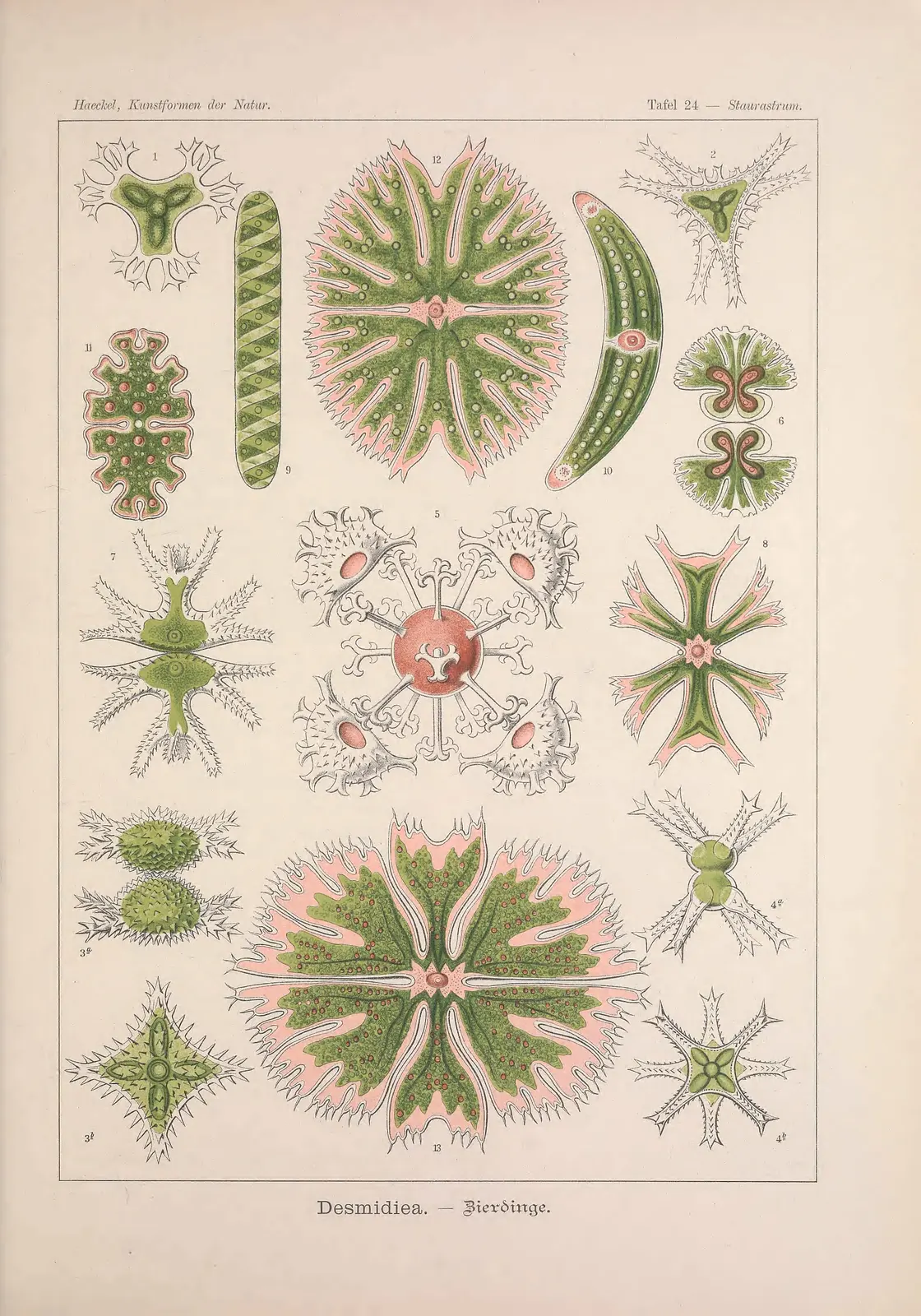
Plant Tree of Life: Land Plants' Closest Kin Are Pond Algae
On the plant tree of life, land plants form one branch, and their closest living kin are freshwater conjugating algae. A guide to its main branches.
Image credit
"Kunstformen der Natur (Tafel 24) BHL47388087" by Ernst Haeckel (Biodiversity Heritage Library) — https://commons.wikimedia.org/wiki/File:Kunstformen_der_Natur_(Tafel_24)_BHL47388087.jpg — Public domain (Ernst Haeckel d. 1919; Adolf Giltsch, the lithographer who turned many of Haeckel's drawings for the book into prints, d. 1911 (no lithographer signature is visible on this plate); published in "Kunstformen der Natur" between 1899 and 1904; US: published before 1931; EU: more than 70 years after both deaths; the Biodiversity Heritage Library scan is a faithful reproduction)


