Reading Evolutionary TreesComparison and chart
How to Read a Phylogenetic Tree: Tip Order Means Nothing
- Published
- Last substantive revision
Spec card
- Clade
- Pentapetalae, the root of the practice treeSource: APweb v14; Open Tree of Life synthesis 16.1
- Representative species
- Coffea arabica (Arabian coffee); Camellia sinensis (tea plant); Theobroma cacao (cacao); Paullinia cupana (guaraná); Citrus (citrus, a genus); Rosa canina (dog rose)Source: WCVP (Kew) v16; World Flora Online Plant List 2026-06; common names from Wikidata and English Wikipedia
- Approximate number of species
- —
- Key features
- —
- Tree type
- phylogenetic hypothesisSource: APweb v14; Open Tree of Life synthesis 16.1 (the Step 5 figure adds a classification diagram from NCBI Taxonomy)
- Place on the tree
- Asterids (coffee, tea) and rosids (cacao, citrus, guaraná, rose) inside Pentapetalae, whose base is unresolved and drawn dashedSource: APweb v14; Open Tree of Life synthesis 16.1; data retrieved 2026-10-21
Download this card as CSV how-to-read-a-phylogeny-spec-card.csv data: APweb version 14 (P. F. Stevens), order and clade placement, retrieved 2026-10-21; Open Tree of Life synthetic tree v16.1 (CC0), https://doi.org/10.5281/zenodo.3937741, with Open Tree Taxonomy 3.7 (draft 3) (CC0), https://doi.org/10.5281/zenodo.3937750, retrieved 2026-10-21; WCVP (Kew), CC BY 3.0, doi:10.34885/egs6-cp24, retrieved 2026-10-21; World Flora Online Plant List 2026-06 (CC0), retrieved 2026-10-21; Wikidata (CC0), Q101815, Q47685, Q42385, Q209089, English common names, retrieved 2026-10-21; English Wikipedia, "Rosa canina", common name dog rose, retrieved 2026-10-21
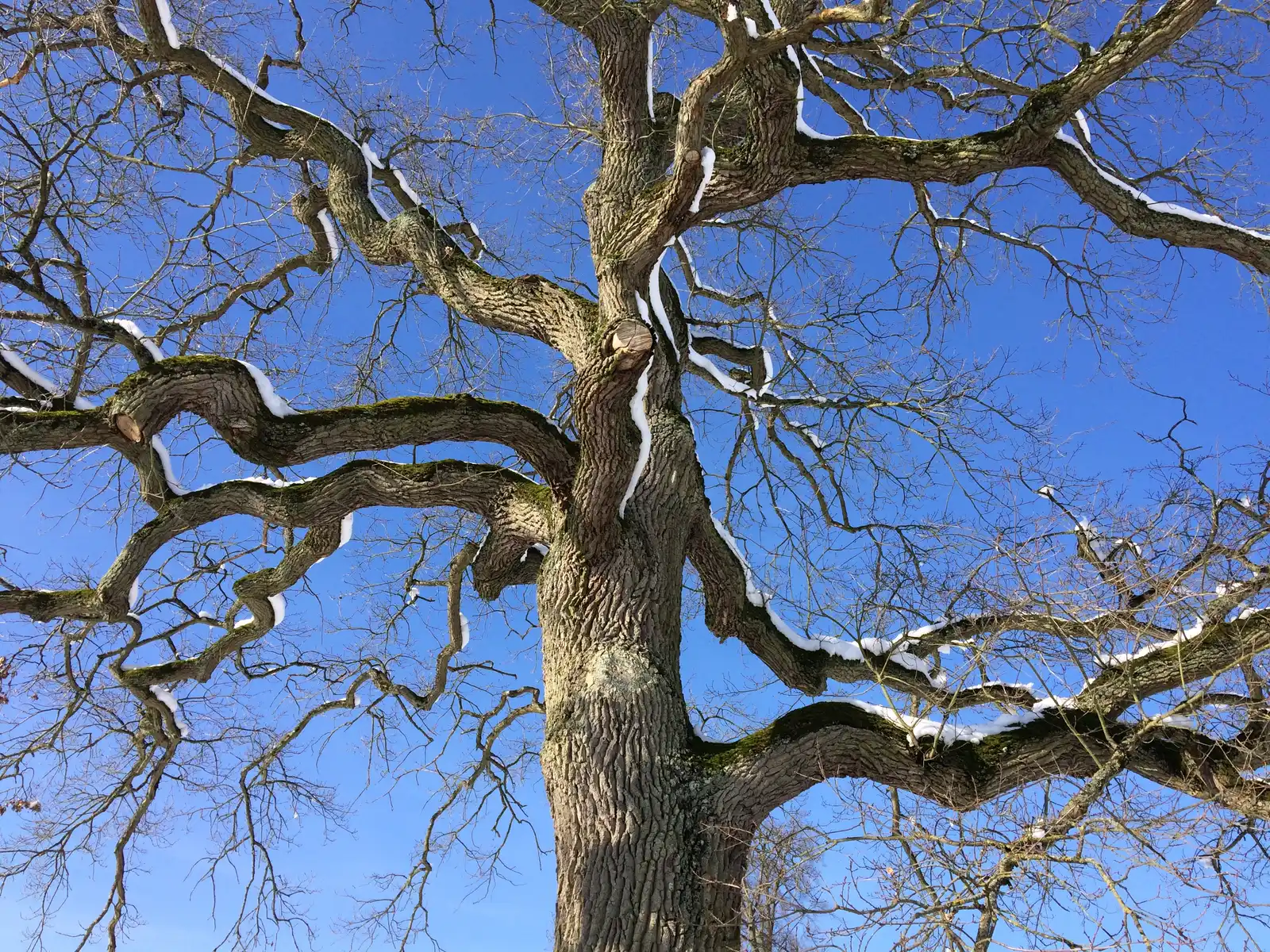
The crown of an oak in winter, its branches outlined by snow, photographed in France in February 2018.
"Silhouette d'arbre en hiver" by Philippe hirou — https://commons.wikimedia.org/wiki/File:Silhouette_d%27arbre_en_hiver.jpg — CC BY 4.0 (https://creativecommons.org/licenses/by/4.0/)
On a phylogenetic tree, the order of the names along the tips says nothing about kinship. Swap the two branches at any branch point and the tree is unchanged, because it records only which lines join where. To read a phylogenetic tree, pick two tips and follow their lines back toward the root until they meet: the more recent that shared ancestor, the more closely the two are related. The five steps below work through that method on a small tree of six plants, coffee and tea among them.
- Find the branch point where the lines of two tips meet.
- Spin the branches: the tip order can change while the tree stays the same.
- Check what branch length means on the drawing in front of you.
- Circle clades: a branch point and every tip beyond it.
- Check whether the tree is a classification diagram or a phylogenetic hypothesis.
The parts of a tree
Fig. 1 labels the parts on the practice tree used throughout this page. The tips at the right are the groups being compared, here six living plants. Each line is a branch, a line of descent, and a branch point (also called a node) is where one line splits into two. In a rooted tree, as English Wikipedia summarizes it, each branch point stands for the inferred most recent common ancestor of everything beyond it, and the root is the oldest branch point in the drawing.
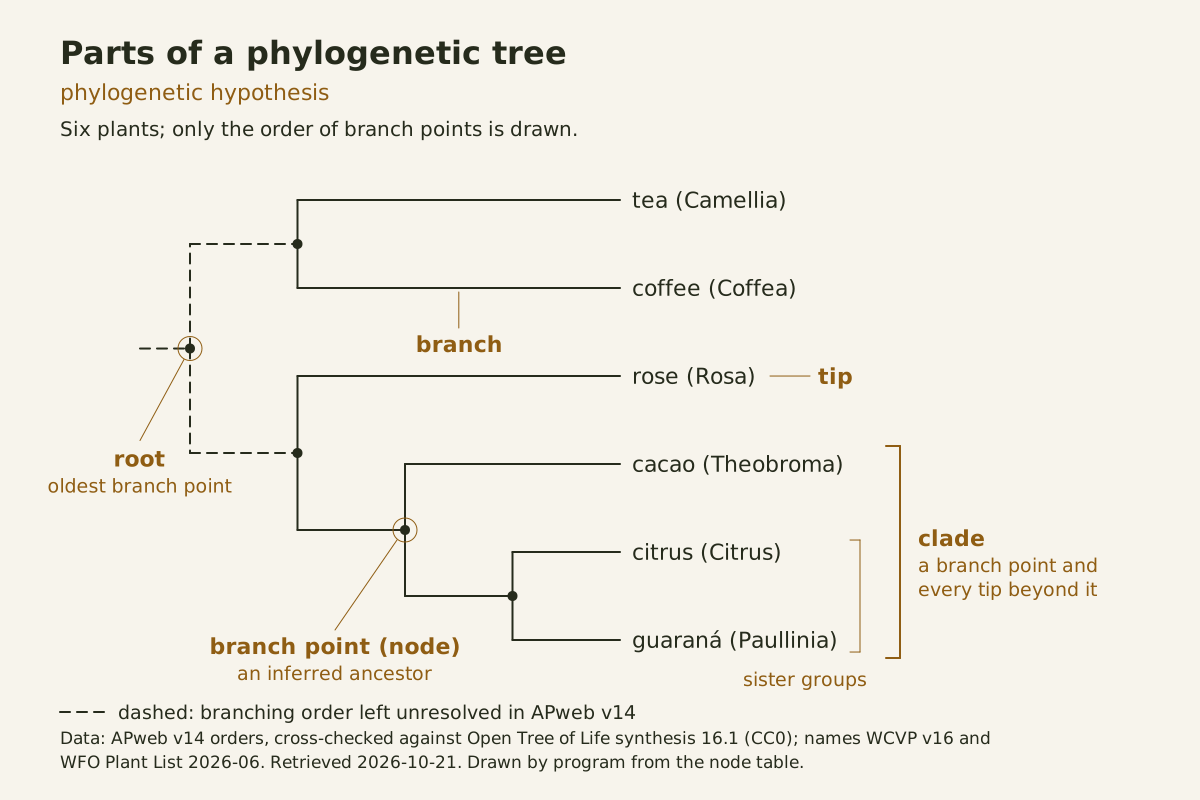
Fig. 1. The parts of a phylogenetic hypothesis, labelled on the six-plant practice tree used throughout this page; the dashed root marks a branching order left unresolved.
"Parts of a phylogenetic tree" by Botany for the Curious, https://botanyforthecurious.com/trees/how-to-read-a-phylogeny/, licensed under CC BY 4.0 (https://creativecommons.org/licenses/by/4.0/)data: APweb version 14 (P. F. Stevens), order and clade placement, retrieved 2026-10-21; Open Tree of Life synthetic tree v16.1 (CC0), https://doi.org/10.5281/zenodo.3937741, with Open Tree Taxonomy 3.7 (draft 3) (CC0), https://doi.org/10.5281/zenodo.3937750, retrieved 2026-10-21; WCVP (Kew), CC BY 3.0, doi:10.34885/egs6-cp24, retrieved 2026-10-21; World Flora Online Plant List 2026-06 (CC0), retrieved 2026-10-21A clade is a branch point together with every tip descended from it, and two clades that share an immediate common ancestor are sister groups. On the practice tree, cacao, citrus and guaraná form a clade, the malvids, and citrus and guaraná are sisters. The six tips stand for Camellia sinensis (L.) Kuntze, the tea plant; Coffea arabica L., Arabian coffee; Rosa canina L., the dog rose; Theobroma cacao L., cacao; the genus Citrus L., citrus; and Paullinia cupana Kunth, guaraná. Each name is accepted in WCVP version 16 and the World Flora Online Plant List as of 2026-06.
The parts are old. Charles Darwin's On the Origin of Species (1859) introduced its branching diagram with the line "The accompanying diagram will aid us in understanding this rather perplexing subject." Its letters A to L stand for the species of a hypothetical genus, and the gaps between its horizontal lines "may represent each a thousand generations", though later in the same chapter Darwin lets each stand for "a million or hundred million generations". Either way, height in his drawing measures time.
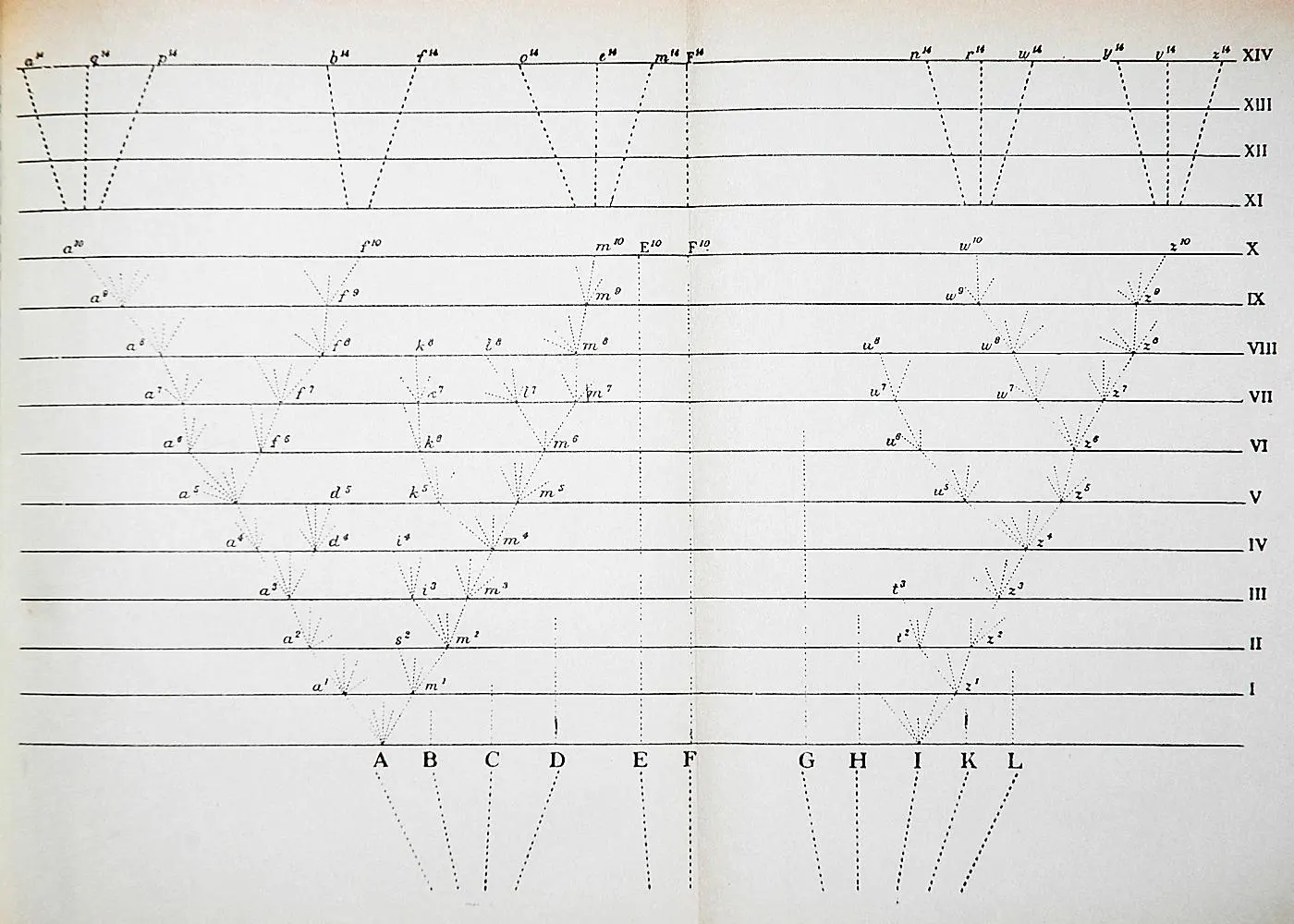
The branching diagram in Charles Darwin's "On the Origin of Species" (1859), drawn for a hypothetical genus: species A to L at the base, horizontal lines each standing for many generations.
Credit and licence
"Darwin divergence" by Charles Darwin (photograph of the printed diagram by Alexei Kouprianov) — https://commons.wikimedia.org/wiki/File:Darwin_divergence.jpg — Public domain (Charles Darwin, named as the author on the file page, d. 1882; the diagram was first published in On the Origin of Species in 1859; the lithographer is named neither on the file page nor on the photographed plate, so the plate is treated as an anonymous work; US: published before 1931; EU: 70 years after the author's death, and for the unnamed lithographer 70 years after publication; the photograph is a faithful copy of a two-dimensional public-domain work and adds no new rights)
Step 1: find the shared ancestor
Pick two tips and trace each line back toward the root until the two lines join. That branch point is their most recent common ancestor on this tree. On a phylogenetic tree, a tip's closest relatives are the tips that share its most recent branch point. Where they sit down the page does not matter.
In Fig. 2, the line of cacao meets the line of citrus at the branch point of the malvids, but meets the line of coffee only at the root. So on this tree cacao is more closely related to citrus than to coffee, even though the drawing puts cacao right next to the rose. The same reading works for every branch of the plant tree of life.
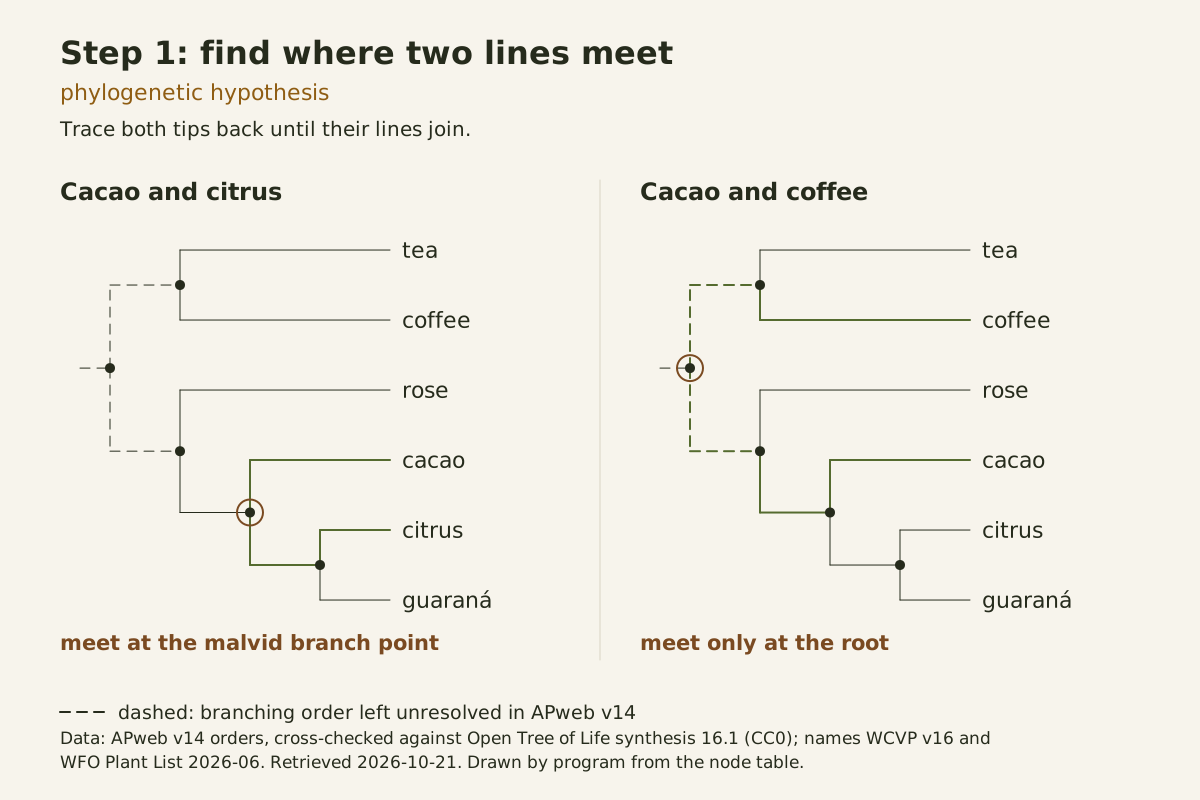
Fig. 2. Two pairs of tips traced back: cacao and citrus meet at the malvid branch point, while cacao and coffee meet only at the root.
"Step 1: find where two lines meet" by Botany for the Curious, https://botanyforthecurious.com/trees/how-to-read-a-phylogeny/, licensed under CC BY 4.0 (https://creativecommons.org/licenses/by/4.0/)data: APweb version 14 (P. F. Stevens), order and clade placement, retrieved 2026-10-21; Open Tree of Life synthetic tree v16.1 (CC0), https://doi.org/10.5281/zenodo.3937741, with Open Tree Taxonomy 3.7 (draft 3) (CC0), https://doi.org/10.5281/zenodo.3937750, retrieved 2026-10-21; WCVP (Kew), CC BY 3.0, doi:10.34885/egs6-cp24, retrieved 2026-10-21; World Flora Online Plant List 2026-06 (CC0), retrieved 2026-10-21Step 2: spin the branches
Each branch point joins two branches, and either one can be drawn on top. Spinning a branch point swaps the order of the tips beyond it and changes nothing else (Fig. 3). The practice tree has five branch points, so the same tree can be drawn in 25 = 32 tip orders. By this page's count, all 32 show the same five clades.
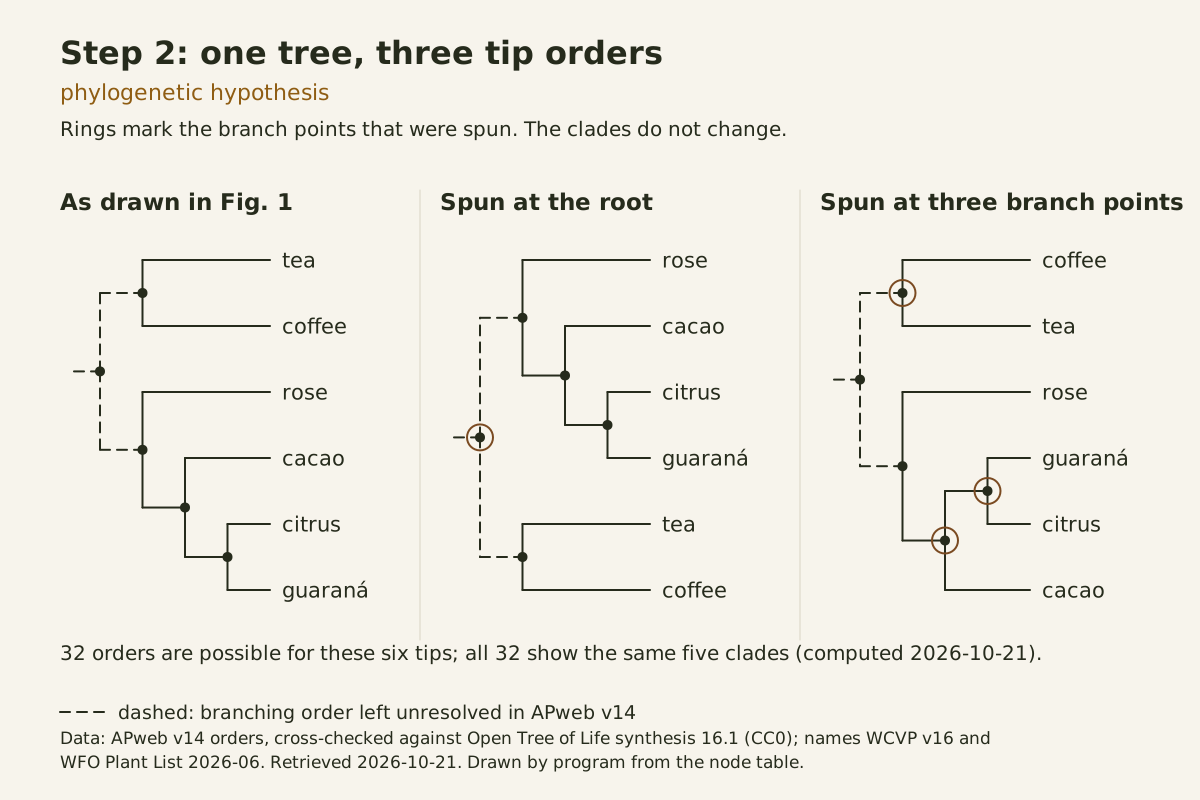
Fig. 3. The practice tree drawn three times, with rings on the branch points that were spun; the tips change places, but the clades do not.
"Step 2: one tree, three tip orders" by Botany for the Curious, https://botanyforthecurious.com/trees/how-to-read-a-phylogeny/, licensed under CC BY 4.0 (https://creativecommons.org/licenses/by/4.0/)data: APweb version 14 (P. F. Stevens), order and clade placement, retrieved 2026-10-21; Open Tree of Life synthetic tree v16.1 (CC0), https://doi.org/10.5281/zenodo.3937741, with Open Tree Taxonomy 3.7 (draft 3) (CC0), https://doi.org/10.5281/zenodo.3937750, retrieved 2026-10-21; WCVP (Kew), CC BY 3.0, doi:10.34885/egs6-cp24, retrieved 2026-10-21; World Flora Online Plant List 2026-06 (CC0), retrieved 2026-10-21; tip orders of the practice tree, computed 2026-10-21Download All 32 tip orders of the practice tree (CSV) how-to-read-a-phylogeny-tip-orders.csv data: APweb version 14 (P. F. Stevens), order and clade placement, retrieved 2026-10-21; Open Tree of Life synthetic tree v16.1 (CC0), https://doi.org/10.5281/zenodo.3937741, with Open Tree Taxonomy 3.7 (draft 3) (CC0), https://doi.org/10.5281/zenodo.3937750, retrieved 2026-10-21; tip orders and neighbours computed 2026-10-21
Neighbours on the page are a drawing choice. Across those 32 drawings, cacao sits directly beside the rose in 16 and beside tea or coffee in 8. It sits beside citrus or guaraná in all 32, because those two together are its sister group.
Reading the row of tips as a sequence, as if each name were a step up from the one before, is one version of the ladder mistake: reading a tree as a ladder from lower forms to higher ones, when a tree has branch points and no floors. In a 2008 paper, Kevin Omland, Lyn Cook and Michael Crisp called reading trees as ladders from "left to right" the most serious problem among widespread misconceptions about what phylogenies show. Every tip on the practice tree is a living plant, and none stands higher than another.
A pressed twig that forks in two; one branch forks again just above the first fork, the other only near its tip.
Illustration: Botany for the Curious. Generated schematic image — not a photograph or botanical record. Reuse terms: no license is granted; any rights Botany for the Curious holds in this image are reserved.Step 3: what branch length means
Before reading anything into the length of a line, check which kind of drawing it is (Fig. 4). As English Wikipedia summarizes three of the tree types it lists, a cladogram shows only the branching pattern, so its branch lengths mean nothing. A phylogram draws each branch in proportion to the amount of change along it, and a chronogram draws it in proportion to time.
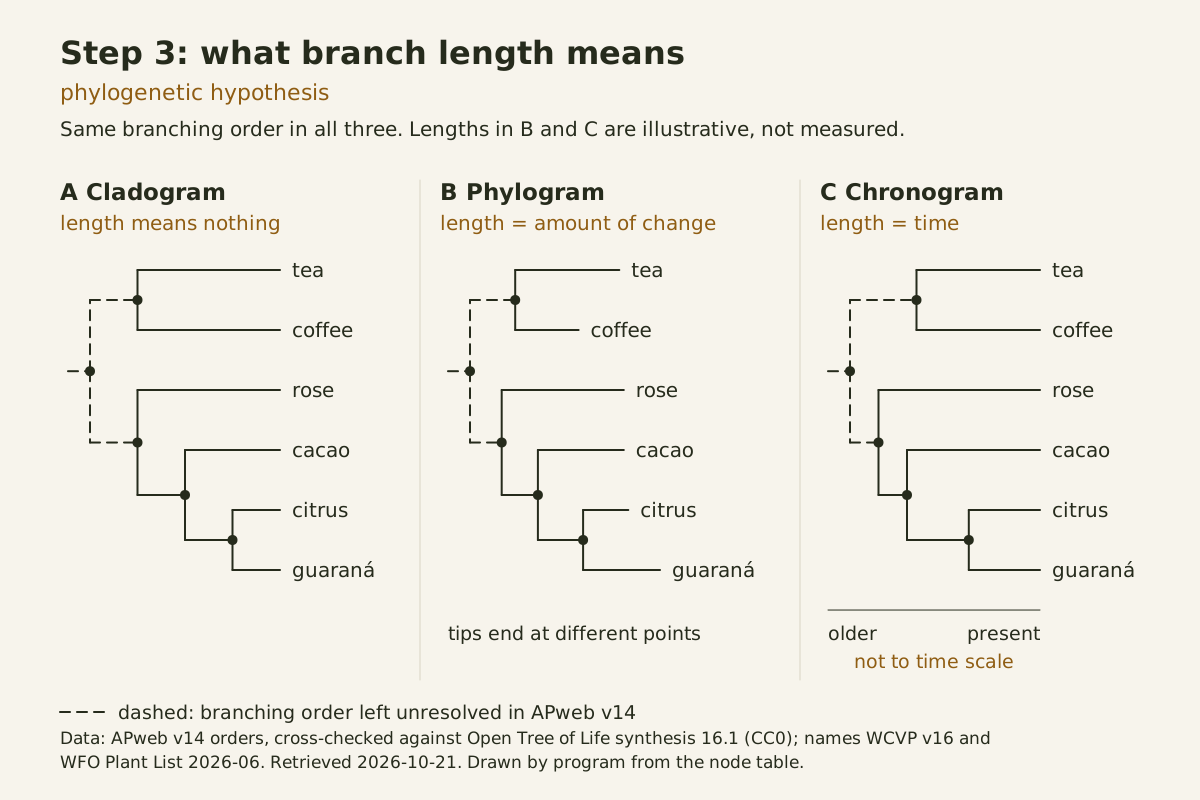
Fig. 4. The practice tree as a cladogram, a phylogram and a chronogram; the phylogram and chronogram lengths are illustrative, not measured, and not to time scale.
"Step 3: what branch length means" by Botany for the Curious, https://botanyforthecurious.com/trees/how-to-read-a-phylogeny/, licensed under CC BY 4.0 (https://creativecommons.org/licenses/by/4.0/)data: APweb version 14 (P. F. Stevens), order and clade placement, retrieved 2026-10-21; Open Tree of Life synthetic tree v16.1 (CC0), https://doi.org/10.5281/zenodo.3937741, with Open Tree Taxonomy 3.7 (draft 3) (CC0), https://doi.org/10.5281/zenodo.3937750, retrieved 2026-10-21; WCVP (Kew), CC BY 3.0, doi:10.34885/egs6-cp24, retrieved 2026-10-21; World Flora Online Plant List 2026-06 (CC0), retrieved 2026-10-21A cladogram is a phylogenetic tree whose branch lengths carry no meaning: it shows only the order of branching. English Wikipedia counts cladograms as one type of phylogenetic tree, usually drawn without evolutionary time. On a chronogram of living plants, every tip ends at the same line, the present, while on a phylogram the tips can end at different distances from the root. Darwin's diagram works like a chronogram, since its height counts generations.
Figs. 1–3, 5 and 7, and the right half of Fig. 6, are drawn as cladograms. The lengths in the phylogram and chronogram of Fig. 4 are set to show the idea and are not measured from any study, so they say nothing about how much these six plants have changed or when their lines split.
Step 4: circle a clade
To circle a clade, pick a branch point and take everything beyond it, leaving nothing out (Fig. 5). If the circle has to cut a branch to leave a tip outside, it is not a clade. Cacao, citrus and guaraná pass that test. Cacao and citrus alone fail it, because the branch point they share also holds guaraná.
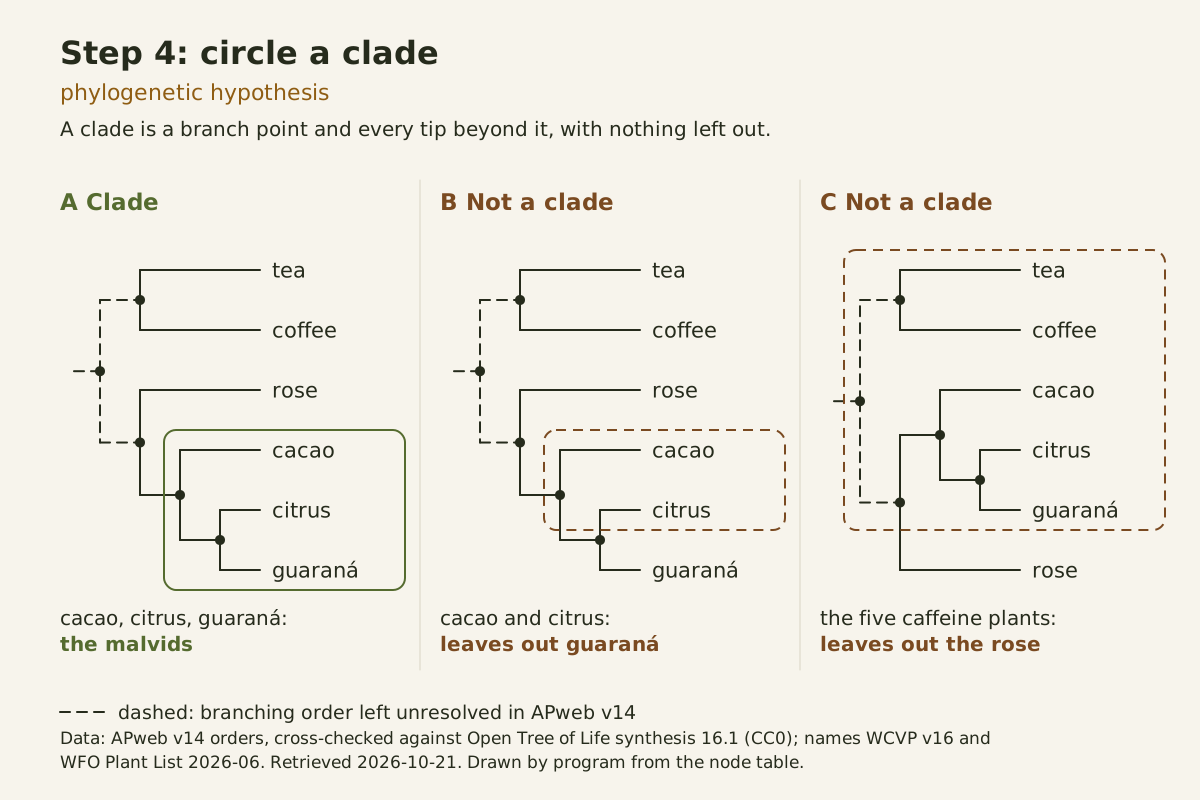
Fig. 5. Three circles on the practice tree: the malvids form a clade, while cacao with citrus and the five caffeine plants do not, because each circle leaves out a tip that shares their branch point.
"Step 4: circle a clade" by Botany for the Curious, https://botanyforthecurious.com/trees/how-to-read-a-phylogeny/, licensed under CC BY 4.0 (https://creativecommons.org/licenses/by/4.0/)data: APweb version 14 (P. F. Stevens), order and clade placement, retrieved 2026-10-21; Open Tree of Life synthetic tree v16.1 (CC0), https://doi.org/10.5281/zenodo.3937741, with Open Tree Taxonomy 3.7 (draft 3) (CC0), https://doi.org/10.5281/zenodo.3937750, retrieved 2026-10-21; WCVP (Kew), CC BY 3.0, doi:10.34885/egs6-cp24, retrieved 2026-10-21; World Flora Online Plant List 2026-06 (CC0), retrieved 2026-10-21; Huang et al. 2016, PNAS 113: 10613 (abstract), the five caffeine lineages, retrieved 2026-10-21The five caffeine plants fail as well. The summary of a 2016 study by Ruiqi Huang and colleagues names the cacao, citrus, guaraná, coffee and tea lineages as making the identical caffeine molecule by different pathways, and says caffeine production evolved independently in numerous species. The rose is not among those five, yet the only branch point holding all five also holds the rose. The tree by itself cannot say whether caffeine arose once or several times; the genetic evidence is set out in Caffeine: Coffee and Tea Evolved It Separately.
Step 5: classification diagram or phylogenetic hypothesis?
Last, check what kind of tree you are reading. Botany for the Curious labels every tree it draws as one of two kinds, as its page on sources and standards explains. A classification diagram follows ranked names, such as class, order, family and genus, and shows how names are filed. A phylogenetic hypothesis is redrawn from studies of how lineages split, with each branch point traced to the research behind it.
Fig. 6 draws the two kinds for the same six genera. The classification diagram, built from the ranks in each plant's NCBI Taxonomy record, hangs five orders side by side from one class, Magnoliopsida, so it cannot say which orders are closer. The hypothesis nests them: Gentianales (coffee) with Ericales (tea) among the asterids, and Malvales (cacao) with Sapindales (citrus and guaraná) among the malvids, inside the rosids with Rosales (the rose).
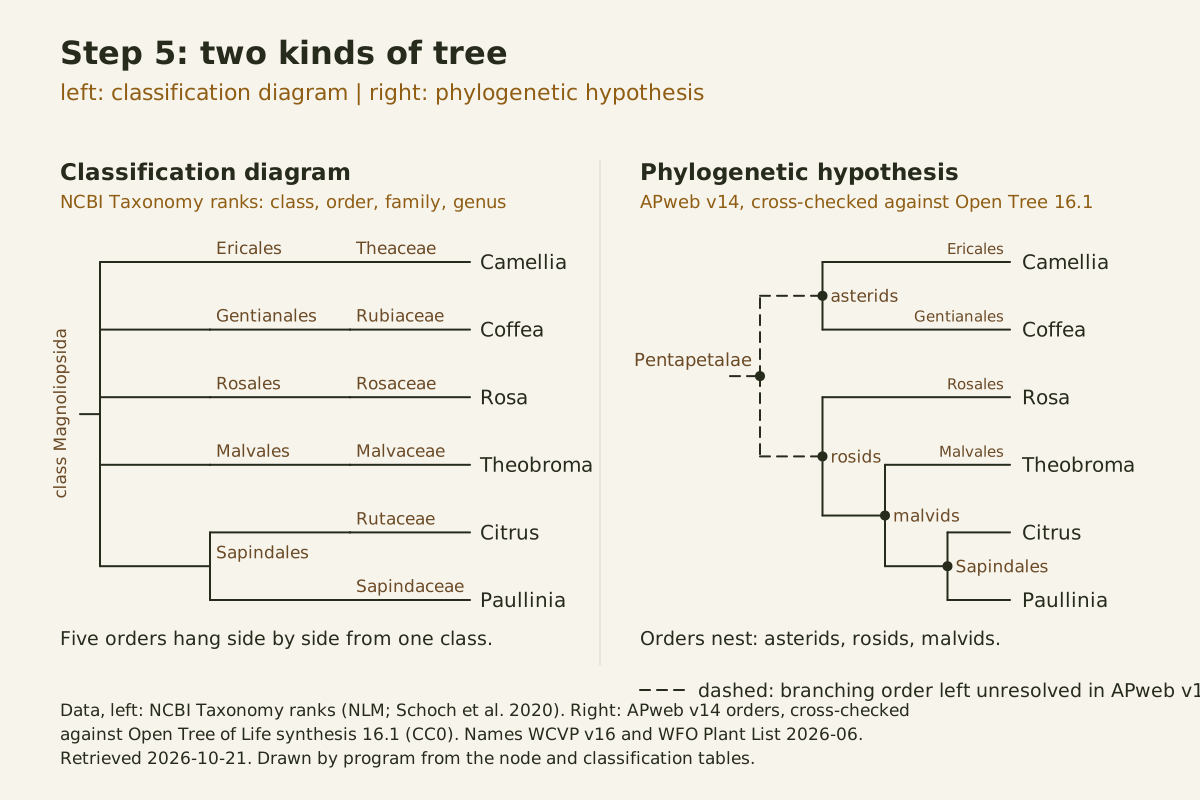
Fig. 6. A classification diagram from NCBI Taxonomy ranks, left, beside a phylogenetic hypothesis for the same six genera, right; only the hypothesis shows which orders are closest.
"Step 5: two kinds of tree" by Botany for the Curious, https://botanyforthecurious.com/trees/how-to-read-a-phylogeny/, licensed under CC BY 4.0 (https://creativecommons.org/licenses/by/4.0/)data: NCBI Taxonomy (NLM; Schoch et al. 2020), retrieved 2026-10-21; APweb version 14 (P. F. Stevens), order and clade placement, retrieved 2026-10-21; Open Tree of Life synthetic tree v16.1 (CC0), https://doi.org/10.5281/zenodo.3937741, with Open Tree Taxonomy 3.7 (draft 3) (CC0), https://doi.org/10.5281/zenodo.3937750, retrieved 2026-10-21; WCVP (Kew), CC BY 3.0, doi:10.34885/egs6-cp24, retrieved 2026-10-21; World Flora Online Plant List 2026-06 (CC0), retrieved 2026-10-21According to the abstract of Schoch and colleagues (2020), NCBI Taxonomy holds organism names and classifications for every sequence in the nucleotide and protein databases of the International Nucleotide Sequence Database Collaboration. Each record carries the disclaimer that the database "is not an authoritative source for nomenclature or classification". The records also list unranked groups such as asterids and rosids. Fig. 6 keeps only the ranked names.
Download Ranked NCBI Taxonomy lineages of the six plants (CSV) plant-classification-ncbi.csv data: NCBI Taxonomy (NLM; Schoch et al. 2020), retrieved 2026-10-21
Practice: the caffeine plants
Fig. 7 is the tree that maps the caffeine plants elsewhere on this site, with its five branch points numbered from the root outwards. Read it with the five steps, then check the answers below.
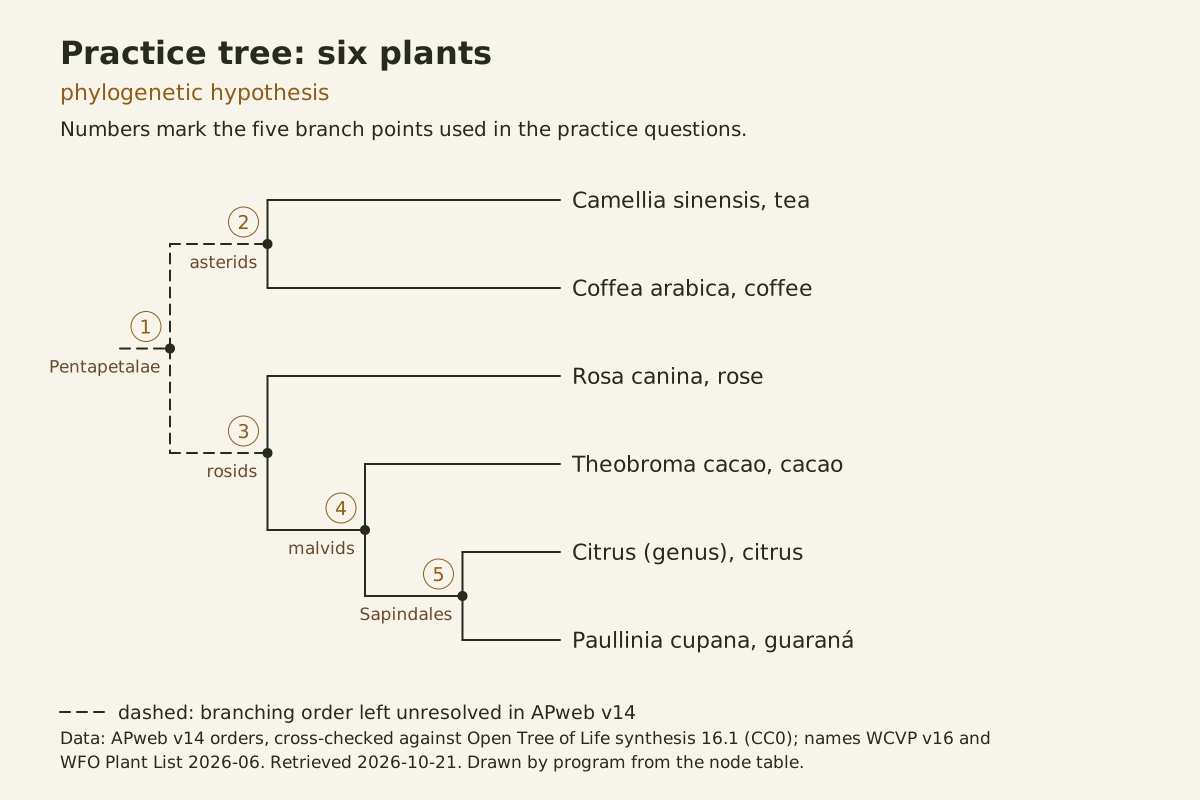
Fig. 7. The practice tree with numbered branch points: 1 Pentapetalae, drawn dashed, 2 asterids, 3 rosids, 4 malvids and 5 Sapindales.
"Practice tree: six plants" by Botany for the Curious, https://botanyforthecurious.com/trees/how-to-read-a-phylogeny/, licensed under CC BY 4.0 (https://creativecommons.org/licenses/by/4.0/)data: APweb version 14 (P. F. Stevens), order and clade placement, retrieved 2026-10-21; Open Tree of Life synthetic tree v16.1 (CC0), https://doi.org/10.5281/zenodo.3937741, with Open Tree Taxonomy 3.7 (draft 3) (CC0), https://doi.org/10.5281/zenodo.3937750, retrieved 2026-10-21; WCVP (Kew), CC BY 3.0, doi:10.34885/egs6-cp24, retrieved 2026-10-21; World Flora Online Plant List 2026-06 (CC0), retrieved 2026-10-21- Which tip is the closest relative of guaraná?
- Is tea more closely related to coffee or to the rose?
- Which single branch point could you spin to put cacao at the bottom of the drawing?
- Do tea, coffee and cacao form a clade?
- Branch point 1 is dashed. Does that change any of the answers?
- Was caffeine inherited once, or did it arise more than once?
Guaraná's closest relative on this tree is citrus, because their lines meet at branch point 5, the most recent branch point on the line of either tip. Tea is closer to coffee than to the rose. Tea and coffee meet at branch point 2, while tea and the rose meet only at branch point 1.
Spinning branch point 4 alone moves cacao below citrus and guaraná, to the bottom of the drawing, and every relationship stays as it was. Tea, coffee and cacao do not form a clade, because the only branch point holding all three is branch point 1, which also holds the rose, citrus and guaraná.
The dashed lines mark the branching order that APweb version 14 leaves unresolved among the asterids, the rosids and several other groups of flowering plants not drawn here. With only asterids and rosids on this tree, each pair of tips still meets at the branch point shown, so none of the answers changes. Open Tree of Life synthesis 16.1 also lists published trees that conflict with each of these branch points, alongside the trees that support them.
The tree alone cannot settle question 6. All five caffeine plants meet only at branch point 1, which also holds the rose, so one origin there or several separate ones would look the same. The 2016 summary by Huang and colleagues reports one molecule made by different pathways and calls caffeine production independently evolved.
Sources
- OpenTree et al. "Open Tree of Life Synthetic Tree", release opentree16.1 (built 2025-12-20), with Open Tree Taxonomy 3.7 (draft 3) identifiers (CC0). doi:10.5281/zenodo.3937741; taxonomy doi:10.5281/zenodo.3937750. https://doi.org/10.5281/zenodo.3937741 subtree of the six practice tips and the supporting and conflicting source trees at its five branch points
- Stevens, P. F. (2001 onwards). Angiosperm Phylogeny Website. Version 14, July 2017 [and more or less continuously updated since]. http://www.mobot.org/MOBOT/research/APweb/ pages for Dilleniales (Pentapetalae), Ericales, Gentianales, Malvales, Rosales and Sapindales
- NCBI Taxonomy Browser, National Center for Biotechnology Information, U.S. National Library of Medicine: records for Coffea arabica (13443), Camellia sinensis (4442), Theobroma cacao (3641), Citrus (2706), Paullinia cupana (392747) and Rosa canina (74635) (public domain) (read 2026-10-21). https://www.ncbi.nlm.nih.gov/Taxonomy/Browser/wwwtax.cgi taxonomy records for six plants: rank, lineage and the database disclaimer
- Govaerts, R. (ed.) (2026). WCVP: World Checklist of Vascular Plants, version 16 (2026-06-04). Facilitated by the Royal Botanic Gardens, Kew. CC BY 3.0. doi:10.34885/egs6-cp24. https://doi.org/10.34885/egs6-cp24 names file: accepted status, authors, families and IPNI identifiers for the six plants named on this page Text licence: CC BY 3.0
- World Flora Online Plant List, classification 2026-06 (CC0). World Flora Online Consortium. doi:10.5281/zenodo.7460141. https://doi.org/10.5281/zenodo.7460141 name records and placements for the six plants named on this page
- Darwin, C. (1859). On the Origin of Species by Means of Natural Selection, 1st edition. London: John Murray. https://www.gutenberg.org/ebooks/1228 Chapter IV, the passage on the diagram (first-edition text) Text licence: Public domain (Project Gutenberg)
- Huang, R., O’Donnell, A. J., Barboline, J. J. & Barkman, T. J. (2016). "Convergent evolution of caffeine in plants by co-option of exapted ancestral enzymes." Proceedings of the National Academy of Sciences of the USA 113(38): 10613–10618. doi:10.1073/pnas.1602575113. https://doi.org/10.1073/pnas.1602575113 abstract only (significance statement)
- Omland, K. E., Cook, L. G. & Crisp, M. D. (2008). "Tree thinking for all biology: the problem with reading phylogenies as ladders of progress." BioEssays 30(9): 854–867. doi:10.1002/bies.20794. https://doi.org/10.1002/bies.20794 abstract
- Schoch, C. L., Ciufo, S., Domrachev, M., Hotton, C. L., Kannan, S., Khovanskaya, R., Leipe, D., Mcveigh, R., O’Neill, K., Robbertse, B., Sharma, S., Soussov, V., Sullivan, J. P., Sun, L., Turner, S. & Karsch-Mizrachi, I. (2020). "NCBI Taxonomy: a comprehensive update on curation, resources and tools." Database 2020: baaa062. doi:10.1093/database/baaa062. https://doi.org/10.1093/database/baaa062 abstract
- Wikidata, items for Camellia sinensis (Q101815), Coffea arabica (Q47685), Theobroma cacao (Q42385) and Paullinia cupana (Q209089) (CC0) (read 2026-10-21). https://www.wikidata.org/wiki/Q101815 taxon names and English common names
- English Wikipedia, "Phylogenetic tree" (read 2026-10-21). https://en.wikipedia.org/wiki/Phylogenetic_tree summarised here through English Wikipedia
- English Wikipedia, "Cladogram" (read 2026-10-21). https://en.wikipedia.org/wiki/Cladogram summarised here through English Wikipedia
- English Wikipedia, "Clade" (read 2026-10-21). https://en.wikipedia.org/wiki/Clade summarised here through English Wikipedia
- English Wikipedia, "Rosa canina" (read 2026-10-21). https://en.wikipedia.org/wiki/Rosa_canina common name only
Related
- Ladder of Progress: Mosses Have Evolved as Long as Roses Deep explainer
- Plant Tree of Life: Land Plants' Closest Kin Are Pond Algae Specimen entry
Cite this page
Botany for the Curious. “How to Read a Phylogenetic Tree: Tip Order Means Nothing.” Published 2026-10-22; last substantive revision 2026-10-22. https://botanyforthecurious.com/trees/how-to-read-a-phylogeny/ (accessed: add the date you read it).
- Published
- Last substantive revision