Reading Evolutionary TreesDeep explainer
Ladder of Progress: Mosses Have Evolved as Long as Roses
- Published
- Last substantive revision
Spec card
- Clade
- Land plants (Embryophyta)Source: One Thousand Plant Transcriptomes Initiative 2019; Open Tree of Life synthesis 16.1
- Representative species
- A moss, Polytrichum commune; a fern, Osmunda regalis; Ginkgo biloba; Amborella trichopoda; a rose, Rosa caninaSource: WCVP (Kew) v16 and World Flora Online Plant List 2026-06; the moss is listed in World Flora Online only
- Approximate number of species
- —
- Key features
- —
- Tree type
- phylogenetic hypothesisSource: One Thousand Plant Transcriptomes Initiative 2019
- Place on the tree
- The five tips are living groups. Amborella and roses share the most recent of the four branch points and mosses join only at the root; none is unresolved for these five tips, and Open Tree lists two source trees that conflict with three of them. Data retrieved 2026-10-21Source: One Thousand Plant Transcriptomes Initiative 2019, cross-checked against Open Tree of Life synthesis 16.1
Download this card as CSV ladder-of-progress-spec-card.csv data: One Thousand Plant Transcriptomes Initiative 2019, Nature 574: 679 (CC BY 4.0), retrieved 2026-10-21; Open Tree of Life synthetic tree v16.1 (CC0), https://doi.org/10.5281/zenodo.3937741, retrieved 2026-10-21; WCVP (Kew), CC BY 3.0, doi:10.34885/egs6-cp24, retrieved 2026-10-21; World Flora Online Plant List 2026-06 (CC0), retrieved 2026-10-21
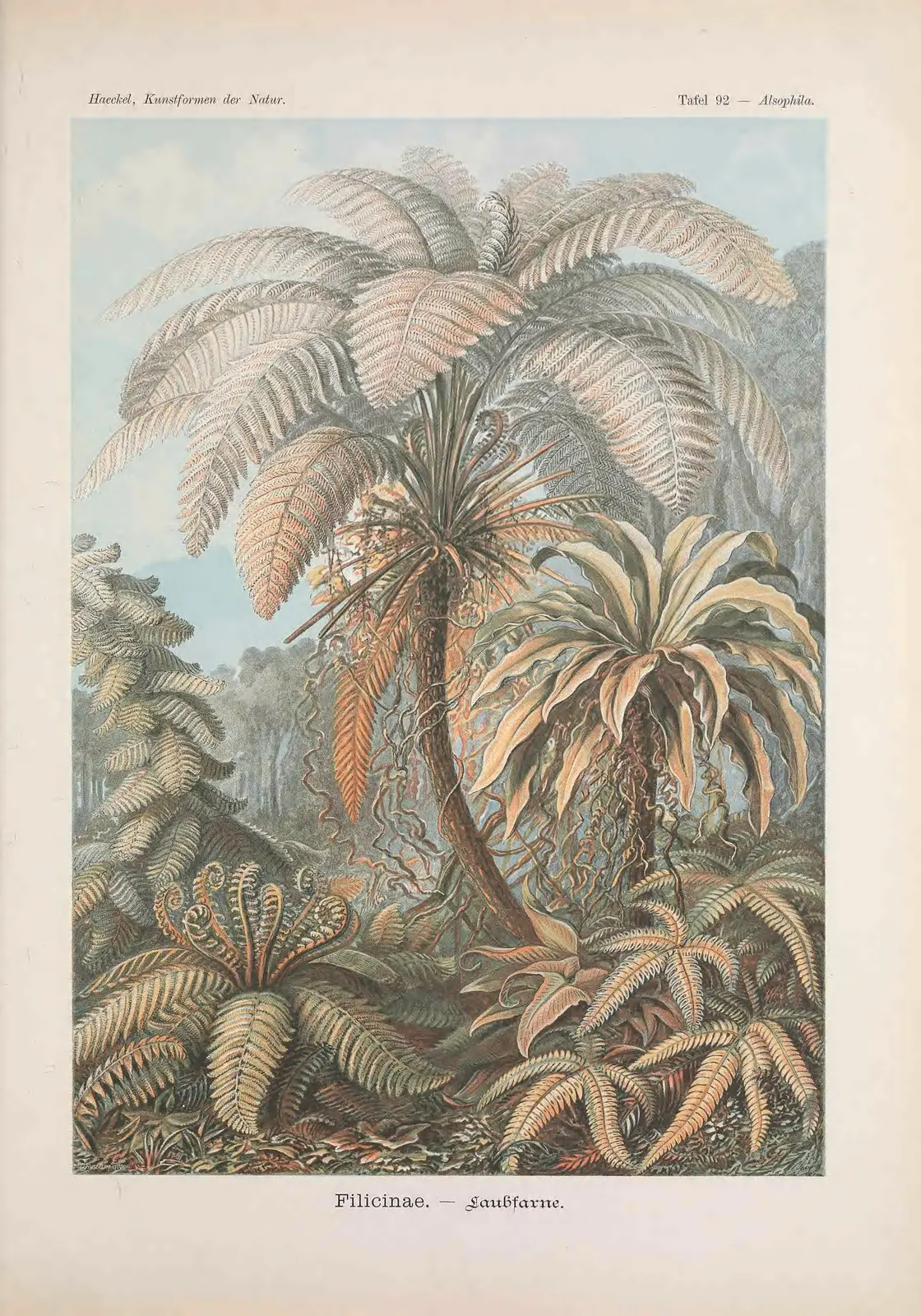
Tree ferns on plate 92 of Ernst Haeckel's "Kunstformen der Natur", issued between 1899 and 1904; the plate is titled Filicinae, and its page header names the genus Alsophila.
Credit and licence
"Kunstformen der Natur (Tafel 92) BHL47388457" by Ernst Haeckel (Biodiversity Heritage Library) — https://commons.wikimedia.org/wiki/File:Kunstformen_der_Natur_(Tafel_92)_BHL47388457.jpg — Public domain (Ernst Haeckel d. 1919; the Vienna printing firm Angerer & Göschl named on the plate is a company credit, treated as an anonymous contribution; published in "Kunstformen der Natur" between 1899 and 1904; US: published before 1931; EU: more than 70 years after Haeckel's death and after publication; the Biodiversity Heritage Library scan is a faithful reproduction)
A moss and a rose have been evolving for exactly the same length of time since their lineages split. The ladder of progress hides that fact. It pictures evolution as a climb, with mosses on a low rung and flowering plants at the top. On Botany for the Curious, reading a tree that way has a name: the ladder mistake, the habit of reading an evolutionary tree as a ladder from lower forms to higher ones, when a tree has branch points and no floors.
On a tree of living plants, every tip is a group alive today; mosses and roses descend from one ancestor that all living land plants share. From the moment their lines split, both have kept changing for the same span of time. Nothing on the tree ranks them. The pictures below show how a drawing can suggest a ranking that the data never held.
Same five living groups, drawn twice
Take five plants that are alive today: the common haircap moss, Polytrichum commune Hedw.; the royal fern, Osmunda regalis L.; the ginkgo, Ginkgo biloba L.; Amborella trichopoda Baill., a shrub of New Caledonia; and the dog rose, Rosa canina L. Each stands for a larger group. The four vascular plants have the same accepted names in two checklists: the World Checklist of Vascular Plants (WCVP, version 16) and the World Flora Online Plant List (June 2026). The moss appears only in World Flora Online, because WCVP covers vascular plants alone.
Fig. 1 draws one phylogenetic hypothesis for those five groups twice. A phylogenetic hypothesis is a tree redrawn from named studies of DNA and other evidence. A classification diagram is different: it only files names in ranks. The guide's Sources and Standards page explains both kinds.
Here the branching order follows the One Thousand Plant Transcriptomes Initiative (1KP). Its 2019 study sequenced 1,124 species and estimated a species tree from them. The Open Tree of Life synthesis 16.1 gives the same order for these five tips.
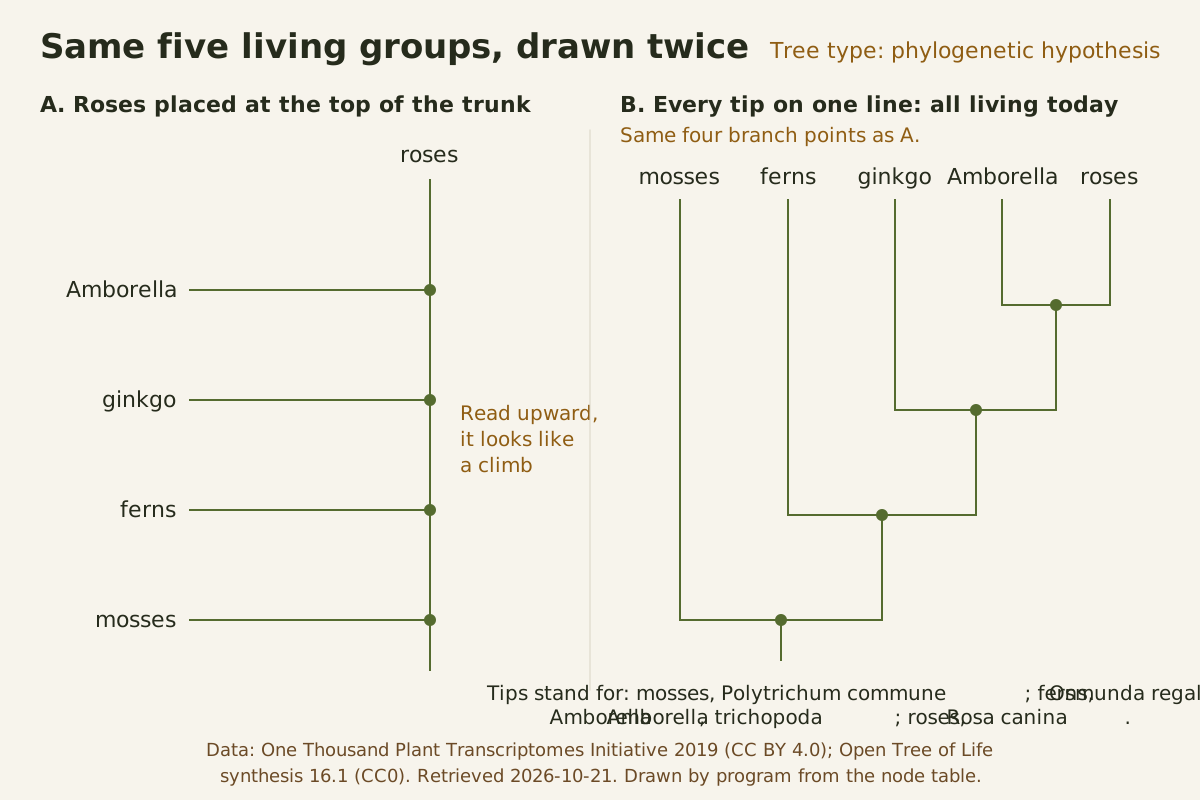
Fig. 1. One phylogenetic hypothesis for five living groups, drawn twice: once with roses at the top of the trunk, once with every tip on the same line.
"Same five living groups, drawn twice" by Botany for the Curious, https://botanyforthecurious.com/trees/ladder-of-progress/, licensed under CC BY 4.0 (https://creativecommons.org/licenses/by/4.0/)data: One Thousand Plant Transcriptomes Initiative 2019, Nature 574: 679 (CC BY 4.0), retrieved 2026-10-21; Open Tree of Life synthetic tree v16.1 (CC0), https://doi.org/10.5281/zenodo.3937741, retrieved 2026-10-21Start at the rose in panel B and follow its branch down. The first branch point it meets is shared with Amborella. The next brings in the ginkgo, then the fern, and the moss joins only at the bottom, which in this hypothesis is the branch point for all land plants. A branch point stands for an ancestor, and a clade is that ancestor with all of its descendants.
Panel A has the same four branch points, and with the rose at the top of one trunk, it reads like a climb. Yet nothing in the data put the rose there. The drawing did. Panel B sets every tip on one line, because every tip is a living group.
Where the ladder came from
The ladder is older than the idea of evolution. English Wikipedia's article on the great chain of being, or scala naturae ("ladder of being"), traces a ranked order of things back to Aristotle and through medieval thought. The order ran from God and the angels through humans, animals and plants down to minerals, and in it, the article notes, the lower plants included fungi and mosses. The ranking pictured creation and said nothing about descent.
Charles Bonnet drew the ladder literally. A fold-out in the first volume of his Traité d'insectologie (1745) is headed "Idée d'une échelle des êtres naturels". Its rungs run from L'HOMME at the top to "Matieres plus subtiles" at the foot. Plants in general share a single rung, PLANTES, with a rung marked Sensitive above it and rungs for lichens, moulds, mushrooms and truffles below.
Trees came next, but the ranking climbed into them. Augustin Augier's Arbre botanique is a fold-out in his Essai d'une nouvelle classification des végétaux (1801). It grows plant classes and families on a tree with roots: fungi, algae, mosses and ferns, grouped as Cryptogames, fill the lowest branches, and the umbellifers sit on the topmost shoot. English Wikipedia, citing work by Petter Hellström, calls it apparently the earliest tree diagram of natural order, with no evolutionary or time dimension.
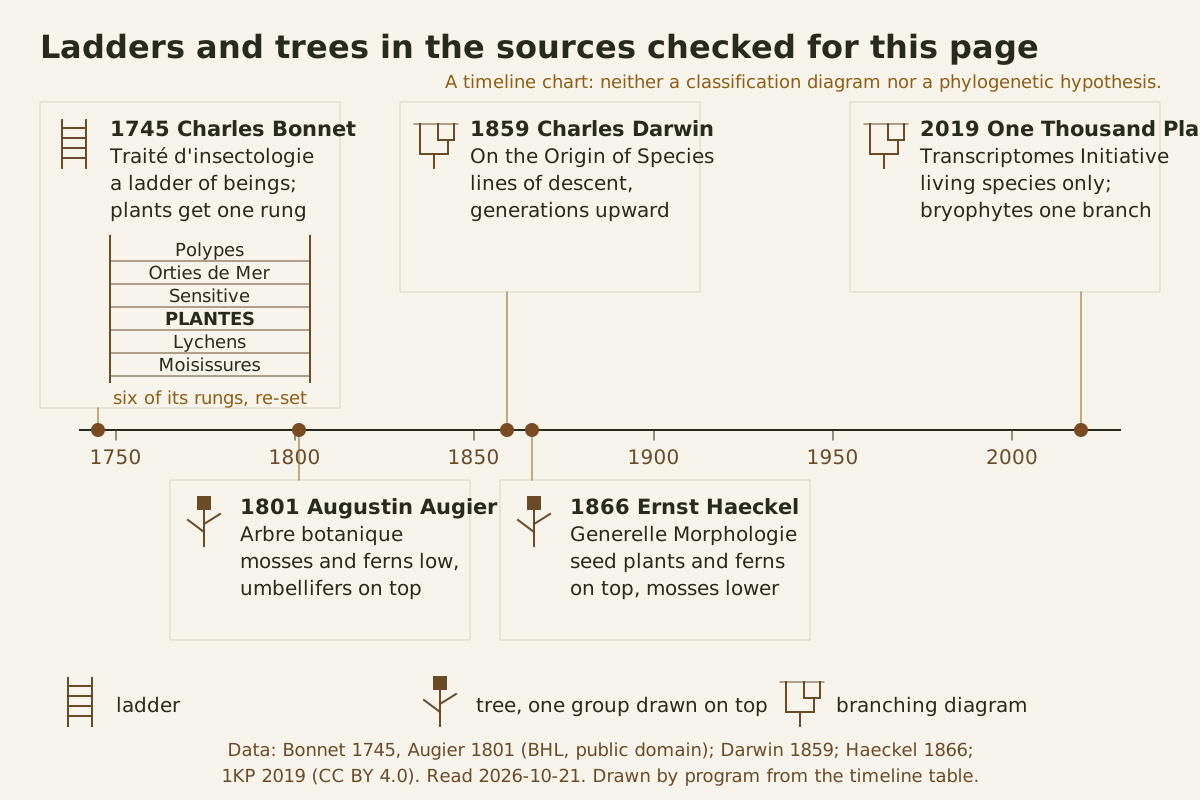
Fig. 2. Five diagrams read in the original for this page, 1745 to 2019, sorted by shape: one ladder, two trees crowned by one group, two branching diagrams.
"Ladders and trees in the sources checked for this page" by Botany for the Curious, https://botanyforthecurious.com/trees/ladder-of-progress/, licensed under CC BY 4.0 (https://creativecommons.org/licenses/by/4.0/)data: Bonnet 1745, Traité d'insectologie, vol. 1 fold-out (Biodiversity Heritage Library, public domain), retrieved 2026-10-21; Augier 1801, Essai d'une nouvelle classification des végétaux, fold-out (Biodiversity Heritage Library, public domain), retrieved 2026-10-21; Darwin 1859, On the Origin of Species, 1st edition (Project Gutenberg eBook 1228, public domain), retrieved 2026-10-21; Haeckel 1866, Generelle Morphologie der Organismen, plate (Wikimedia Commons scan, public domain), retrieved 2026-10-21; One Thousand Plant Transcriptomes Initiative 2019, Nature 574: 679 (CC BY 4.0), retrieved 2026-10-21Download Timeline table (CSV) ladder-of-progress-images.csv data: Bonnet 1745, Traité d'insectologie, vol. 1 fold-out (Biodiversity Heritage Library, public domain), retrieved 2026-10-21; Augier 1801, Essai d'une nouvelle classification des végétaux, fold-out (Biodiversity Heritage Library, public domain), retrieved 2026-10-21; Darwin 1859, On the Origin of Species, 1st edition (Project Gutenberg eBook 1228, public domain), retrieved 2026-10-21; Haeckel 1866, Generelle Morphologie der Organismen, plate (Wikimedia Commons scan, public domain), retrieved 2026-10-21; One Thousand Plant Transcriptomes Initiative 2019, Nature 574: 679 (CC BY 4.0), retrieved 2026-10-21
Trees that kept a top
Charles Darwin's On the Origin of Species (1859) offered the tree as a picture of descent. "The affinities of all the beings of the same class have sometimes been represented by a great tree," he wrote. "The green and budding twigs may represent existing species." His diagram in Chapter IV draws lines of descent spreading out from the species of one large genus, with each band between its lines standing for many generations: "a thousand" at first, and later in the chapter "a million or hundred million".
Ernst Haeckel's tree of 1866, from his Generelle Morphologie der Organismen, was a tree of descent that still had a top. In its plant column, the seed plants (his Anthophyta) and the ferns and their allies sit at the crown, under the label Cormophyta. The mosses (Bryophyta) sit on a branch below them, and seaweeds lower still.
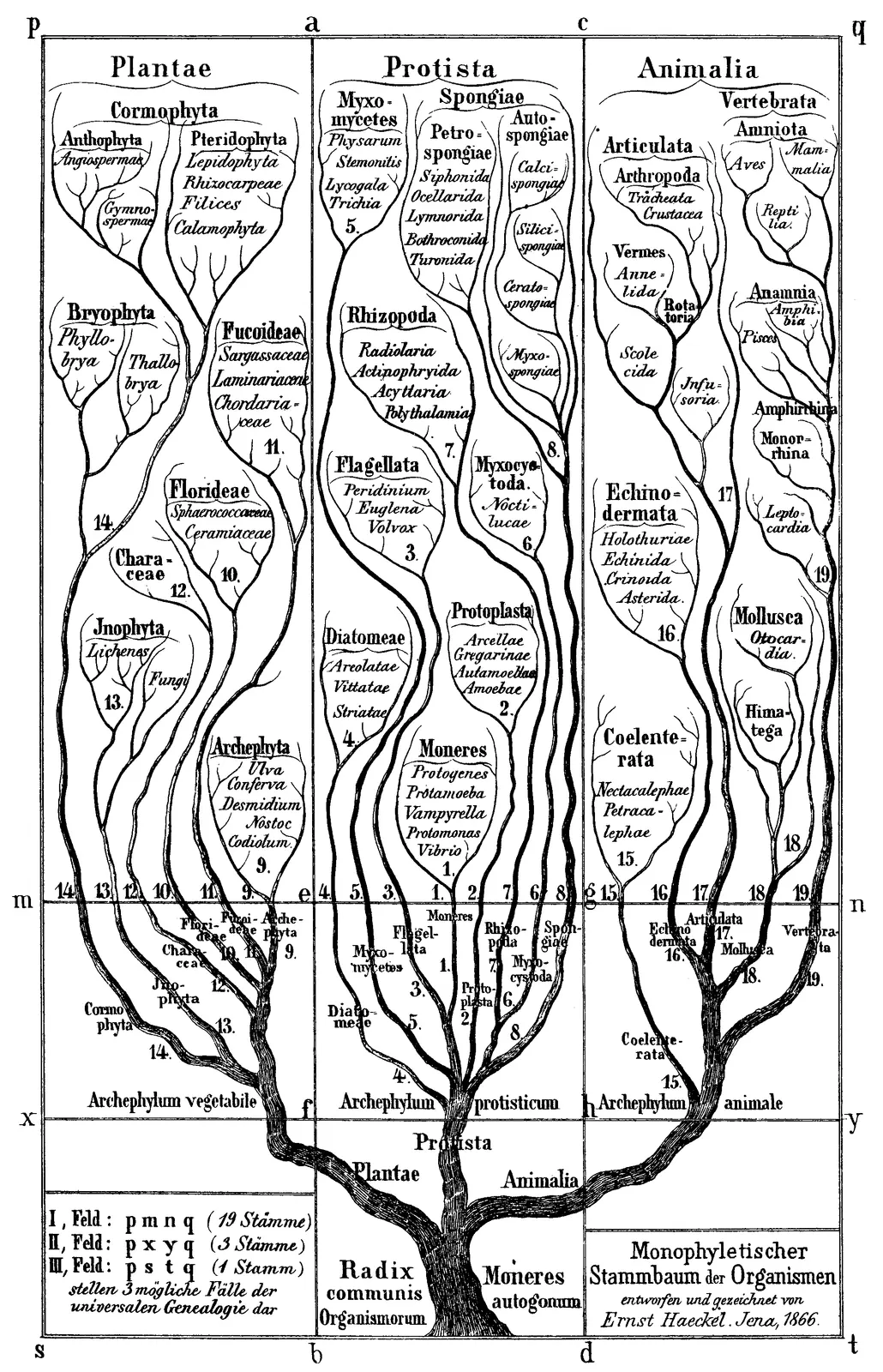
Ernst Haeckel's "Monophyletischer Stammbaum der Organismen" from "Generelle Morphologie der Organismen" (1866), with the seed plants at the top of the Plantae column.
"Haeckel arbol bn" by Ernst Haeckel — https://commons.wikimedia.org/wiki/File:Haeckel_arbol_bn.png — Public domain (Ernst Haeckel d. 1919; US: published 1866, before 1931; EU: 70 years after the author's death; the scan by Luis Fernández García is a faithful reproduction of a public-domain plate)
Textbook language kept the rungs too. Asa Gray's Botanical Text-Book of 1879 (sixth edition, volume 1) filed lichens and mosses among plants of a lower grade (p. 35). It also described Antoine Laurent de Jussieu's 1789 system as working from lower, simpler forms up to higher, more complex ones (p. 339). Those words ranked plants by how complicated they looked, not by where their lines branch.
Every living tip has had the same time
Put a finger on the moss in Fig. 3 and trace its line down to the branch point at the base. Then do the same from the rose. Both lines end at the same branch point, which in this hypothesis is the ancestor shared by all living land plants, and both start at the line marked today. The moss lineage and the rose lineage have run for the same span of time since they split.
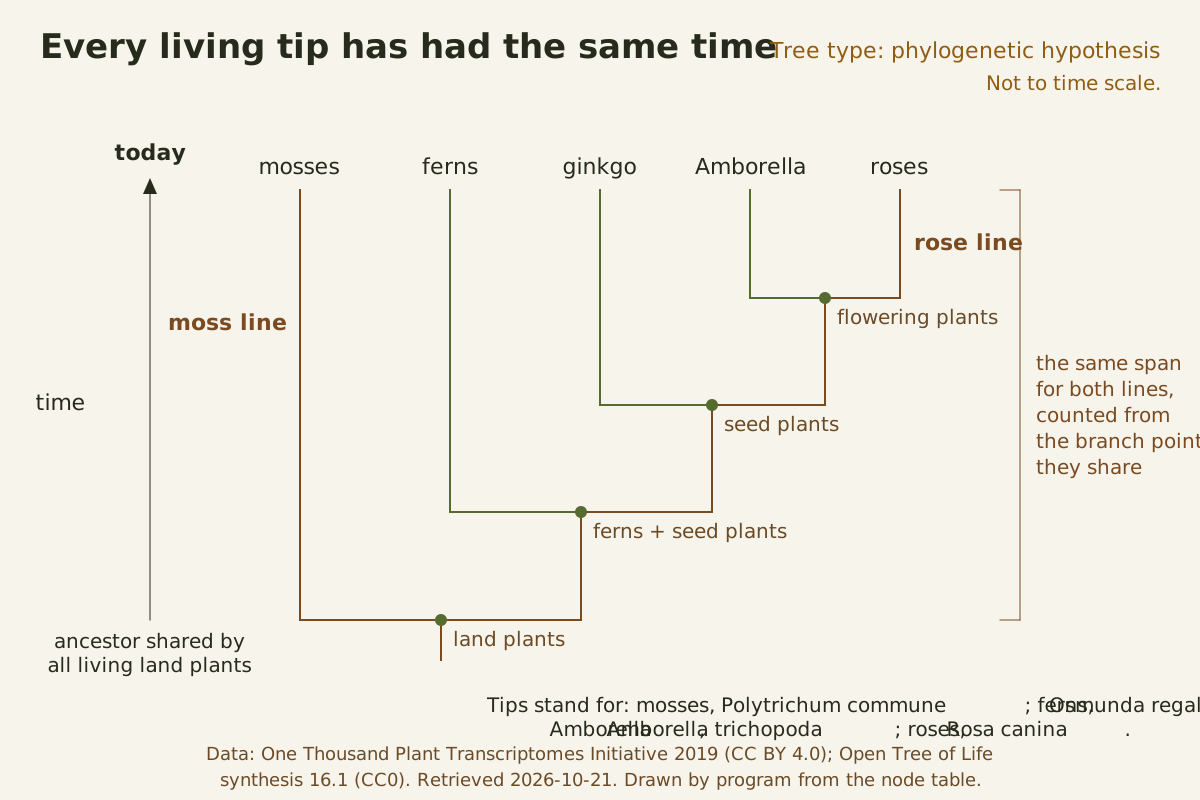
Fig. 3. Not to time scale: the line from the ancestor of living land plants up to mosses spans the same time as the line up to roses.
"Every living tip has had the same time" by Botany for the Curious, https://botanyforthecurious.com/trees/ladder-of-progress/, licensed under CC BY 4.0 (https://creativecommons.org/licenses/by/4.0/)data: One Thousand Plant Transcriptomes Initiative 2019, Nature 574: 679 (CC BY 4.0), retrieved 2026-10-21; Open Tree of Life synthetic tree v16.1 (CC0), https://doi.org/10.5281/zenodo.3937741, retrieved 2026-10-21A 2018 dating study by Jennifer Morris and colleagues put dates on that span. Its published summary estimates that land plants emerged between the middle Cambrian and the Early Ordovician, and vascular plants later, in the Late Ordovician to Silurian. Fig. 3 is not drawn to time scale, so its point does not depend on those dates. Whatever the true age of the split, the mosses have had all of it.
Living mosses are not leftovers from a stage that roses passed through. In the 1KP analyses of nuclear gene trees and of plastid genomes, mosses, liverworts and hornworts formed one clade beside the vascular plants. Within it, hornworts were sister to a clade of mosses and liverworts.
The study notes that the bryophytes have sometimes been resolved as a grade instead, a series of groups branching off one after another below the vascular plants. All of its analyses rejected the idea that liverworts are sister to all other land plants. Either way, the mosses on the tree are a living branch beside the vascular plants, not their ancestors.
A ladder has one way up, and every rung leads to the next one. A tree of living groups splits at every branch point, and both sides of every split carry on to the present.
A ladder of pressed plant stems that forks into two branches halfway up.
Illustration: Botany for the Curious. Generated schematic image — not a photograph or botanical record. Reuse terms: no license is granted; any rights Botany for the Curious holds in this image are reserved.Early branches are not ancestors
In a 2008 paper in BioEssays, Kevin Omland, Lyn Cook and Michael Crisp called reading trees as ladders, from left to right, the most serious problem in tree reading. They named one form of it the "primitive lineage fallacy": assuming that species-poor lineages which look early-branching, or basal, are ancestral. Their abstract recommends reading trees of present-day species as maps of relationships among evolutionary cousins.
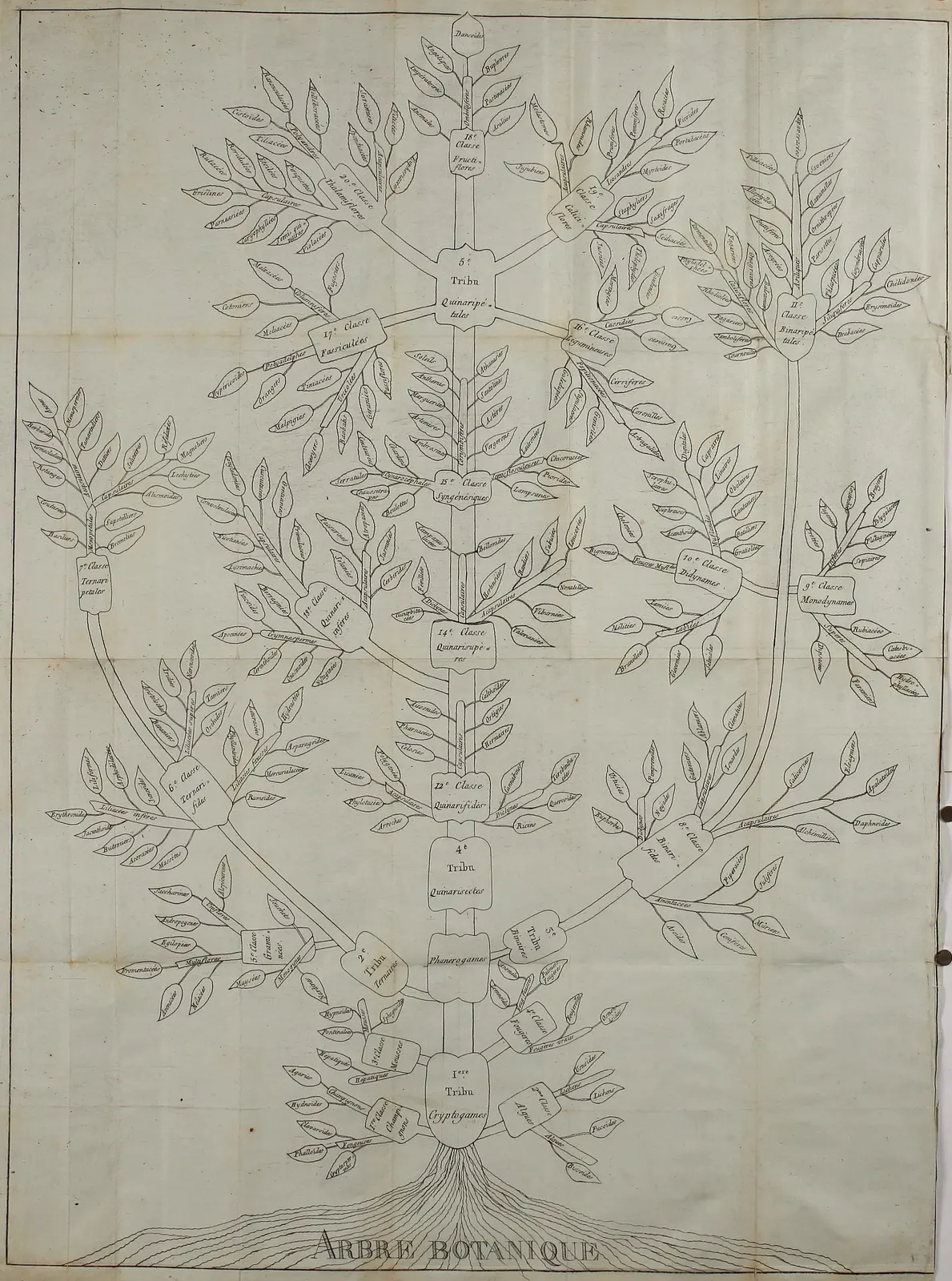
Augustin Augier's "Arbre botanique" (1801), a tree of plant classification rather than of descent, with the cryptogams on the lowest branches and the umbellifers on the topmost shoot.
Credit and licence
"Arbre botanique" by Augustin Augier — https://www.biodiversitylibrary.org/page/45782289 — Public domain (Augustin Augier d. 1825 (dates in the title of a 2017 biography cited by English Wikipedia; he was active as an author in 1801, so he must have died before 1955 in any case); the plate names no engraver; US: published 1801, before 1931; EU: more than 70 years after the author's death; the Biodiversity Heritage Library scan of the Harvard University Botany Libraries copy is a faithful reproduction)The New Caledonian shrub Amborella trichopoda shows how the fallacy works. In the 1KP study, Amborellales branch off first, then the water lilies (Nymphaeales), then Austrobaileyales, as successive sisters to all other flowering plants. Nuclear and plastid analyses agree on that order. APweb, the Angiosperm Phylogeny Website (version 14), reviews earlier analyses that paired Amborella with the water lilies instead, which would not change the five-tip tree of Fig. 1.
WCVP lists Amborella trichopoda as a scrambling shrub or tree found only in New Caledonia. APweb records its order as one family, one genus and one species. Being sister to all other flowering plants means only that the Amborella line split from theirs at the oldest branch point among living flowering plants. It does not make Amborella an ancestor.
Nor has the lineage stopped changing. APweb, summarising a 2024 genome study by Carey and colleagues, reports that its separate male and female plants evolved only recently. The estimates it gives, about 5 and 2.4 million years ago, are for two groups, or strata, of the genes involved.
"Basal" names where a branch joins near the root of one drawing. "Higher" and "lower" say only where a group sits on the page. A trait can be passed down with little change. But Amborella shows that a lineage on the first branch still gains new traits, so calling the whole plant primitive confuses a trait with a species.
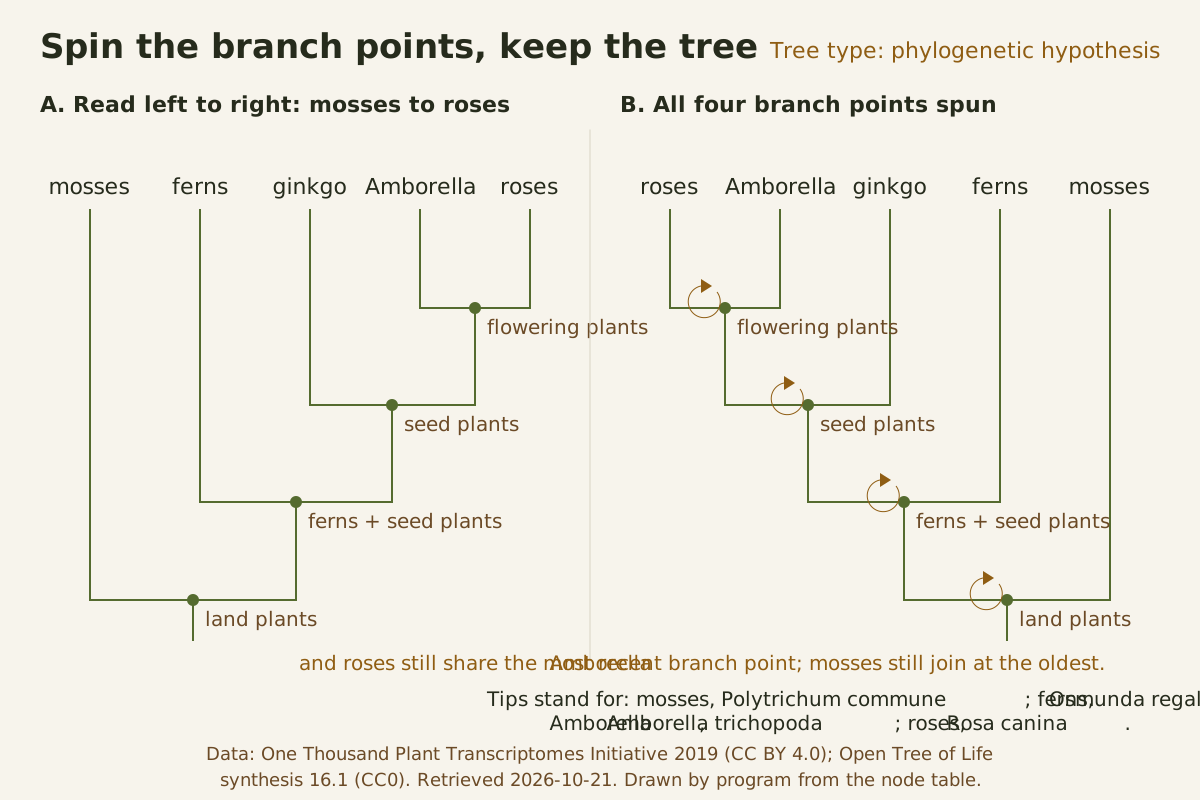
Fig. 4. Rotating all four branch points turns the order mosses to roses into roses to mosses; each pair of tips keeps the same most recent shared branch point.
"Spin the branch points, keep the tree" by Botany for the Curious, https://botanyforthecurious.com/trees/ladder-of-progress/, licensed under CC BY 4.0 (https://creativecommons.org/licenses/by/4.0/)data: One Thousand Plant Transcriptomes Initiative 2019, Nature 574: 679 (CC BY 4.0), retrieved 2026-10-21; Open Tree of Life synthetic tree v16.1 (CC0), https://doi.org/10.5281/zenodo.3937741, retrieved 2026-10-21Spin any branch point in Fig. 4 and the tips swap sides, while every relationship stays put. How to read a phylogenetic tree walks through the full reading. The plant tree of life places Amborella among the other branches of flowering plants.
What the ginkgo's fossils show
The label "living fossil" appears in Darwin's 1859 book. He wrote that two animals, "the Ornithorhynchus and Lepidosiren", "may almost be called living fossils". He meant forms that connect groups now widely separated and that had, in his words, "endured to the present day" in a confined area with less severe competition. It was a figure of speech, hedged with "almost", and not a claim that evolution had stopped for them.
English Wikipedia's article on living fossils lists Ginkgo biloba as one example: a single living species with no close living relatives, surviving from a large group in the fossil record. The same article notes that the term is deprecated among palaeontologists and evolutionary biologists, and that a living fossil is never the same species as the remote relatives it resembles. WCVP version 16 lists Ginkgo biloba as the only accepted species of Ginkgo, native to Zhejiang in China.
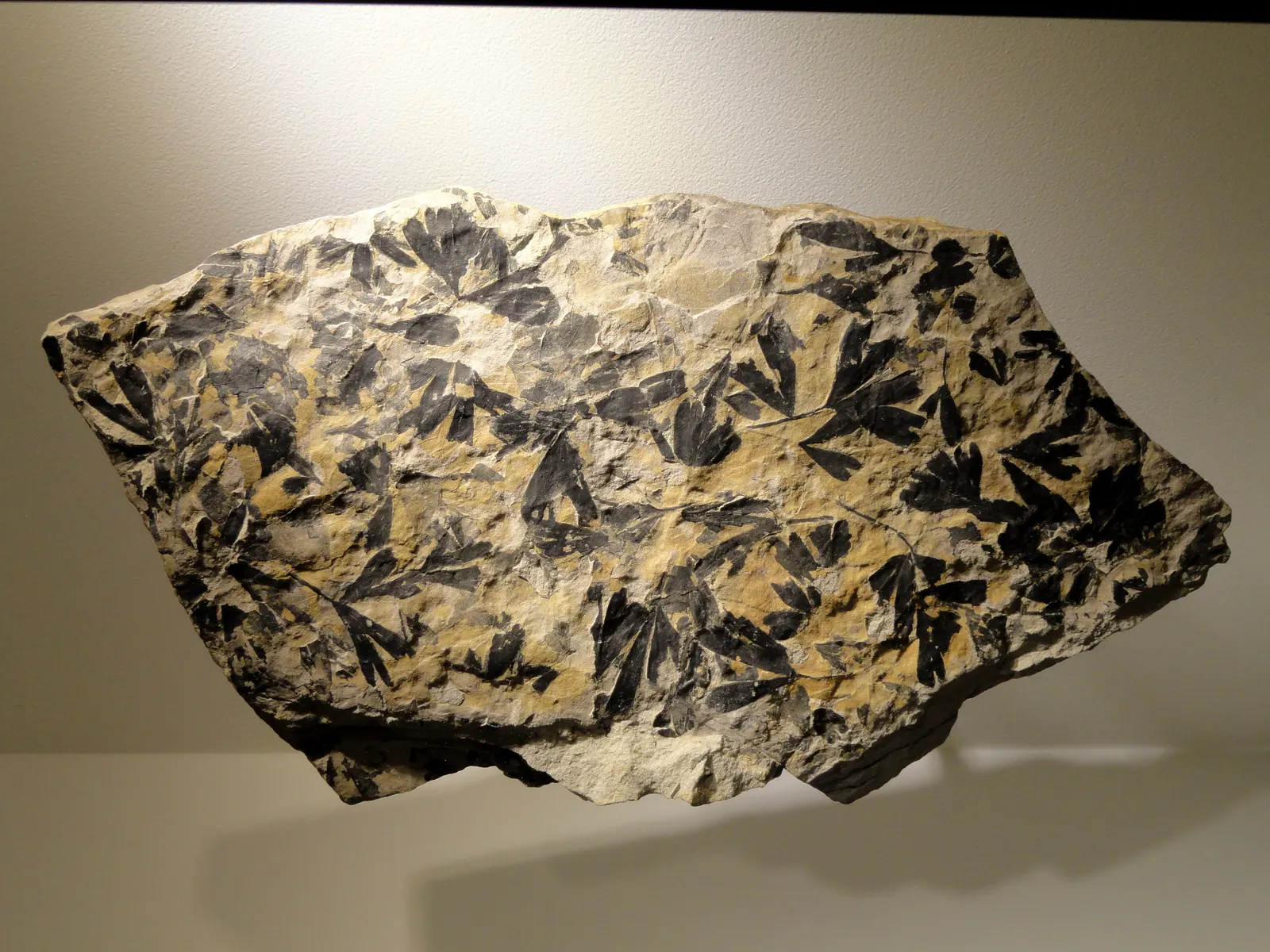
Leaves of an extinct Ginkgo species, probably the morphospecies Ginkgoites huttoni, in Middle Jurassic sandstone from near Scarborough, England, at the Houston Museum of Natural Science.
"Ginkgo sp., Middle Jurassic, Scarborough, North Yorkshire, England - Houston Museum of Natural Science - DSC01774" by Daderot — https://commons.wikimedia.org/wiki/File:Ginkgo_sp.,_Middle_Jurassic,_Scarborough,_North_Yorkshire,_England_-_Houston_Museum_of_Natural_Science_-_DSC01774.jpg — CC0 1.0 (https://creativecommons.org/publicdomain/zero/1.0/)
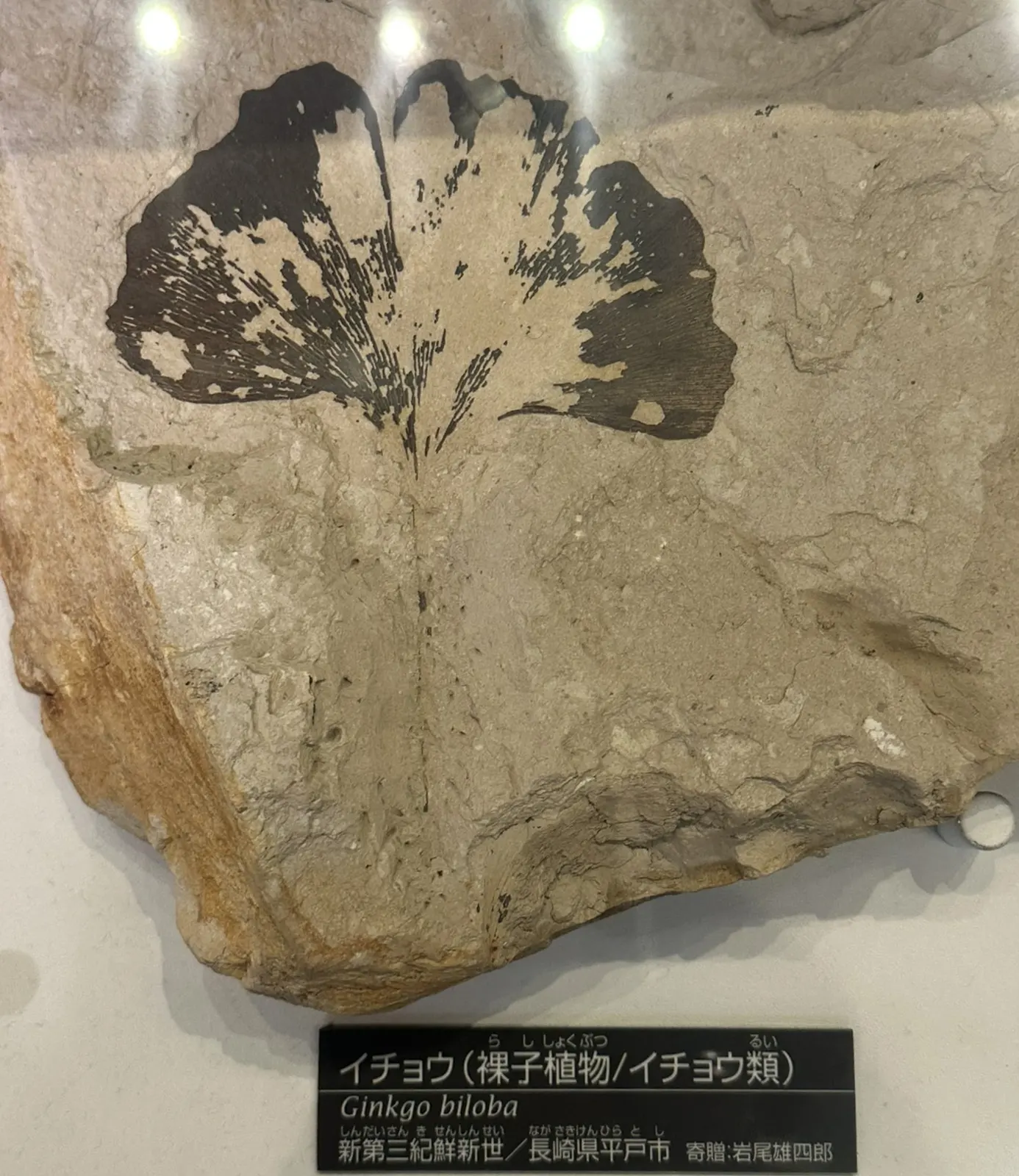
A fossil leaf labelled Ginkgo biloba, the living species, from Pliocene rocks of Hirado in Nagasaki Prefecture, at the National Museum of Nature and Science, Tokyo.
"Ginkgo biloba National Museum of Nature and Science, Japan" by Geekgecko — https://commons.wikimedia.org/wiki/File:Ginkgo_biloba_National_Museum_of_Nature_and_Science,_Japan.jpg — CC BY 4.0 (https://creativecommons.org/licenses/by/4.0/)
The two fossils show what the label lumps together. The Jurassic slab carries leaves of an extinct Ginkgo species, as its photographer's description on Wikimedia Commons records. The Pliocene leaf from Japan is labelled as the living species itself: a fossil of the ginkgo, not of a remote relative.
On the tree, the living ginkgo is a tip like the rose. In the 1KP study, ginkgo and the cycads form a clade sister to the other gymnosperms. Since the seed-plant branch point, the ginkgo line and the rose line have run for the same time.
Questions people ask about mosses, ginkgo and Amborella
Are mosses more primitive than flowering plants?
No. Mosses and flowering plants descend from one ancestor shared by all living land plants. Since their lines split, each has had the same span of time to evolve. In the One Thousand Plant Transcriptomes Initiative's 2019 analyses of nuclear gene trees and plastid genomes, mosses, liverworts and hornworts form a branch of their own beside the vascular plants, not a stage on the way to them.
Is the ginkgo really a living fossil?
Only as a loose label. English Wikipedia notes that "living fossil" is deprecated among palaeontologists and evolutionary biologists, and that a living fossil is never the same species as the remote relatives it resembles. Ginkgo biloba is the only living species of its genus in WCVP version 16. On an evolutionary tree it is a living tip whose line has run as long as the rose's since the two split.
What is the most primitive flowering plant?
No living flowering plant is the ancestor of the others. Amborella trichopoda, a shrub of New Caledonia, is placed as sister to all other living flowering plants in the 2019 1KP study (the One Thousand Plant Transcriptomes Initiative). APweb version 14 also reviews analyses that pair it with the water lilies. Its lineage has been evolving as long as theirs, and APweb reports that its separate male and female plants evolved only recently.
Sources
- One Thousand Plant Transcriptomes Initiative (2019). "One thousand plant transcriptomes and the phylogenomics of green plants." Nature 574(7780): 679–685. doi:10.1038/s41586-019-1693-2. https://doi.org/10.1038/s41586-019-1693-2 full text Text licence: CC BY 4.0
- OpenTree et al. "Open Tree of Life Synthetic Tree", release opentree16.1 (built 2025-12-20), with Open Tree Taxonomy 3.7 (draft 3) identifiers (CC0). doi:10.5281/zenodo.3937741; taxonomy doi:10.5281/zenodo.3937750. https://doi.org/10.5281/zenodo.3937741 subtree and branch-point support for the five tips of this page
- Bonnet, C. (1745). Traité d'insectologie, vol. 1. Paris: Durand. Fold-out "Idée d'une échelle des êtres naturels". https://doi.org/10.5962/bhl.title.51914 fold-out plate in vol. 1 (Duke University Libraries copy)
- Augier, A. (1801). Essai d'une nouvelle classification des végétaux. Lyon: Bruyset Ainé et Comp. Fold-out "Arbre botanique". https://doi.org/10.5962/bhl.title.87725 fold-out plate (Harvard University Botany Libraries copy)
- Darwin, C. (1859). On the Origin of Species by Means of Natural Selection, 1st edition. London: John Murray. https://www.gutenberg.org/ebooks/1228 Chapter IV and Chapter XIV, first-edition text Text licence: Public domain (Project Gutenberg)
- Haeckel, E. (1866). Generelle Morphologie der Organismen. Berlin: Georg Reimer. Plate "Monophyletischer Stammbaum der Organismen". https://commons.wikimedia.org/wiki/File:Haeckel_arbol_bn.png plate, scan on Wikimedia Commons
- Gray, A. (1879). Gray's Botanical Text-Book, 6th edition, vol. 1: Structural Botany. New York: American Book Company; copyright 1879. https://archive.org/details/graysbotanicalte01gray pp. 35 and 339
- Omland, K. E., Cook, L. G. & Crisp, M. D. (2008). "Tree thinking for all biology: the problem with reading phylogenies as ladders of progress." BioEssays 30(9): 854–867. doi:10.1002/bies.20794. https://doi.org/10.1002/bies.20794 abstract
- Morris, J. L., Puttick, M. N., Clark, J. W., Edwards, D., Kenrick, P., Pressel, S., Wellman, C. H., Yang, Z., Schneider, H. & Donoghue, P. C. J. (2018). "The timescale of early land plant evolution." Proceedings of the National Academy of Sciences 115(10). doi:10.1073/pnas.1719588115. https://doi.org/10.1073/pnas.1719588115 abstract (significance statement)
- Stevens, P. F. (2001 onwards). Angiosperm Phylogeny Website. Version 14, July 2017 [and more or less continuously updated since]. http://www.mobot.org/MOBOT/research/APweb/ angiosperm and Amborellales pages, read 2026-10-21
- The Angiosperm Phylogeny Group (2016). "An update of the Angiosperm Phylogeny Group classification for the orders and families of flowering plants: APG IV." Botanical Journal of the Linnean Society 181(1): 1–20. doi:10.1111/boj.12385. https://doi.org/10.1111/boj.12385 bibliographic record only
- Govaerts, R. (ed.) (2026). WCVP: World Checklist of Vascular Plants, version 16. Facilitated by the Royal Botanic Gardens, Kew. doi:10.34885/egs6-cp24. Retrieved 2026-10-21. https://doi.org/10.34885/egs6-cp24 records for Ginkgo biloba, Amborella trichopoda, Osmunda regalis and Rosa canina Text licence: CC BY 3.0
- World Flora Online Plant List, classification 2026-06 (CC0). Retrieved 2026-10-21. https://list.worldfloraonline.org/ name records for the five representative species
- English Wikipedia, "Great chain of being" (read 2026-10-21). https://en.wikipedia.org/wiki/Great_chain_of_being summarised here through English Wikipedia
- English Wikipedia, "Tree of life (biology)" (read 2026-10-21). https://en.wikipedia.org/wiki/Tree_of_life_(biology) summarised here through English Wikipedia
- English Wikipedia, "Living fossil" (read 2026-10-21). https://en.wikipedia.org/wiki/Living_fossil summarised here through English Wikipedia
- English Wikipedia, "Polytrichum commune" (read 2026-10-21). https://en.wikipedia.org/wiki/Polytrichum_commune common name only
- English Wikipedia, "Osmunda regalis" (read 2026-10-21). https://en.wikipedia.org/wiki/Osmunda_regalis common name only
- English Wikipedia, "Rosa canina" (read 2026-10-21). https://en.wikipedia.org/wiki/Rosa_canina common name only
Related
- How to Read a Phylogenetic Tree: Tip Order Means Nothing Comparison and chart
- Plant Tree of Life: Land Plants' Closest Kin Are Pond Algae Specimen entry
Cite this page
Botany for the Curious. “Ladder of Progress: Mosses Have Evolved as Long as Roses.” Published 2026-10-22; last substantive revision 2026-10-22. https://botanyforthecurious.com/trees/ladder-of-progress/ (accessed: add the date you read it).
- Published
- Last substantive revision