Plant Forms & StructuresDeep explainer
Fibonacci in Nature: The Sunflowers That Break the Sequence
- Published
- Last substantive revision
Spec card
- Term
- Fibonacci phyllotaxis: spiral rows (parastichies) whose counts are Fibonacci numbersSource: Swinton et al. 2016
- Example species
- Helianthus annuus (common sunflower), daisy family AsteraceaeSource: WCVP (Kew) and World Flora Online, both 2026-06; Flora of China
- Structure
- Capitulum (flower head); spirals counted on the seeds near the rimSource: Flora of China; Swinton et al. 2016
- Not to be confused with
- Golden spiral, a logarithmic spiral. Seed-head spirals are closer to Fermat spiralsSource: Prusinkiewicz & Lindenmayer 1990; English Wikipedia (secondary source)
- Diagrams
- Fig. 1 (what 768 counts showed); Fig. 2 (one rule, three angles); Fig. 3 (one spacing rule, three settings)
Download this card as CSV fibonacci-in-nature-spec-card.csv data: Swinton, Ochu et al. 2016, Royal Society Open Science 3: 160091, retrieved 2026-10-21; WCVP (Kew), CC BY 3.0, doi:10.34885/egs6-cp24, retrieved 2026-10-21; World Flora Online Plant List 2026-06 (CC0), retrieved 2026-10-21; Flora of China, Vol. 20–21 (Asteraceae), Helianthus, retrieved 2026-10-21; Prusinkiewicz & Lindenmayer 1990, The Algorithmic Beauty of Plants, Chapter 4, retrieved 2026-10-21
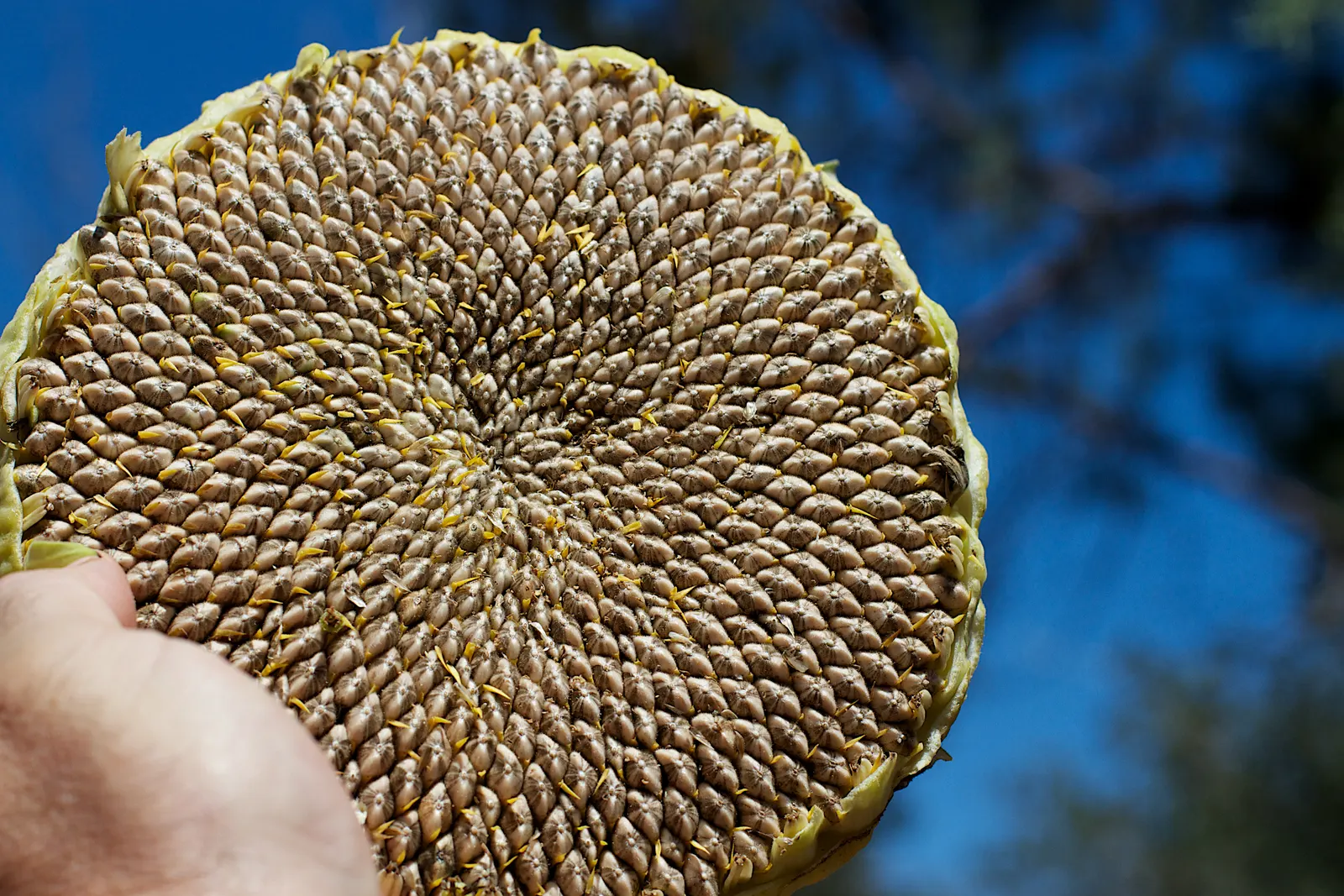
A ripe sunflower head packed with seeds, its spiral rows running both clockwise and anticlockwise.
"2013-365-247 Packed With Seeds (9678568718)" by cogdogblog — https://commons.wikimedia.org/wiki/File:2013-365-247_Packed_With_Seeds_(9678568718).jpg — CC BY 2.0 (https://creativecommons.org/licenses/by/2.0/)
In a 2016 study of sunflower heads, about one spiral count in four was not a Fibonacci number. The sunflower is still the most famous case of Fibonacci in nature, and most of its counts do land on numbers such as 34, 55 and 89. The misses show that the pattern is a tendency produced by growth, with room for error.
So is Fibonacci in nature real? Yes, as a tendency. Spirals on sunflower heads, pine cones and pineapples often come in two sets whose counts are neighbouring Fibonacci numbers. In the 2016 sunflower data, 565 of 768 photo-checked counts (73.6%) were Fibonacci numbers, and 136 (17.7%) had no Fibonacci structure as the study defined it.
What does "Fibonacci in nature" mean in a plant?
The Fibonacci sequence runs 1, 2, 3, 5, 8, 13, 21, 34, 55, 89, 144, and each number after the second is the sum of the two before it. It is named after Leonardo of Pisa, known as Fibonacci, whose 1202 book Liber Abaci introduced it to Western European mathematics. Indian scholars had described it centuries earlier.
The "flower" of Helianthus annuus, the common sunflower, is really a capitulum, or flower head: many small flowers called florets packed onto one disc. The petal-like ray florets around the edge are sterile. The disc florets in the middle ripen into the fruits known as sunflower seeds. A capitulum is one of several ways plants bundle flowers together (inflorescence types).
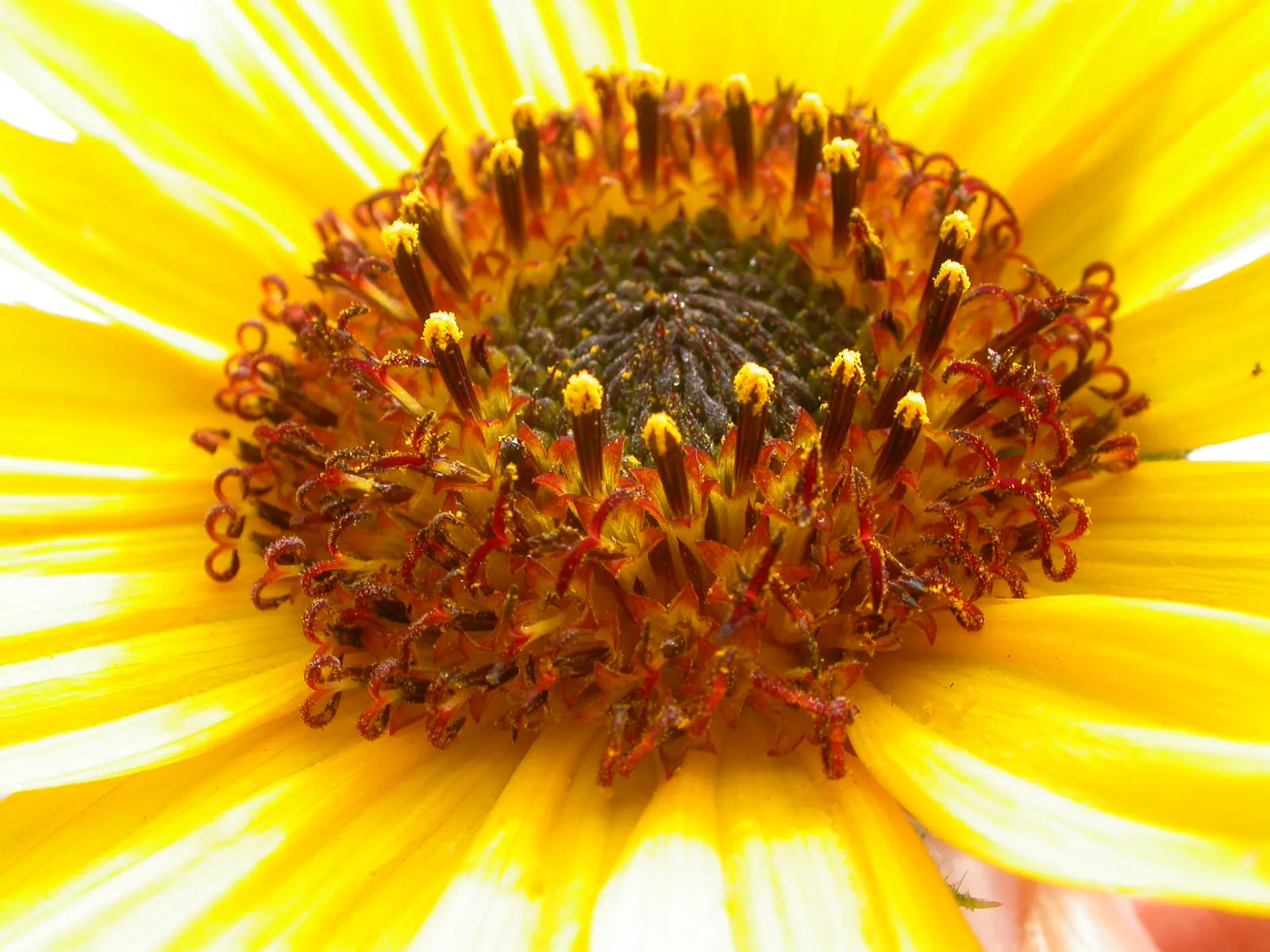
Ray florets and disc florets of Helianthus annuus close up: the yellow rays ring a darker disc of many small florets.
"Helianthus annuus (5021132456)" by Matt Lavin — https://commons.wikimedia.org/wiki/File:Helianthus_annuus_(5021132456).jpg — CC BY-SA 2.0 (https://creativecommons.org/licenses/by-sa/2.0/)
Think of the sterile rays as part of a wager, the sessile wager: a rooted plant cannot go looking for a mate, so its pollen has to travel some other way. Showy rays look like one way to play it, by drawing in animal pollinators. Field work on Anacyclus, a genus in the same daisy family, supports only part of that reading: rayed plants drew significantly more flower visitors than rayless ones, yet they set no more fruit or seed, because the rayless heads carried more flowers. Other explanations stay open too, such as a limit set by how the head develops or plain historical accident.
To read a sunflower head, take the ripe head in the photo at the top of this page and pick a spiral of seeds near the rim. Follow it inward, then count every spiral that runs the same way around the head. That total is a parastichy number, and the spirals running the other way give you a second one.
Botanists call the arrangement of leaves and other side organs phyllotaxis, and the spiral rows parastichies. The same counting works on cone scales and pineapple fruitlets. Fibonacci structure has been recorded in hundreds of plant species. Phyllotaxis covers where leaves sit on a stem; the shape of each leaf has a vocabulary of its own, set out in Leaf Shapes.
How often do sunflowers break the Fibonacci pattern?
In 2012 the Museum of Science and Industry in Manchester, UK, marked the centenary of Alan Turing's birth by inviting the public to grow sunflowers and count them. The project, Turing's Sunflowers, gathered data on 657 heads. One of the researchers re-counted every submission that came with a photo, without seeing the volunteer's numbers. Those 768 photo-checked counts are the most reliable part of the data, published in 2016 by Jonathan Swinton, Erinma Ochu and the project's consortium.
Where a volunteer and the reviewer had both counted the same spiral family, they disagreed 266 times out of 745.
Of the 768 photo-checked counts, 565 were Fibonacci numbers (Figure 1). Another 67 belonged to sequences built by the same add-the-last-two rule from different starting numbers: 41 Lucas numbers (1, 3, 4, 7, 11, 18, 29, 47, 76 and on), 25 doubled Fibonacci numbers and one from a rarer series called F4. The remaining 136 counts had no Fibonacci structure.
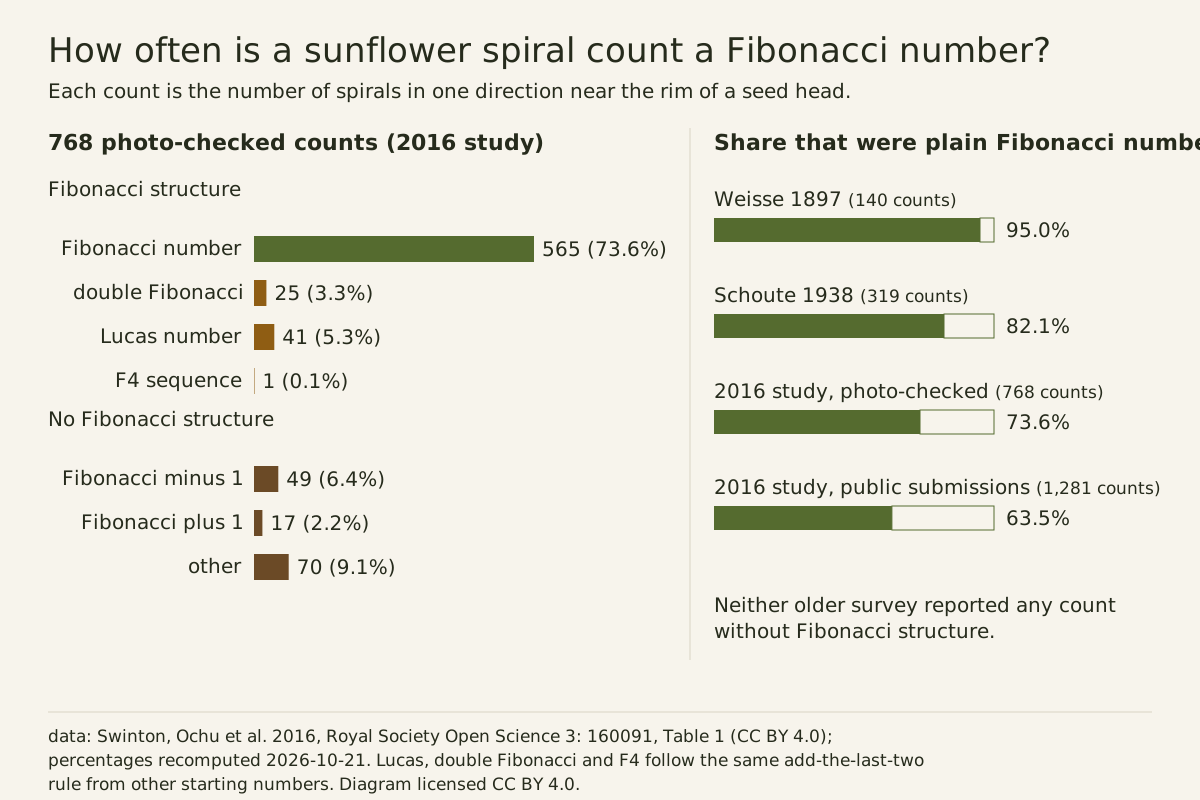
Fig. 1. The 768 photo-checked counts of 2016, and the share of plain Fibonacci numbers against two older surveys.
"How often is a sunflower spiral count a Fibonacci number?" by Botany for the Curious, https://botanyforthecurious.com/forms/fibonacci-in-nature/, licensed under CC BY 4.0 (https://creativecommons.org/licenses/by/4.0/)data: Swinton, Ochu et al. 2016, Royal Society Open Science 3: 160091, Table 1 (CC BY 4.0), retrieved 2026-10-21Download CSV fibonacci-in-nature-sunflower-counts.csv data: Swinton, Ochu et al. 2016, Royal Society Open Science 3: 160091, Table 1 (CC BY 4.0), retrieved 2026-10-21
The older surveys looked cleaner. A. Weisse in 1897 reported 95% Fibonacci numbers from 140 counts, and J. C. Schoute in 1938 reported 82% from 319, yet neither recorded a single count without Fibonacci structure. Neither explained exactly how they assigned their counts. The 2016 team set out to define Fibonacci structure in advance and to document its counting method.
The misses were not scattered at random. The most common non-Fibonacci count was 54, one short of 55, and it turned up more often than 47, the most common Lucas count. Counts one below a Fibonacci number (49 cases) outnumbered counts one above (17), an excess the authors found statistically significant. Some heads had regions so disordered that no count could be assigned at all.
Why don't small counts prove much?
Writing in 2006, T. J. Cooke warned that the Fibonacci, Lucas, F4 and doubled-Fibonacci sequences between them cover all but three of the first 17 whole numbers. We checked by listing them: only 12, 15 and 17 are left out. A flower with five petals, or a cone with eight spirals, tells you little by itself. The case gets strong at counts like 55 and 89, and sunflower heads give the largest Fibonacci numbers in phyllotaxis.
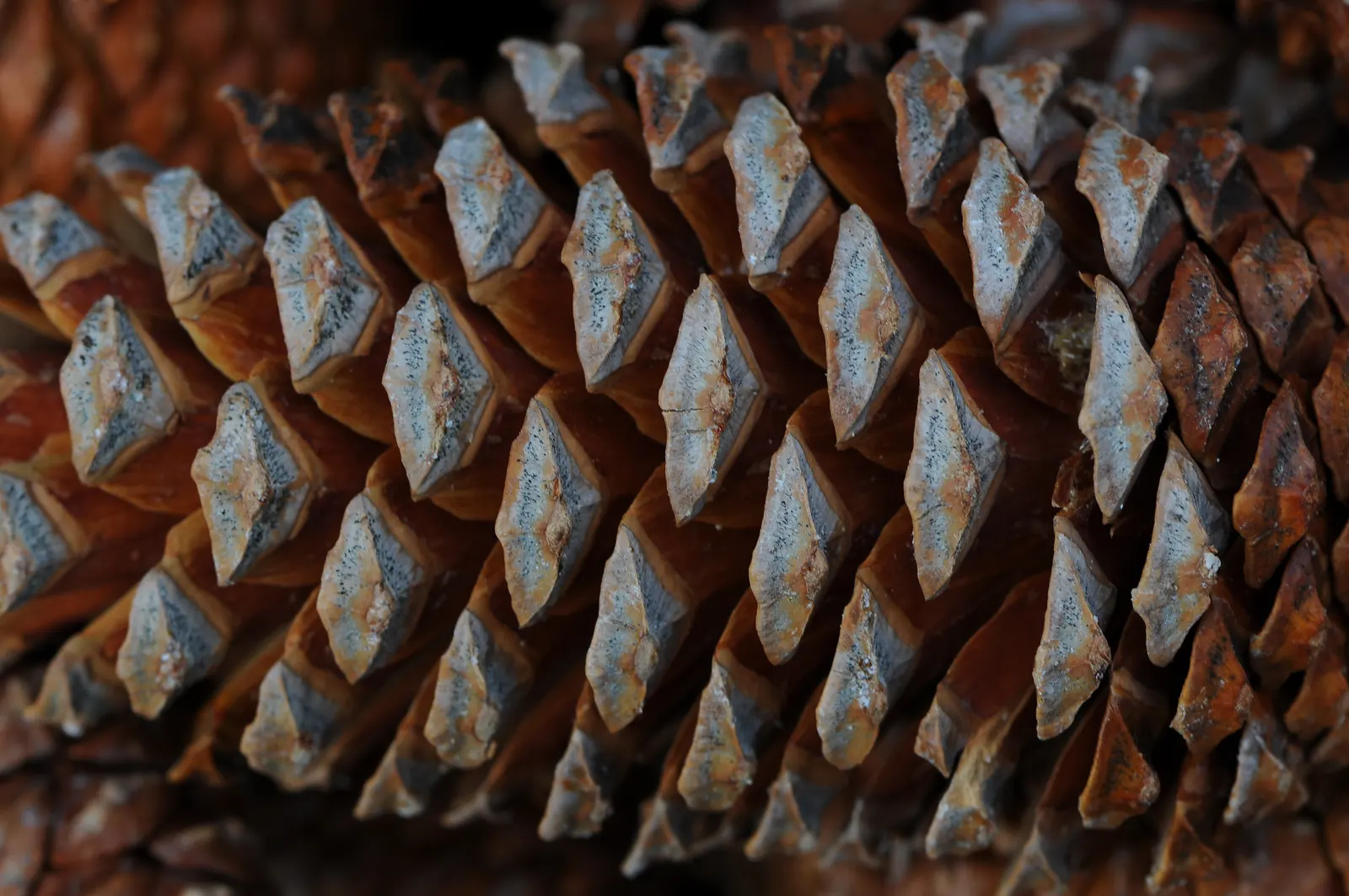
Scales of a pine cone, genus Pinus, close up, set in rows that slope across the cone.
"Kiefer Zapfen, Pine cones 13" by Böhringer Friedrich — https://commons.wikimedia.org/wiki/File:Kiefer_Zapfen,_Pine_cones_13.JPG — CC BY 3.0 AT (https://creativecommons.org/licenses/by/3.0/at/)
Petals also follow the rule more loosely than seeds. The ray florets around a sunflower's edge vary more from head to head; one survey of 1,002 heads found their counts spread around a centre of 21.
Why does a sunflower make Fibonacci spirals at all?
Helmut Vogel published a simple recipe for a sunflower head in 1979. Put floret number n at an angle of n × 137.5° from a fixed direction, and at a distance from the centre proportional to the square root of n. The square root keeps equal-sized florets evenly packed, because the number that fit inside a circle grows with its area.
The 137.5° is the golden angle. Split a full turn into two arcs whose ratio is the golden ratio, φ ≈ 1.618, and the smaller arc is 360° × (1 − 1/φ) ≈ 137.508°. In the model, florets are numbered outward from the centre. In a real head the order runs the other way, and the florets at the rim form first.
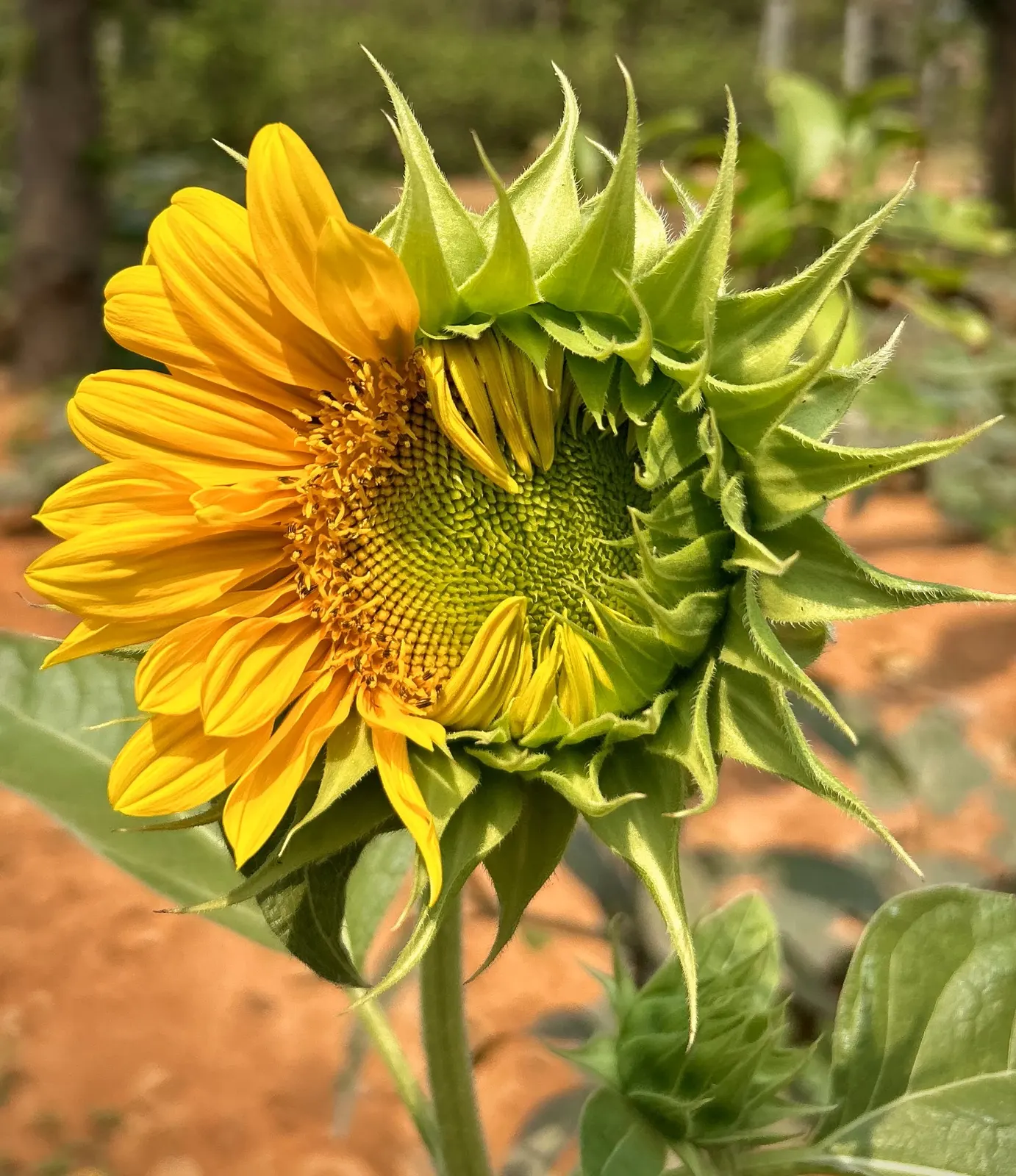
A common sunflower head opening, with green bracts, a few ray florets unfolded, and the outer disc florets in flower while the centre is still closed.
"Common Sunflower Beginning to Open" by Rifat R — https://commons.wikimedia.org/wiki/File:Common_Sunflower_Beginning_to_Open.jpg — CC BY 4.0 (https://creativecommons.org/licenses/by/4.0/)
Where do the numbers 55 and 89 come from?
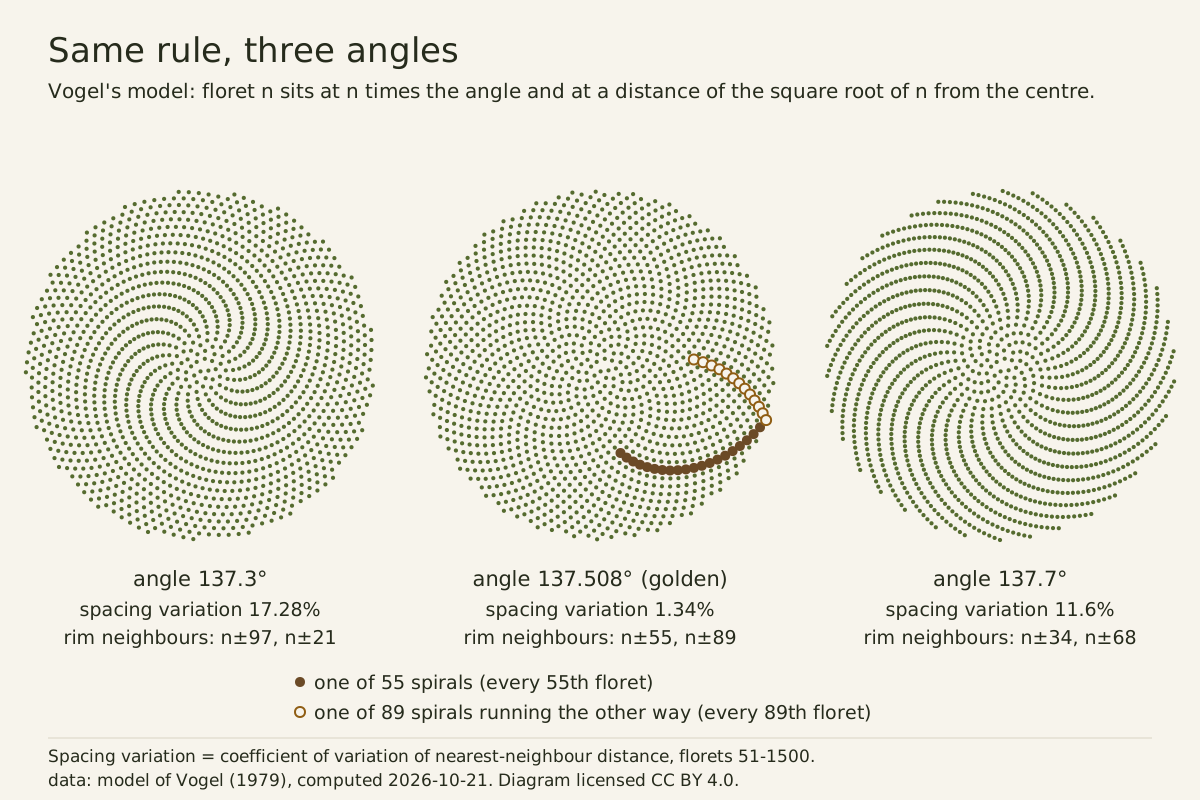
Fig. 2. Vogel's recipe with 1,500 florets, changing only the angle; spacing variation is the coefficient of variation of nearest-neighbour distance over florets 51–1,500.
"Same rule, three angles" by Botany for the Curious, https://botanyforthecurious.com/forms/fibonacci-in-nature/, licensed under CC BY 4.0 (https://creativecommons.org/licenses/by/4.0/)data: model of Vogel (1979), computed 2026-10-21Download CSV, nine angles fibonacci-in-nature-model-angles.csv data: model of Vogel (1979), computed 2026-10-21 Download CSV, gaps by ring fibonacci-in-nature-neighbour-gaps.csv data: model of Vogel (1979), computed 2026-10-21
Now read Figure 2. Follow every 55th floret near the rim of the middle disc and you trace one spiral; there are 55 of them, because a family of spirals linking every k-th floret contains exactly k spirals. Every 89th floret traces a spiral running the other way. Nobody picked those numbers: they are the gaps in floret number between each floret and its nearest neighbours.
In our runs of the golden-angle model, those gaps climb through the Fibonacci numbers as you move outward. They are 13 and 21 near the middle, then 21 and 34, 34 and 55, 55 and 89, and finally 89 and 144 between florets 1,601 and 3,200 of a 3,300-floret model head. The reason is arithmetic. Fractions built from Fibonacci numbers, such as 21/55 and 34/89, come ever closer to the golden angle's share of a full turn (0.382), so florets that far apart in the sequence end up nearly in line.
The model is touchy. Shift the angle by 0.2° either way and the even spacing breaks. Spacing variation rises from 1.3% at the golden angle to 17.3% at 137.3° and 11.6% at 137.7°, and the rim neighbours stop being a Fibonacci pair. At 137.45°, almost exactly 21/55 of a turn, the florets line up into 55 nearly straight spokes.
Ridley, in an analysis quoted in The Algorithmic Beauty of Plants, put a number on this. For 55 and 89 spirals to stand out, the angle has to fall between 21/55 and 34/89 of a turn. That is a window from about 137.45° to 137.53°, a relative accuracy of one part in 1,869.
A model that draws the pattern has not yet explained how the plant makes it. Ridley made that point too, arguing that genetic information alone could not fix an angle so precisely, since biological traits usually vary far more.
How does a growing plant hit such a precise angle?
In the explanations found in the sources checked for this page, no angle is set directly. English Wikipedia's account of the history credits Wilhelm Hofmeister with an 1868 model in which a primordium, the bud of a future leaf or floret, forms in the least crowded part of the growing tip. Repeat that spacing rule bud after bud, and a steady angle emerges.
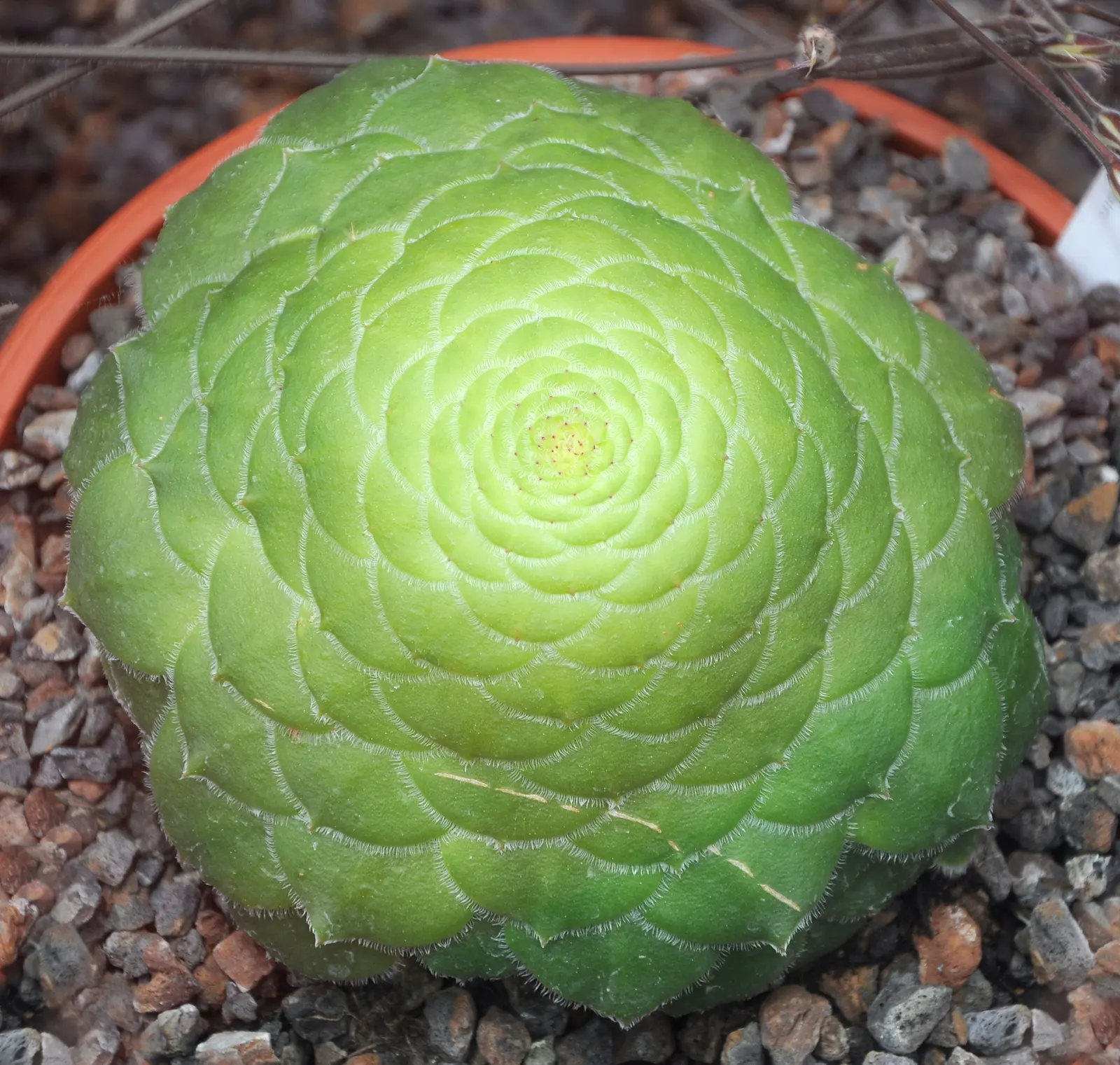
A flat rosette of an Aeonium seen from above, its leaves packed in crossing spiral rows around the centre.
"Aeonium tabuliforme 001" by Amada44 — https://commons.wikimedia.org/wiki/File:Aeonium_tabuliforme_001.jpg — CC BY 3.0 (https://creativecommons.org/licenses/by/3.0/)
The molecular side comes from experiments on the plant hormone auxin. A 2006 modelling study by Richard S. Smith and colleagues sums up what those experiments indicate: active transport of auxin is the key process regulating phyllotaxis, an idea that Didier Reinhardt and colleagues had turned into a conceptual model in 2003. The 2006 computer model reproduced, within the standard error, the divergence angles measured in seedlings of Arabidopsis thaliana (thale cress).
Physics points the same way. In 1992 Douady and Couder produced Fibonacci patterns in both a laboratory experiment and a numerical simulation, from an iterative process governed by one parameter and the starting conditions. They explained the order as the system avoiding periodic arrangements, which drives it toward the golden mean.
In the 1950s Alan Turing saw that as a growing pattern deforms smoothly, its spiral counts can change in only a few ways. He also saw, but could not prove, that when the counts change during development, an adjacent Fibonacci-type pair can only step up to the next pair in the same sequence. Douady and Couder later proved this for a range of models. The 2016 sunflower authors suggest that models which build in developmental noise may be needed to explain near-misses like 54.
Can a spacing rule alone produce the golden angle?
Fig. 3 runs this page's own spacing rule, an iterative process with one setting like the process Douady and Couder described: how far the older buds drift outward each time a new bud forms on the rim of the growing tip. Each new bud goes where the older buds crowd it least. With a drift factor of 1.65 the angle between buds settles at 137.6°, close to the golden angle; at 2.0 it settles at 148.2°, and at 3.0 it stays at 180°. The figure follows the guide's rule for calculations and models: it shows that a spacing rule can produce the angle, not that a plant uses this one.
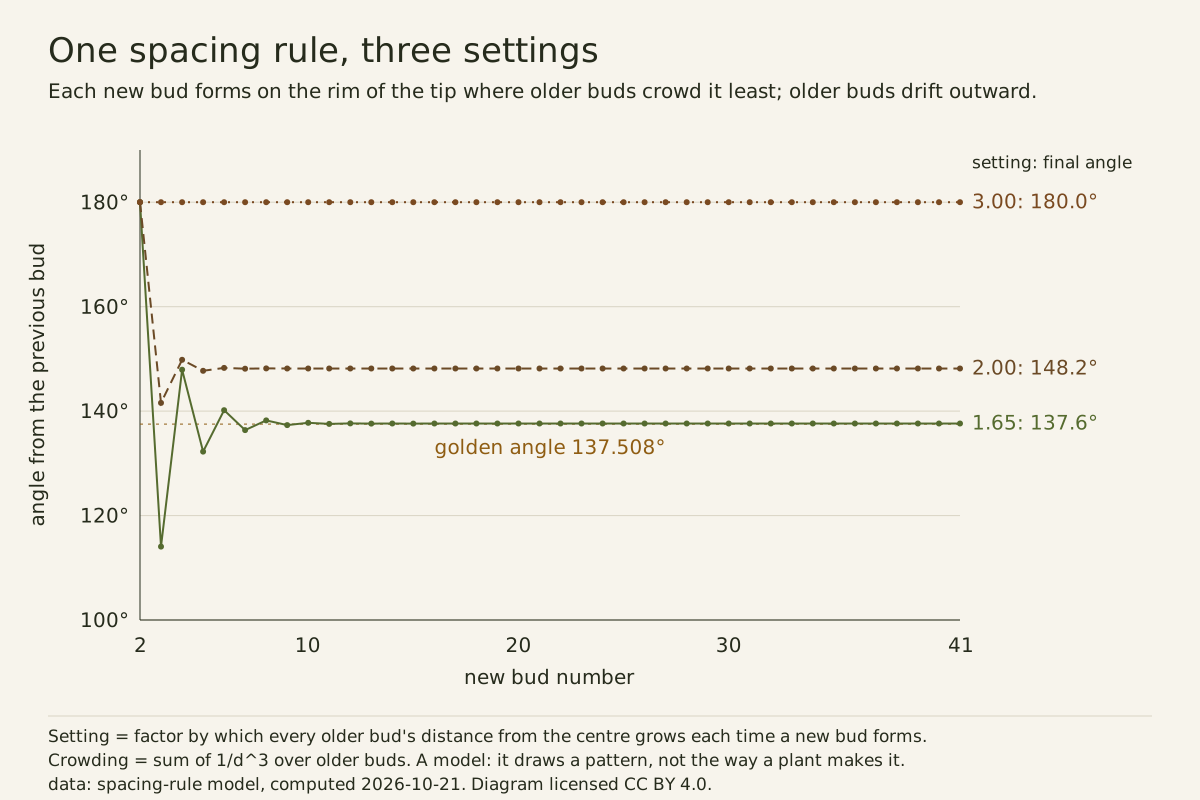
Fig. 3. A model, not a plant's mechanism: each new bud forms where older buds crowd it least, and the angle it settles on depends on how far older buds drift outward per bud.
"One spacing rule, three settings" by Botany for the Curious, https://botanyforthecurious.com/forms/fibonacci-in-nature/, licensed under CC BY 4.0 (https://creativecommons.org/licenses/by/4.0/)data: spacing-rule model designed for this page, after the iterative model described by Douady & Couder (1992, abstract), computed 2026-10-21Download CSV, three settings fibonacci-in-nature-spacing-rule.csv data: spacing-rule model designed for this page, after the iterative model described by Douady & Couder (1992, abstract), computed 2026-10-21
Is the golden angle the best angle for catching light?
Because the golden angle is so common, some researchers have proposed that evolution selected it for a benefit such as catching light. The idea is easy to picture: organs set the golden angle apart never line up at exactly the same angle from the centre, so leaves might shade each other less.
The evidence for that reading is thin. Sören Strauss and colleagues tested it in 2020 with computer models built from idealised and scanned leaves of thale cress and its relative Cardamine hirsuta (hairy bittercress). Other angles produced by Fibonacci-like series found in nature captured light just as well as the golden angle. The authors suggest that evolution more likely acted on the repeating mechanism that positions organs than on any single angle.
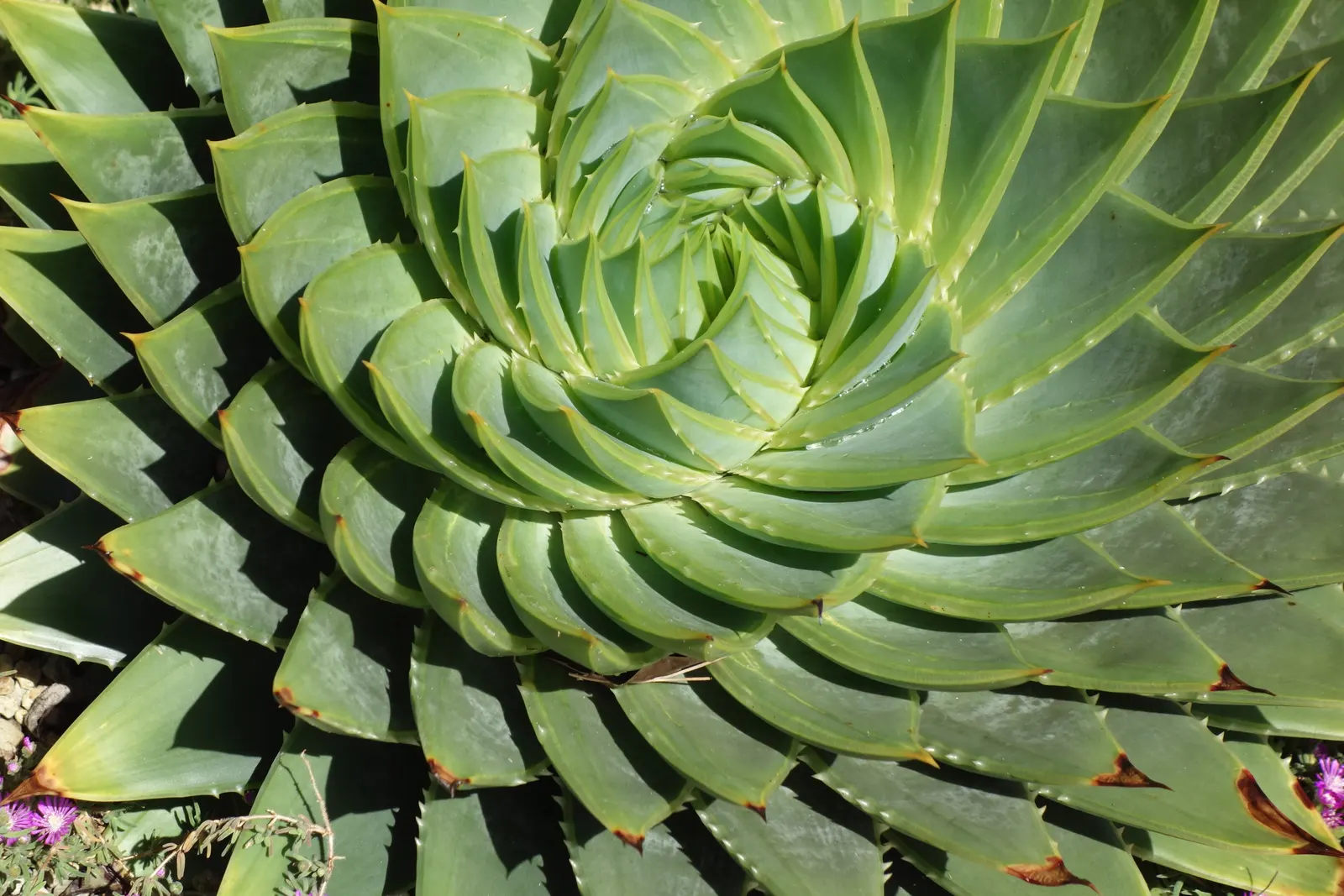
A rosette of Aloe polyphylla seen from above in Auckland Botanic Gardens, New Zealand, its leaves set in crossing spirals.
"Aloe polyphylla - Auckland Botanic Gardens - Auckland, NZ - DSC08556" by Daderot — https://commons.wikimedia.org/wiki/File:Aloe_polyphylla_-_Auckland_Botanic_Gardens_-_Auckland,_NZ_-_DSC08556.jpg — CC0 1.0 (https://creativecommons.org/publicdomain/zero/1.0/)
For now the evidence favours the process. What the plant seems to get right is a spacing rule that holds across a whole head of florets. Light capture also says nothing about a seed head, whose florets are not leaves.
Which popular claims about Fibonacci in nature hold up?
| Popular claim | What the evidence shows |
|---|---|
| Sunflower spirals are always Fibonacci numbers | Usually: 565 of 768 photo-checked counts (73.6%) in the 2016 study; 136 had no Fibonacci structure |
| The spirals are golden spirals | No. A golden spiral is a logarithmic spiral; seed-head spirals in Vogel's model lie closer to Fermat spirals |
| Any match with a small number is evidence | Weak evidence: 14 of the first 17 whole numbers belong to Fibonacci or a related sequence |
| The golden angle is the best angle for light | Not uniquely: in 2020 computer models, other Fibonacci-like angles did equally well |
| The plant stores the number 137.5° | No evidence. Models get the angle from a repeated spacing rule, which auxin experiments help explain |
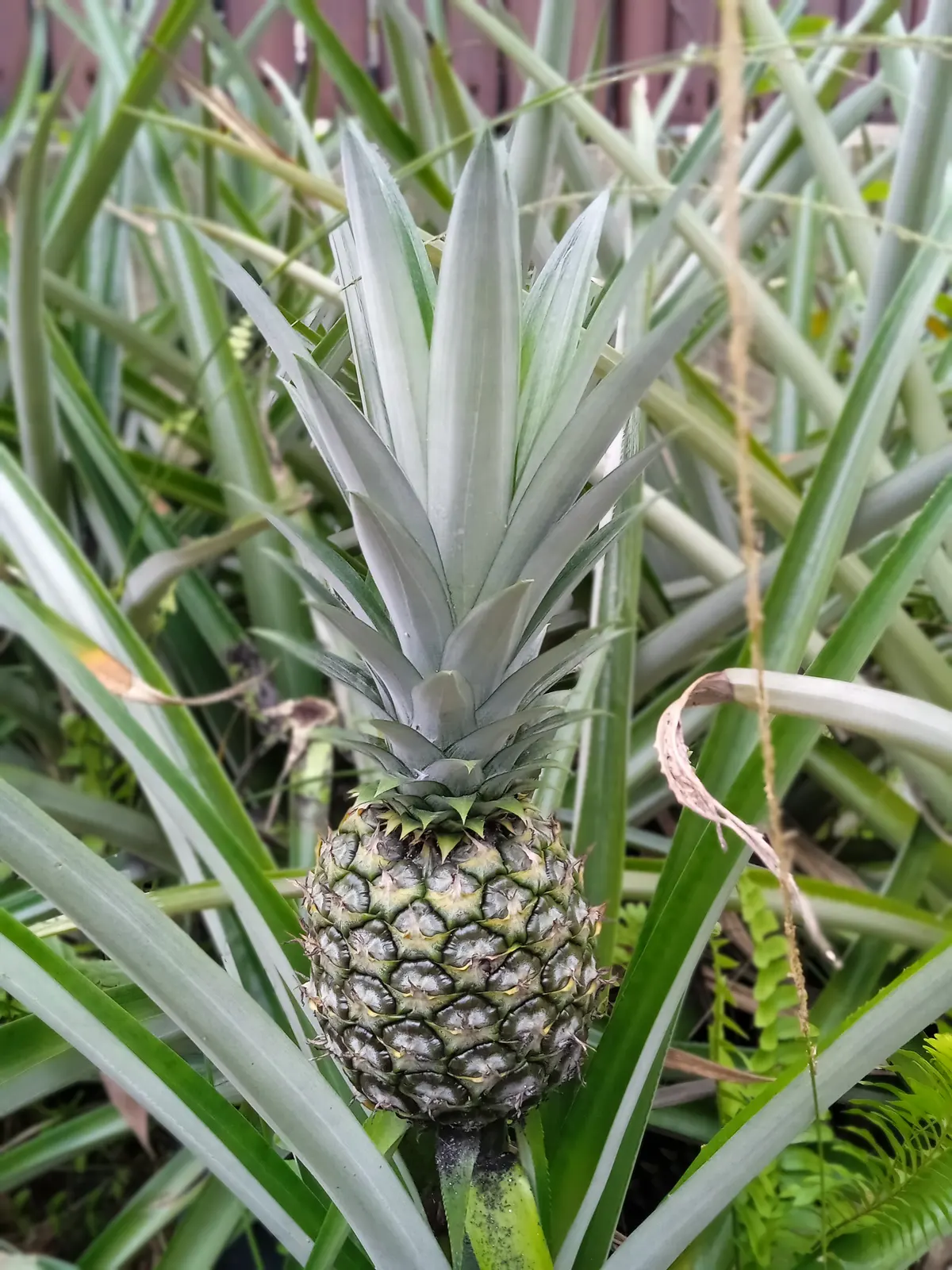
A green pineapple, Ananas comosus, at Taman Sutera in Selangor, Malaysia, its fruitlets set in rows that slope both ways.
"Ananas comosus at Taman Sutera, Kajang 20230708 170516" by Wiki Farazi — https://commons.wikimedia.org/wiki/File:Ananas_comosus_at_Taman_Sutera,_Kajang_20230708_170516.jpg — CC0 1.0 (https://creativecommons.org/publicdomain/zero/1.0/)
Questions people ask about Fibonacci in nature
Do all sunflowers have Fibonacci spirals?
No: in a 2016 survey, the largest of its kind at the time, 565 of 768 photo-checked spiral counts were Fibonacci numbers. Another 67 fitted related sequences such as the Lucas numbers, and 136 had no Fibonacci structure. Near-misses such as 54 were not uncommon, and some heads were too disordered to count. Fibonacci counts were the strong majority in that survey, and the exceptions were real.
What is the golden angle in plants?
The golden angle is about 137.5°, the smaller arc when a full turn is divided in the golden ratio. In spiral phyllotaxis it is the most common angle between one new leaf or floret and the next. In Vogel's 1979 sunflower model, placing each floret 137.5° from the last, at a distance set by the square root of its number, reproduces the familiar crossing spirals.
Do pine cones and pineapples follow the Fibonacci sequence?
Often, yes. Cone scales and pineapple fruitlets sit in two sets of sloping rows, and one classic description of a pineapple counts 8 rows one way and 13 the other. Their counts are small, though. Because 14 of the first 17 whole numbers belong to Fibonacci or a related sequence, a small count that matches is weaker evidence than a sunflower's 55 and 89.
Why does the Fibonacci sequence show up in plants?
In the explanations found in the sources checked for this page, the Fibonacci sequence comes from a spacing rule at the growing tip. Each new leaf or floret bud forms where older buds crowd it least, and experiments point to the transport of the hormone auxin as the key process behind that placement. Repeated bud after bud, a rule of this kind can settle near the golden angle, and the golden angle produces spiral counts that are neighbouring Fibonacci numbers. The plant does not need to count anything.
Sources
- Swinton, J., Ochu, E. & The MSI Turing's Sunflower Consortium (2016). "Novel Fibonacci and non-Fibonacci structure in the sunflower: results of a citizen science experiment." Royal Society Open Science 3(5): 160091. doi:10.1098/rsos.160091. https://doi.org/10.1098/rsos.160091 full text Text licence: CC BY 4.0
- Prusinkiewicz, P. & Lindenmayer, A. (1990). The Algorithmic Beauty of Plants, Chapter 4: Phyllotaxis. Springer-Verlag. https://algorithmicbotany.org/papers/abop/abop-ch4.pdf Chapter 4, electronic edition
- Vogel, H. (1979). "A better way to construct the sunflower head." Mathematical Biosciences 44(3–4): 179–189. doi:10.1016/0025-5564(79)90080-4. https://doi.org/10.1016/0025-5564(79)90080-4 bibliographic record only
- Smith, R. S., Guyomarc'h, S., Mandel, T., Reinhardt, D., Kuhlemeier, C. & Prusinkiewicz, P. (2006). "A plausible model of phyllotaxis." PNAS 103(5): 1301–1306. doi:10.1073/pnas.0510457103. https://doi.org/10.1073/pnas.0510457103 abstract
- Reinhardt, D., Pesce, E.-R., Stieger, P., Mandel, T., Baltensperger, K., Bennett, M., Traas, J., Friml, J. & Kuhlemeier, C. (2003). "Regulation of phyllotaxis by polar auxin transport." Nature 426: 255–260. doi:10.1038/nature02081. https://doi.org/10.1038/nature02081 bibliographic record only; summarised here through Smith et al. 2006
- Douady, S. & Couder, Y. (1992). "Phyllotaxis as a physical self-organized growth process." Physical Review Letters 68(13): 2098–2101. doi:10.1103/PhysRevLett.68.2098. https://doi.org/10.1103/PhysRevLett.68.2098 abstract
- Strauss, S., Lempe, J., Prusinkiewicz, P., Tsiantis, M. & Smith, R. S. (2020). "Phyllotaxis: is the golden angle optimal for light capture?" New Phytologist 225(1): 499–510. doi:10.1111/nph.16040. https://doi.org/10.1111/nph.16040 abstract
- Cerca, J., Agudo, A. B., Castro, S., Afonso, A., Alvarez, I. & Torices, R. (2019). "Fitness benefits and costs of floral advertising traits: insights from rayed and rayless phenotypes of Anacyclus (Asteraceae)." American Journal of Botany 106(2): 231–243. doi:10.1002/ajb2.1238. https://doi.org/10.1002/ajb2.1238 abstract
- The World Checklist of Vascular Plants (WCVP), version 16.0 (2026-06-04). Facilitated by the Royal Botanic Gardens, Kew. CC BY 3.0. doi:10.34885/egs6-cp24. https://doi.org/10.34885/egs6-cp24 names file: accepted status, family, authors and IPNI identifiers for the eight names on this page Text licence: CC BY 3.0
- World Flora Online Plant List, version 2026-06 (CC0). World Flora Online Consortium. doi:10.5281/zenodo.7460141. Records for Helianthus annuus L. (wfo-0000088131) and the other names on this page. https://list.worldfloraonline.org/wfo-0000088131 name records for the eight names on this page; for Aloe polyphylla the WFO author is Pillans, where WCVP gives Schönland ex Pillans; Aeonium tabuliforme is listed without a placement in the 2026-06 classification, so the page names only the genus Aeonium
- Flora of China, Vol. 20–21 (Asteraceae), Helianthus and Helianthus annuus. eFloras. http://www.efloras.org/florataxon.aspx?flora_id=2&taxon_id=114871 genus and species entries, vol. 20–21
- English Wikipedia, "Common sunflower" (read 2026-10-21). https://en.wikipedia.org/wiki/Common_sunflower description section; summarised here
- English Wikipedia, "Pseudanthium" (read 2026-10-21). https://en.wikipedia.org/wiki/Pseudanthium lead section; summarised here
- English Wikipedia, "Fibonacci sequence" (read 2026-10-21). https://en.wikipedia.org/wiki/Fibonacci_sequence lead, history and nature sections; summarised here
- English Wikipedia, "Golden angle" (read 2026-10-21). https://en.wikipedia.org/wiki/Golden_angle lead section; summarised here
- English Wikipedia, "Golden spiral" and "Fermat's spiral" (read 2026-10-21). https://en.wikipedia.org/wiki/Golden_spiral lead and spirals-in-nature sections of both articles; summarised here
- English Wikipedia, "Arabidopsis thaliana" and "Cardamine hirsuta" (read 2026-10-21). https://en.wikipedia.org/wiki/Arabidopsis_thaliana lead sections, for the English common names; summarised here
- English Wikipedia, "Phyllotaxis" and "Parastichy" (read 2026-10-21). https://en.wikipedia.org/wiki/Phyllotaxis Phyllotaxis: lead, repeating spiral, history and plant physiology sections; Parastichy: lead; summarised here
Computed on this page (2026-10-21): golden angle from 360° × (1 − 1/φ); the 21/55–34/89 window and its 1-in-1,869 accuracy; the Cooke check over the integers 1–17; all percentages in Fig. 1; both Vogel-model CSVs (nearest neighbours found by distance, spacing variation over florets 51–1,500 of a 1,500-floret model, neighbour gaps counted over the four nearest neighbours of each floret in a 3,300-floret model); and the Fig. 3 runs (each new bud placed where the summed crowding from older buds, 1/d3, is least, with every older bud's distance from the centre multiplied by the setting as each new bud forms).
Related
- Leaf Shapes: A Leaf's Name Is a Phrase, Not a Single Word Comparison and chart
- Inflorescence Types: The First Flower to Open Is the Clue Specimen entry
Cite this page
Botany for the Curious. “Fibonacci in Nature: The Sunflowers That Break the Sequence.” Published 2026-10-22; last substantive revision 2026-10-22. https://botanyforthecurious.com/forms/fibonacci-in-nature/ (accessed: add the date you read it).
- Published
- Last substantive revision