Plant Forms & StructuresComparison and chart
Leaf Shapes: A Leaf's Name Is a Phrase, Not a Single Word
- Published
- Last substantive revision
Spec card
- Term
- Leaf-shape terms in four word classes: shape (with tip and base), margin, venation and divisionSource: Jackson 1928; Gray 1879
- Example species
- Ginkgo biloba (ginkgo): fan-shaped blade with close, forking veinsSource: Flora of China vol. 4 (Ginkgoaceae); WCVP (Kew); World Flora Online
- Structure
- Leaf blade (lamina)Source: Jackson 1928
- Not to be confused with
- A leaflet of a compound leafSource: Gray 1879
- Diagrams
- Plates 1–6
Download this card as CSV leaf-shapes-spec-card.csv data: B. D. Jackson (1928) and A. Gray (1879), retrieved 2026-10-21; Flora of China vol. 4, Ginkgoaceae (taxon 10370), retrieved 2026-10-21; WCVP (Kew), CC BY 3.0, doi:10.34885/egs6-cp24, retrieved 2026-10-21; World Flora Online Plant List 2026-06 (CC0), retrieved 2026-10-21
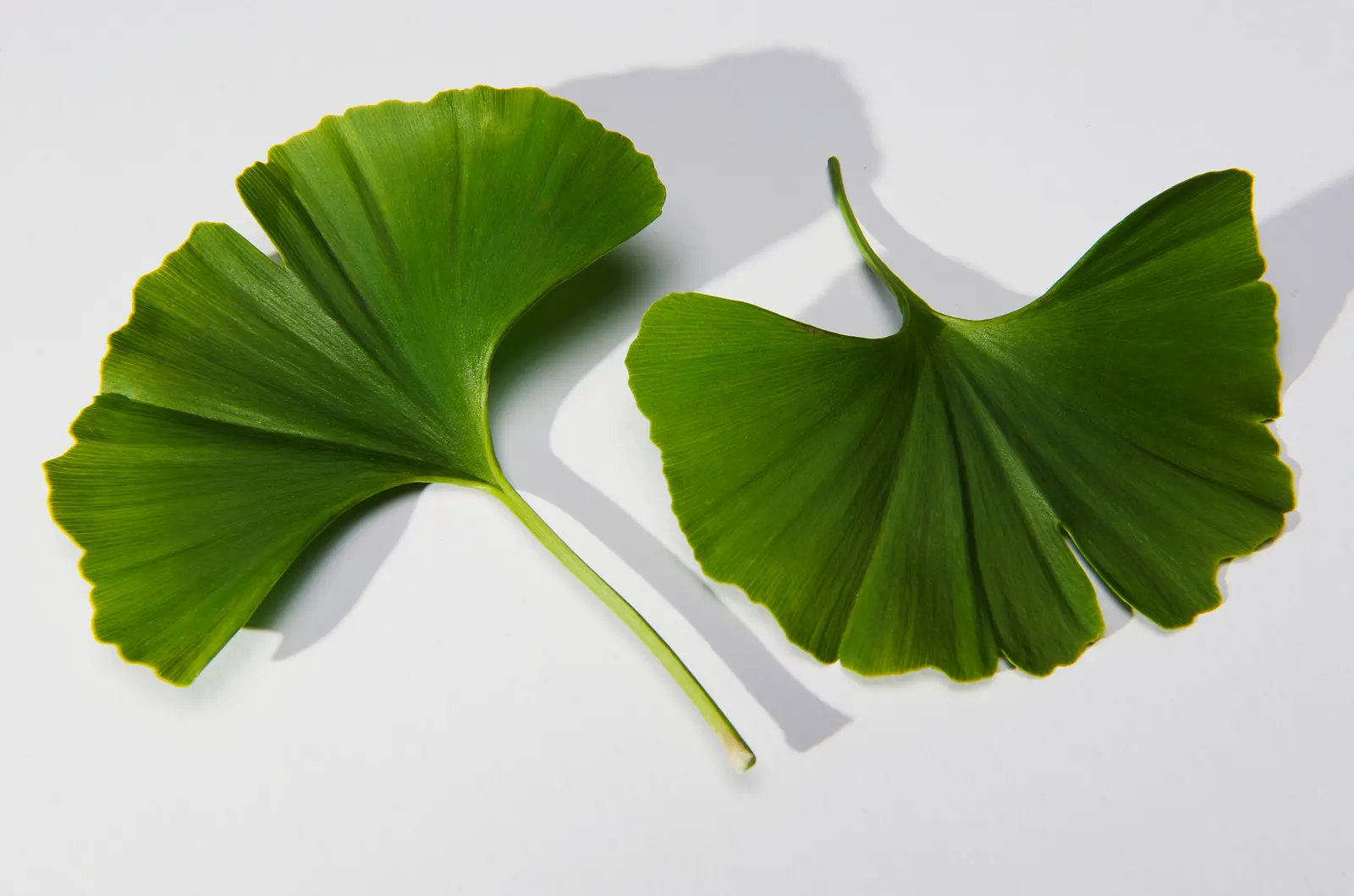
Two ginkgo leaves: fan-shaped blades on long stalks, with fine veins spreading out from the base.
"GingkoLeaf" by THOR — https://commons.wikimedia.org/wiki/File:GingkoLeaf.jpg — CC BY 2.0 (https://creativecommons.org/licenses/by/2.0/)
Flora of China does not describe a ginkgo leaf with one shape word. Its entry for the ginkgo family calls the leaf of Ginkgo biloba, the ginkgo, flabellate (fan-shaped), broadly cuneate at the base and entire at the margin, with close veins that fork in pairs and an apex that is two-lobed or notched.
In botany, leaf shapes are named part by part, and a whole leaf is described by the phrase those part names make. This guide sorts those terms into four word classes, a system it calls leaf grammar: shape (the outline, with its tip and base), margin, venation and division. Its definitions of 55 terms follow two public-domain reference books, Asa Gray's textbook of 1879 and B. D. Jackson's glossary of 1928. Each term is drawn from its definition on Plates 1 to 6 and paired with a species whose Flora of China treatment, or that of its genus or family, uses that word or a close variant; how the drawings are checked is set out in Sources and Standards.
Download Download the terms table (CSV) leaf-shapes-terms.csv data: definitions after B. D. Jackson, A Glossary of Botanic Terms, 4th ed. (1928), and A. Gray, Structural Botany (1879), computed 2026-10-21; Flora of China (eFloras), volume, page and taxon references only, retrieved 2026-10-21; WCVP (Kew), CC BY 3.0, doi:10.34885/egs6-cp24, retrieved 2026-10-21; World Flora Online Plant List 2026-06 (CC0), retrieved 2026-10-21
How to spell a leaf
Gray wrote in 1879 that "a word or two, or a short phrase" could describe even a complex leaf. The phrase is built from the blade, the flat, expanded part of the leaf. Shape covers its outline, and two shape terms describe its ends: the tip, or apex, and the base, where the blade meets the leaf stalk. Margin is the edge and venation the arrangement of the veins, while division says whether the blade is one piece or cut into parts.
Look at the leaf of European beech, Fagus sylvatica, in the photo below. Find the outline first and ask where it is widest. Then check the two ends, run your eye along the edge, follow the side veins out from the midrib, and see whether the blade is whole or cut.
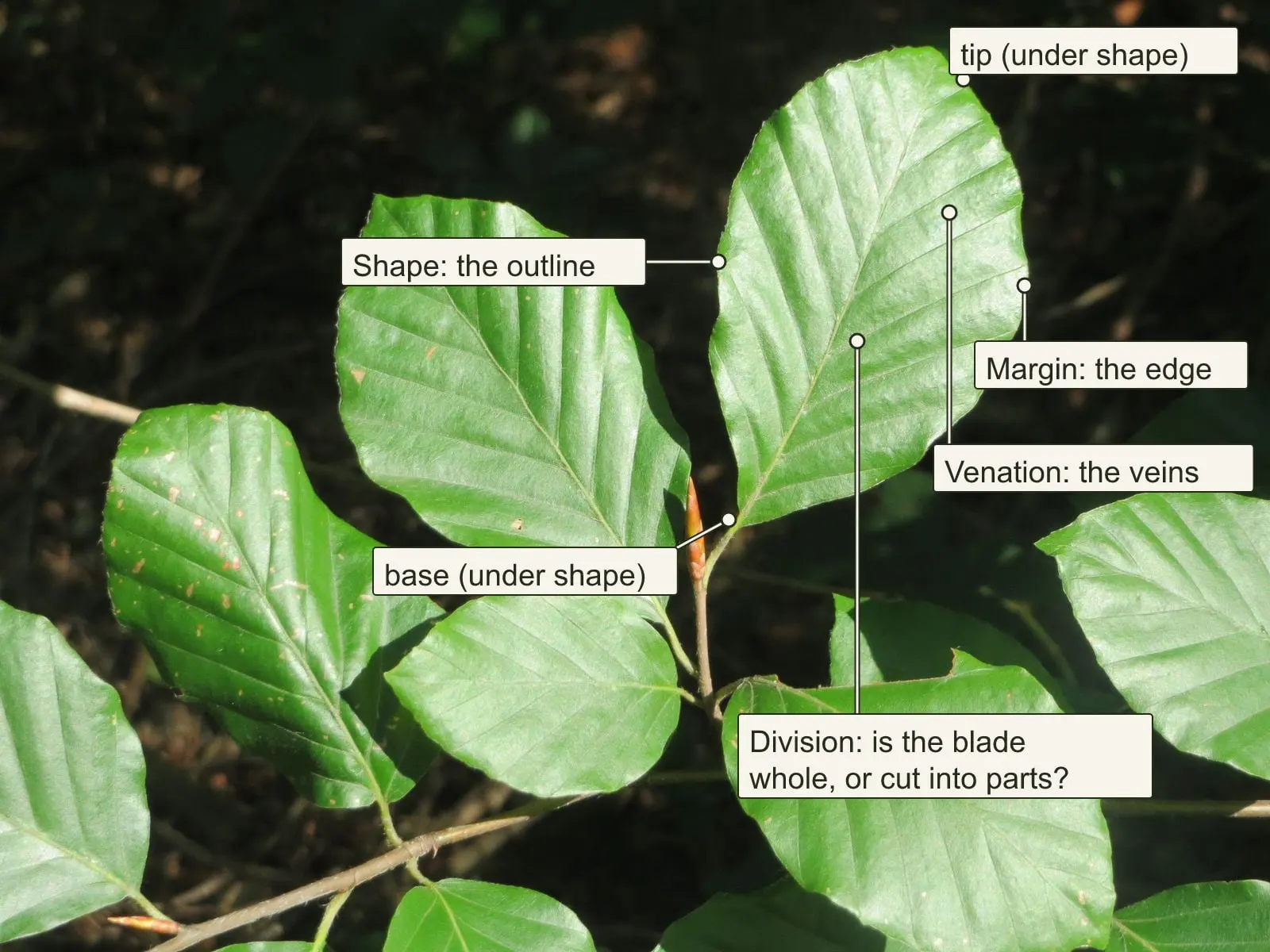
The four word classes pointed out on one leaf of European beech, Fagus sylvatica: each label names a part of the blade, not a feature of the species.
Credit, licence and underlying images
"The four word classes on one beech leaf" by Botany for the Curious, https://botanyforthecurious.com/forms/leaf-shapes/, licensed under CC BY 4.0 (https://creativecommons.org/licenses/by/4.0/). Underlying image: "20170921Fagus sylvatica2" by AnRo0002 — https://commons.wikimedia.org/wiki/File:20170921Fagus_sylvatica2.jpg — CC0 1.0 (https://creativecommons.org/publicdomain/zero/1.0/); modified: resized to 1,600 x 1,200 px, labels and leader lines overlaid.
For most leaves, one term from each class gives a description that another reader can check against the leaf. Leaf arrangement on the stem, called phyllotaxis, is not one of the classes: it describes where leaves sit, not the leaf itself, and its spirals are the subject of Fibonacci in Nature.
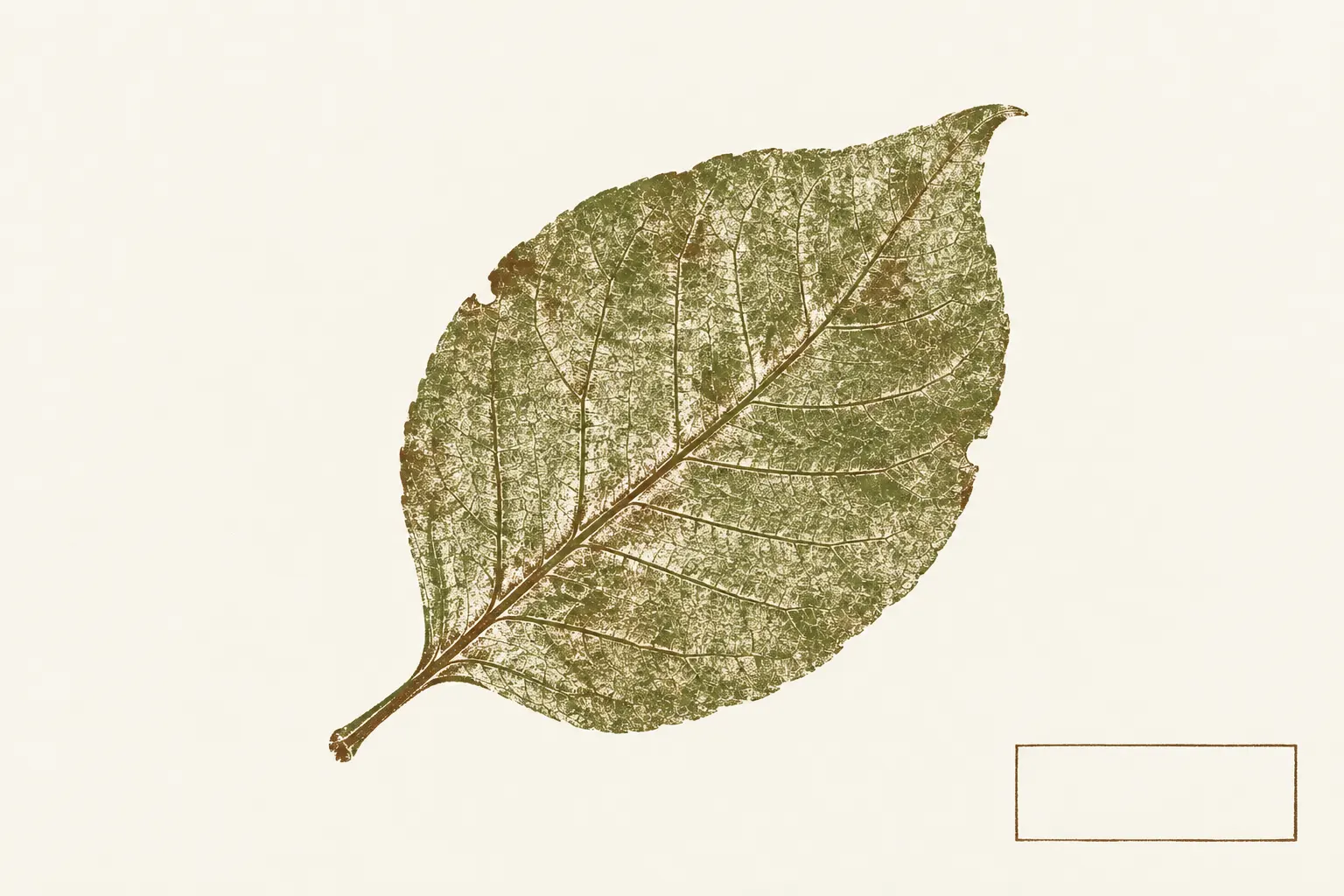
A pressed leaf left unlabelled: its outline, edge, veins and one-piece blade are the parts the four word classes describe.
Illustration: Botany for the Curious. Generated schematic image — not a photograph or botanical record. Reuse terms: no license is granted; any rights Botany for the Curious holds in this image are reserved.Shape: where the blade is widest
Many outline terms record where the blade is widest. An ovate blade is broadest toward the stalk and an obovate one toward the tip; elliptic and oblong blades are widest across the middle. An oblong blade, though, keeps almost parallel sides. Linear and acicular leaves are narrow from end to end, so the widest-point test hardly applies.
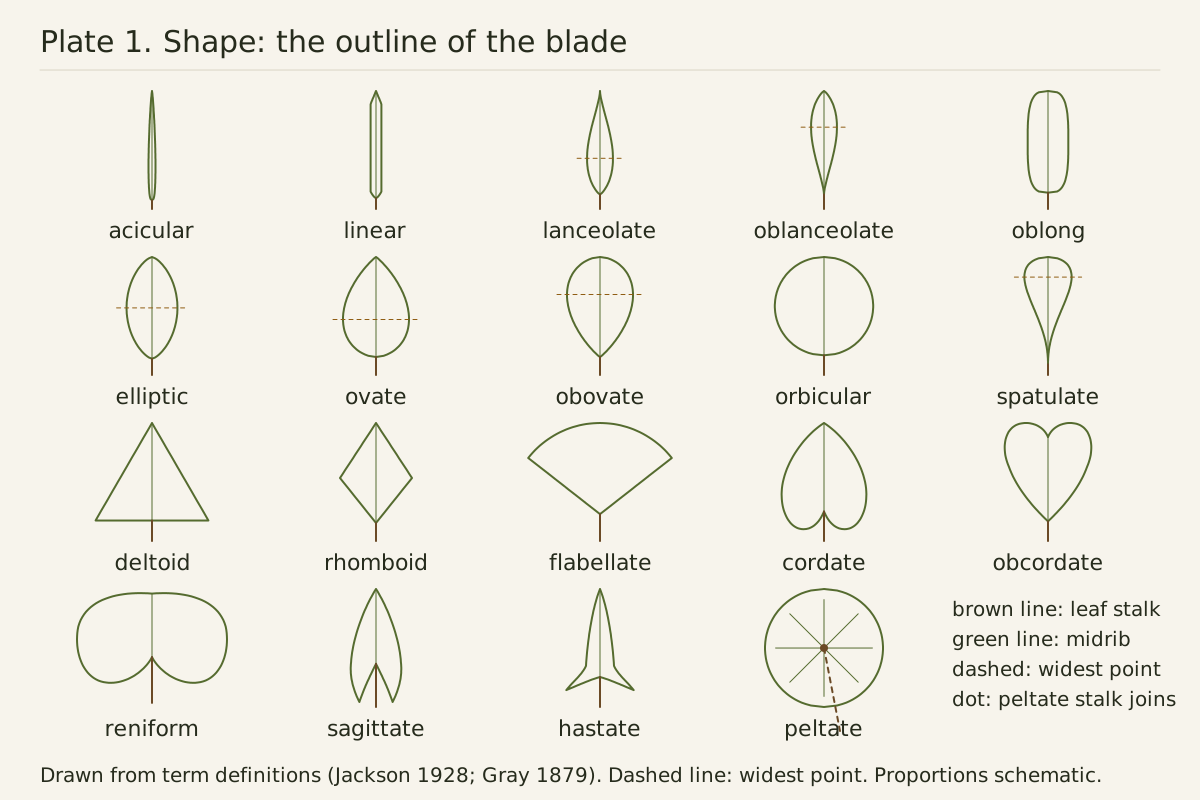
Plate 1. Nineteen outlines drawn from their definitions; the dashed line marks where each egg, lance or spoon shape is widest.
"Plate 1. Shape: the outline of the blade" by Botany for the Curious, https://botanyforthecurious.com/forms/leaf-shapes/, licensed under CC BY 4.0 (https://creativecommons.org/licenses/by/4.0/)data: definitions after B. D. Jackson, A Glossary of Botanic Terms, 4th ed. (1928), and A. Gray, Structural Botany (1879), computed 2026-10-21| Shape term | What it means | Example in Flora of China |
|---|---|---|
| acicular | Needle-shaped: slender and tapering to a sharp point. | Juniperus formosana (Formosan juniper) |
| linear | Narrow, several times longer than wide, with almost parallel sides. | Cedrus deodara (deodar cedar) |
| lanceolate | Lance-shaped: narrow, tapering to the tip, widest below the middle. | Salix babylonica (weeping willow) |
| oblanceolate | Lanceolate turned upside down: widest above the middle, tapering to the base. | Sonchus oleraceus (common sowthistle) |
| oblong | Much longer than wide, with nearly parallel sides. | Ficus elastica (rubber fig) |
| elliptic | Like an ellipse: widest at the middle, both ends equally rounded. | Camellia sinensis (tea plant) |
| ovate | Egg-shaped in outline, with the broader end at the base. | Morus alba (white mulberry) |
| obovate | Egg-shaped with the broader end toward the tip. | Pittosporum tobira (Japanese cheesewood) |
| orbicular | Circular or nearly circular in outline. | Nelumbo nucifera (sacred lotus) |
| spatulate | Rounded at the top, narrowing to a long slender base. | Bellis perennis (common daisy) |
| deltoid | Broadly triangular, like the Greek capital delta. | Populus nigra (black poplar) |
| rhomboid | Diamond-shaped and four-sided, with blunt angles at the sides. | Chenopodium album (lamb's quarters) |
| flabellate | Fan-shaped: widening from a narrow, wedge-like base. | Ginkgo biloba (ginkgo; stated for the whole family) |
| cordate | Heart-shaped, with the stalk in a notch at the broad end. | Glechoma longituba (Chinese name huo xue dan) |
| obcordate | Heart-shaped upside down: the notch is at the tip. | Oxalis corniculata (creeping woodsorrel) |
| reniform | Kidney-shaped: broader than long, notched where the stalk joins. | Hydrocotyle sibthorpioides (lawn marshpennywort) |
| sagittate | Arrow-shaped: two pointed basal lobes aimed back toward the stalk. | Sagittaria trifolia (threeleaf arrowhead) |
| hastate | Halberd-shaped: pointed basal lobes spreading outward. | Rumex acetosella (sheep's sorrel) |
| peltate | Shield-like: the stalk joins the underside, inside the margin. | Tropaeolum majus (garden nasturtium) |
Some of these words have shifted in meaning. Jackson's 1928 glossary notes that Linnaeus used lanceolate for a leaf with nearly matching ends, while by Jackson's day the base was usually a little broader, with the greatest width about a third of the way up. Gray allows either reading, and adds that anyone who keeps the narrow, evenly tapering sense has no need for oblanceolate. Jackson is blunter: strictly, he writes, such a leaf cannot exist, but the word is used for blades that taper more toward the base.
A second group of outlines is defined by lobes beside the stalk. They are rounded in a cordate leaf, and a reniform leaf is like a cordate one but rounder and broader than long. The lobes are aimed back toward the stalk in a sagittate leaf and spread outward in a hastate one. In a peltate leaf, such as the garden nasturtium's, the stalk joins the underside of the blade instead of its edge.
Printed plates of leaf outlines are older than either reference book. The oldest printed plate on this page is the first plate, marked Tab. I, in Linnaeus's "Philosophia Botanica" of 1751, which sets out 62 numbered figures and is signed by its draughtsman, J. G. Hallman.
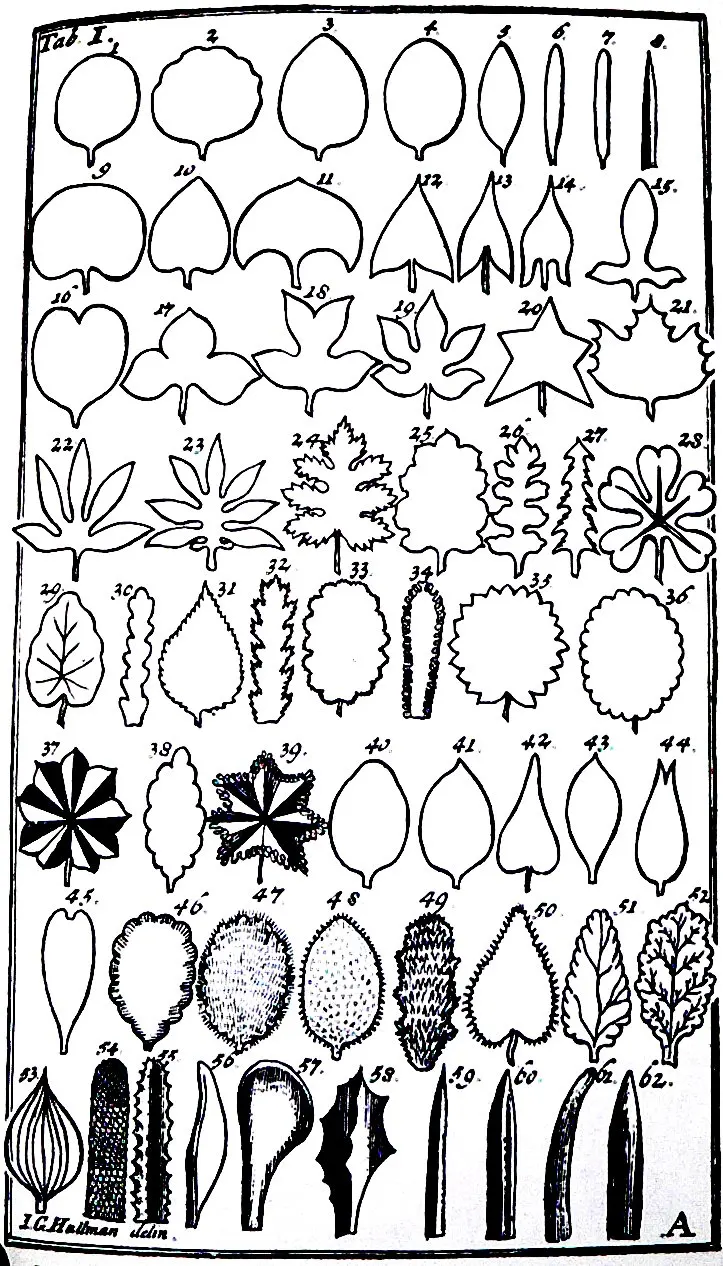
The first plate of Carl Linnaeus's "Philosophia Botanica", 1751, signed by its draughtsman Hallman: 62 numbered leaf outlines, the oldest printed plate on this page.
Credit and licence
"Philosophia botanica 1751 Tab 1" by Carl von Linné — https://commons.wikimedia.org/wiki/File:Philosophia_botanica_1751_Tab_1.JPG — Public domain (published 1751; US: published before 1931; EU: Carl Linnaeus d. 1778; the draughtsman who signed the plate, I. G. Hallman, was active when it was published in 1751, so must have died before 1955; the engraver is unsigned, and the plate was made public more than 70 years ago)
Tip and base
Gray's textbook uses one set of words for both ends of a blade. Acuminate, acute, obtuse, truncate, retuse and emarginate can each describe a tip or a base, while obcordate, mucronate and cuspidate apply to the tip only. In this guide rounded and truncate appear in both rows of Plate 2, and cordate names a base as well as a whole outline.
Look closely at the very end of the blade. An acuminate tip narrows gradually into a drawn-out point, while an acute tip meets at a sharp angle without one; a notch is emarginate when it is distinct and retuse when it is shallow in a rounded tip. At the other end, cuneate sides run to the stalk in straight lines. An attenuate base tapers down into the stalk.
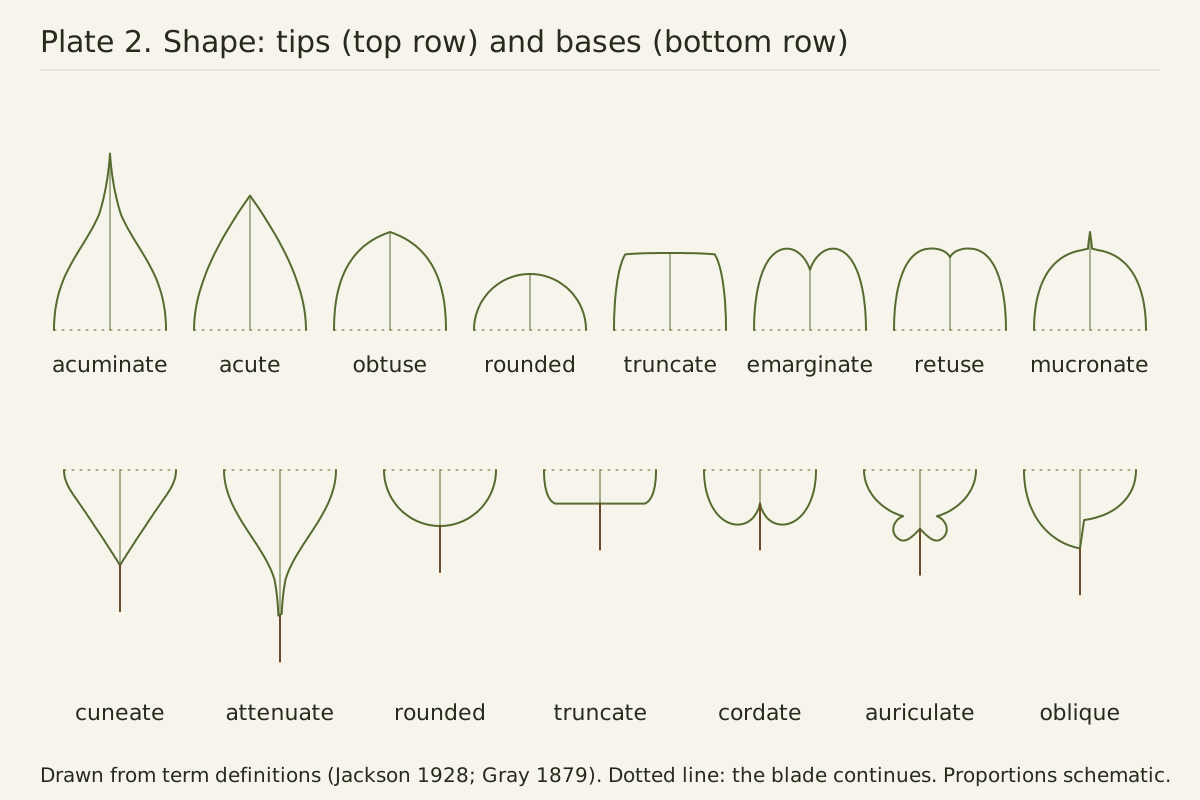
Plate 2. Eight tips, top row, and seven bases, bottom row, drawn from their definitions; each panel shows only one end of the blade.
"Plate 2. Shape: tips and bases" by Botany for the Curious, https://botanyforthecurious.com/forms/leaf-shapes/, licensed under CC BY 4.0 (https://creativecommons.org/licenses/by/4.0/)data: definitions after B. D. Jackson, A Glossary of Botanic Terms, 4th ed. (1928), and A. Gray, Structural Botany (1879), computed 2026-10-21| Tip term | What it means | Example in Flora of China |
|---|---|---|
| acuminate | Tapering gradually to a long, drawn-out point. | Salix babylonica (weeping willow) |
| acute | Ending in a sharp angle, without a drawn-out point. | Cercis chinensis (Chinese redbud) |
| obtuse | Blunt: ending in a wide angle or a rounded point. | Bellis perennis (common daisy) |
| rounded | Ending in a smooth curve, with no angle at all. | Pittosporum tobira (Japanese cheesewood) |
| truncate | Ending abruptly, as if cut straight across. | Lespedeza cuneata (Chinese bushclover) |
| emarginate | With a distinct notch cut into the tip. | Trifolium repens (white clover) |
| retuse | Rounded, with a shallow notch at the very tip. | Bellis perennis (common daisy) |
| mucronate | Tipped with a short, straight, abrupt point. | Lespedeza cuneata (Chinese bushclover) |
| Base term | What it means | Example in Flora of China |
|---|---|---|
| cuneate | Wedge-shaped: narrowing to the stalk in straight lines. | Camellia sinensis (tea plant) |
| attenuate | Tapered, narrowing down into the stalk. | Bellis perennis (common daisy) |
| rounded | Curving smoothly into the stalk, with no angle. | Morus alba (white mulberry) |
| truncate | Cut straight across where the stalk joins. | Acer truncatum (Shantung maple) |
| cordate | Notched, with two rounded lobes beside the stalk. | Cercis chinensis (Chinese redbud) |
| auriculate | With a pair of small, blunt, ear-like lobes. | Quercus robur (English oak) |
| oblique | Lopsided: the two sides of the blade meet the stalk unequally. | Celtis sinensis (Chinese hackberry) |
Margins
The margin is the edge of the blade, and many margin terms describe teeth: their size, direction and shape. Serrate teeth point toward the tip like the teeth of a saw, and serrulate ones are the same but small. Crenate teeth are rounded, like scallops. An entire margin is even, with no teeth at all.
Direction is where the two old books part company. Gray keeps dentate for teeth that stick out without pointing toward the tip, and this guide follows him; Jackson defines dentate as "toothed, especially with salient teeth directed forward", which leaves little room between it and serrate. Undulate drifted too. For Gray it is an edge that bends slightly in and out, a gentler sinuate, while Jackson cites other authors for whom a margin can be sinuate without being undulate, and a margin that is not undulate is flat.
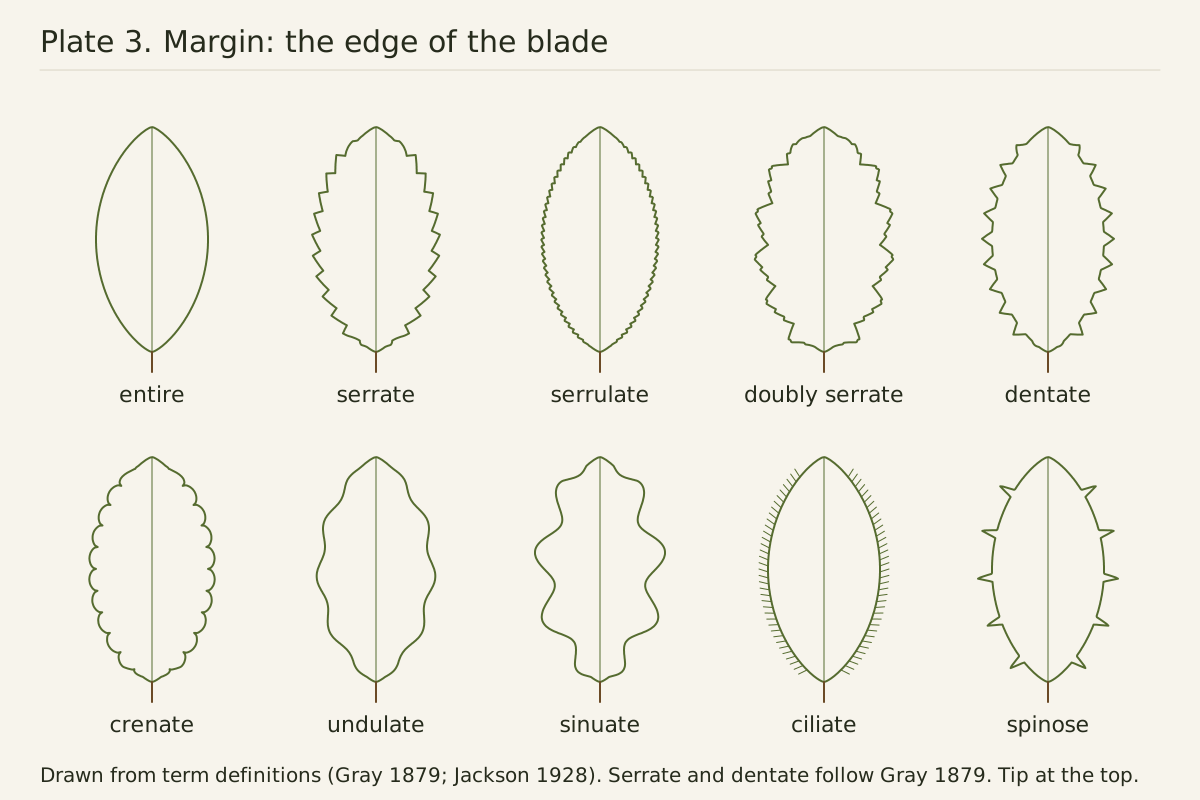
Plate 3. Ten margins drawn on the same blade; serrate and dentate follow Gray's 1879 definitions.
"Plate 3. Margin: the edge of the blade" by Botany for the Curious, https://botanyforthecurious.com/forms/leaf-shapes/, licensed under CC BY 4.0 (https://creativecommons.org/licenses/by/4.0/)data: definitions after B. D. Jackson, A Glossary of Botanic Terms, 4th ed. (1928), and A. Gray, Structural Botany (1879), computed 2026-10-21| Margin term | What it means | Example in Flora of China |
|---|---|---|
| entire | Edge smooth and even, without teeth or lobes. | Nelumbo nucifera (sacred lotus) |
| serrate | Toothed like a saw, the teeth pointing toward the tip. | Salix babylonica (weeping willow) |
| serrulate | Serrate with very small teeth. | Ophiopogon japonicus (dwarf lilyturf) |
| doubly serrate | Saw-toothed, with smaller teeth on the larger teeth. | Crataegus pinnatifida (Chinese hawthorn) |
| dentate | Toothed, the teeth pointing outward rather than toward the tip. | Plantago asiatica (Chinese name che qian) |
| crenate | Scalloped: edged with rounded teeth. | Glechoma longituba (Chinese name huo xue dan) |
| undulate | Edge wavy, bending slightly in and out. | Hosta plantaginea (fragrant plantain lily) |
| sinuate | Edge deeply and distinctly wavy. | Tropaeolum majus (garden nasturtium) |
| ciliate | Edge fringed with hairs. | Populus nigra (black poplar) |
| spinose | Edge armed with spines. | Ilex cornuta (Chinese holly) |
One species can need more than one margin word. Flora of China gives the margin of che qian, Plantago asiatica, as entire, repand, serrate or dentate, and the tea plant's as serrate to serrulate. Sweet chestnut, Castanea sativa, is not covered by Flora of China, so the photo below carries no margin term; follow one edge from stalk to tip and compare it with Plate 3.
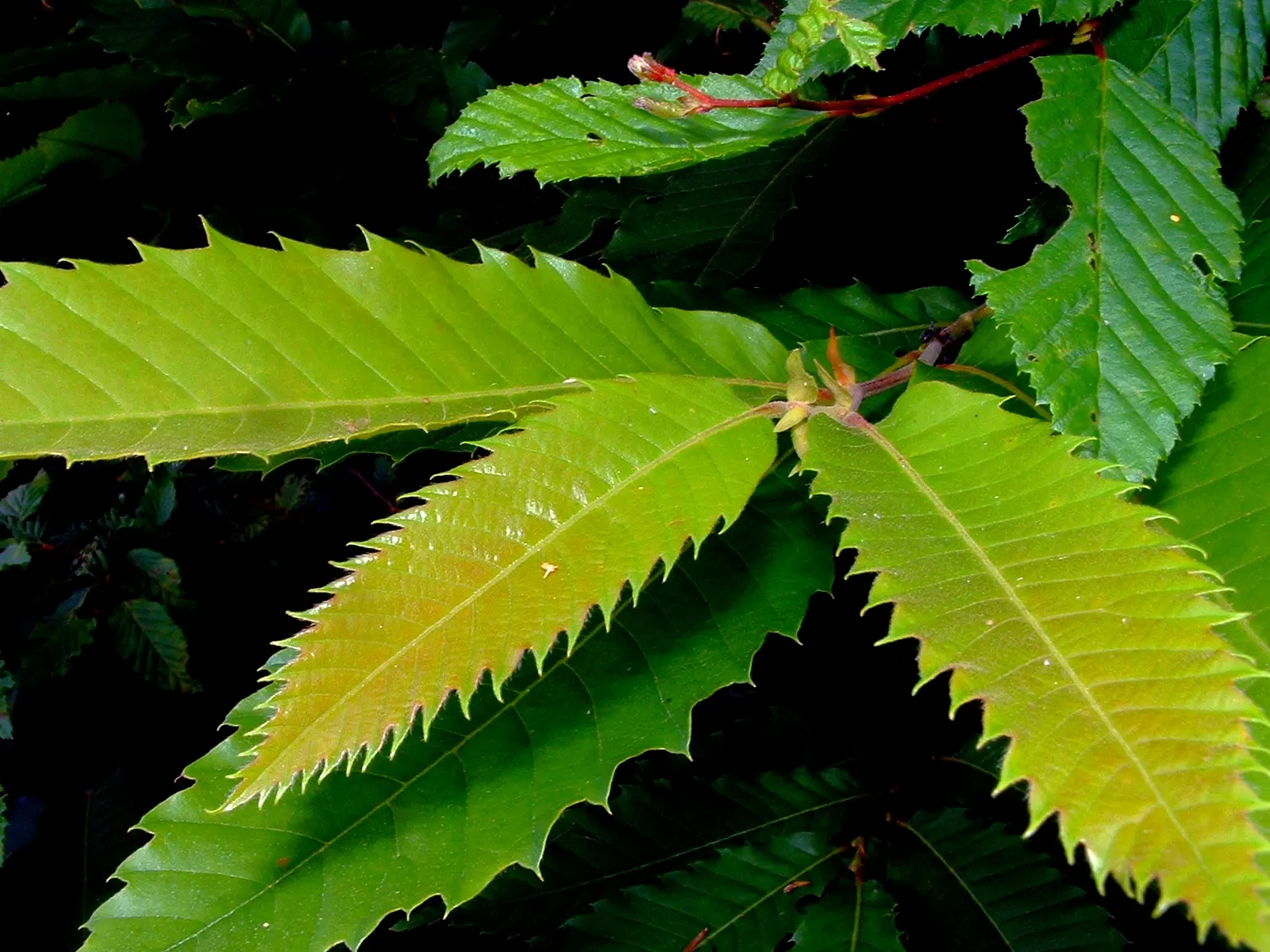
Leaves of sweet chestnut, Castanea sativa, photographed in Corrèze, France, in July 2007.
"Castanea sativa (994517228)" by OliBac — https://commons.wikimedia.org/wiki/File:Castanea_sativa_(994517228).jpg — CC BY 2.0 (https://creativecommons.org/licenses/by/2.0/)
Veins
Gray sorts leaf veins on two levels. A leaf is either parallel-veined, with simple ribs running side by side, usually from base to tip, or netted, with veins that branch and join into a network. Netted leaves then split into pinnately veined, with side veins off one midrib like the barbs of a feather, and palmately veined, with several main ribs spreading from the top of the stalk like fingers. In that scheme pinnate and palmate are kinds of netted venation, which is why reticulate sits on a different axis from them in the table below.
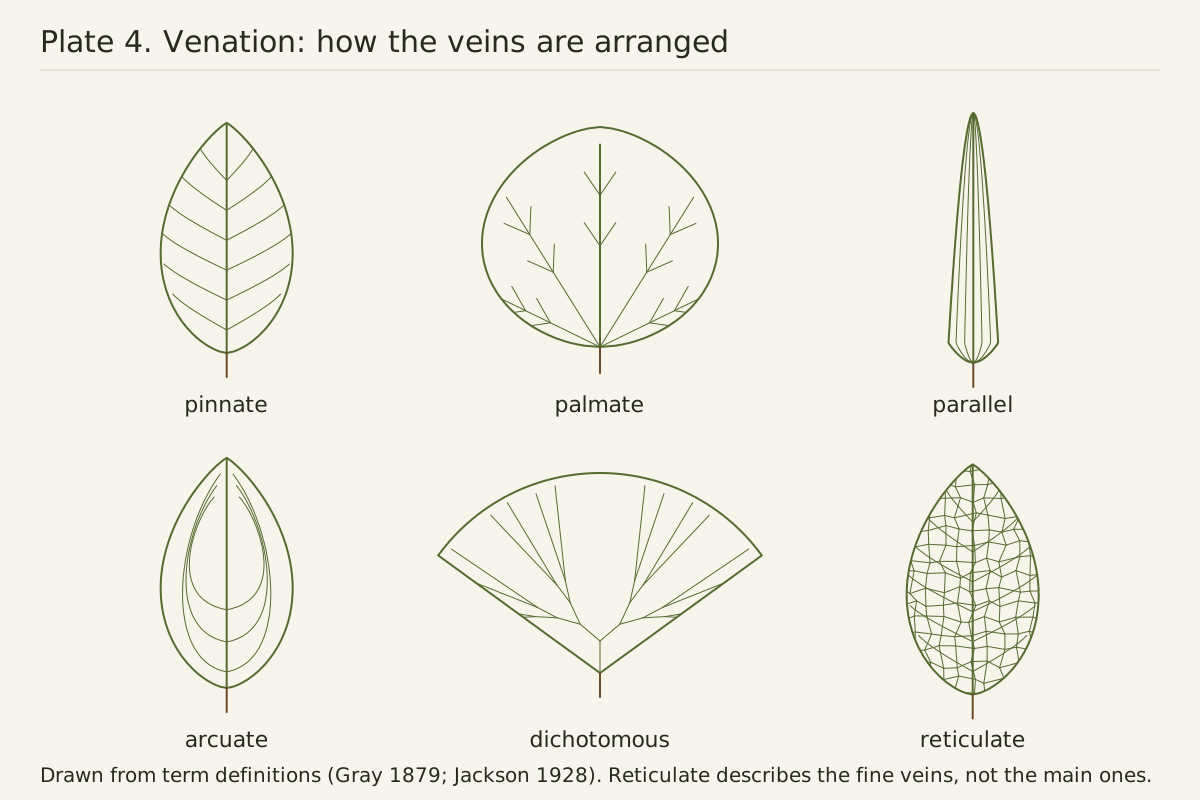
Plate 4. Six vein patterns drawn from their definitions; reticulate describes the fine veins, which can fill pinnate or palmate leaves.
"Plate 4. Venation: how the veins are arranged" by Botany for the Curious, https://botanyforthecurious.com/forms/leaf-shapes/, licensed under CC BY 4.0 (https://creativecommons.org/licenses/by/4.0/)data: definitions after B. D. Jackson, A Glossary of Botanic Terms, 4th ed. (1928), and A. Gray, Structural Botany (1879), computed 2026-10-21| Venation term | What it means | Example in Flora of China |
|---|---|---|
| pinnate | Side veins branch from one midrib, like a feather's barbs. | Machilus thunbergii (Japanese bay tree; stated for the whole genus) |
| palmate | Several main veins spread from the stalk's tip, like fingers. | Cercis chinensis (Chinese redbud; stated for the whole genus) |
| parallel | Main veins run side by side, usually from base to tip. | Phragmites australis (common reed; stated for the whole family) |
| arcuate | Main side veins bow outward and curve up toward the tip. | Cinnamomum wilsonii (Chinese name chuan gui) |
| dichotomous | Veins fork repeatedly into equal pairs. | Ginkgo biloba (ginkgo; stated for the whole family) |
| reticulate | Fine veins joined into a net. | Camellia sinensis (tea plant) |
In Gray's account, parallel veins are a tendency of whole groups of plants: he calls them especially characteristic of the monocotyledons, plants with a single seed leaf in the embryo, and also of the gymnosperm trees. Flora of China's account of the grass family gives parallel veins, sometimes with cross-connecting veinlets. Where the monocots sit among the land plants is shown in Plant Tree of Life.
The ginkgo shows how far the vocabulary can vary for one set of veins. Gray files it with the fan palms as flabellinerved, with straight ribs radiating from the top of the stalk; Jackson calls its venation diadromous, a fan-shaped pattern; and Flora of China describes the veins as parallel, close and dichotomous. The ginkgo's place on the tree of life, and why that tree has no rungs to rank it on, are covered in Ladder of Progress.
Lobed or compound?
Division measures how deep the cuts go. Gray's scale runs from lobed, cut no more than halfway, through cleft and parted, to divided, where the cuts sever the blade into distinct parts. In Jackson's glossary pinnatifid means pinnately cleft, and pinnatisect means cut right down to the central axis. Once the pieces are separate blades on a common stalk, the leaf is compound and the pieces are leaflets.
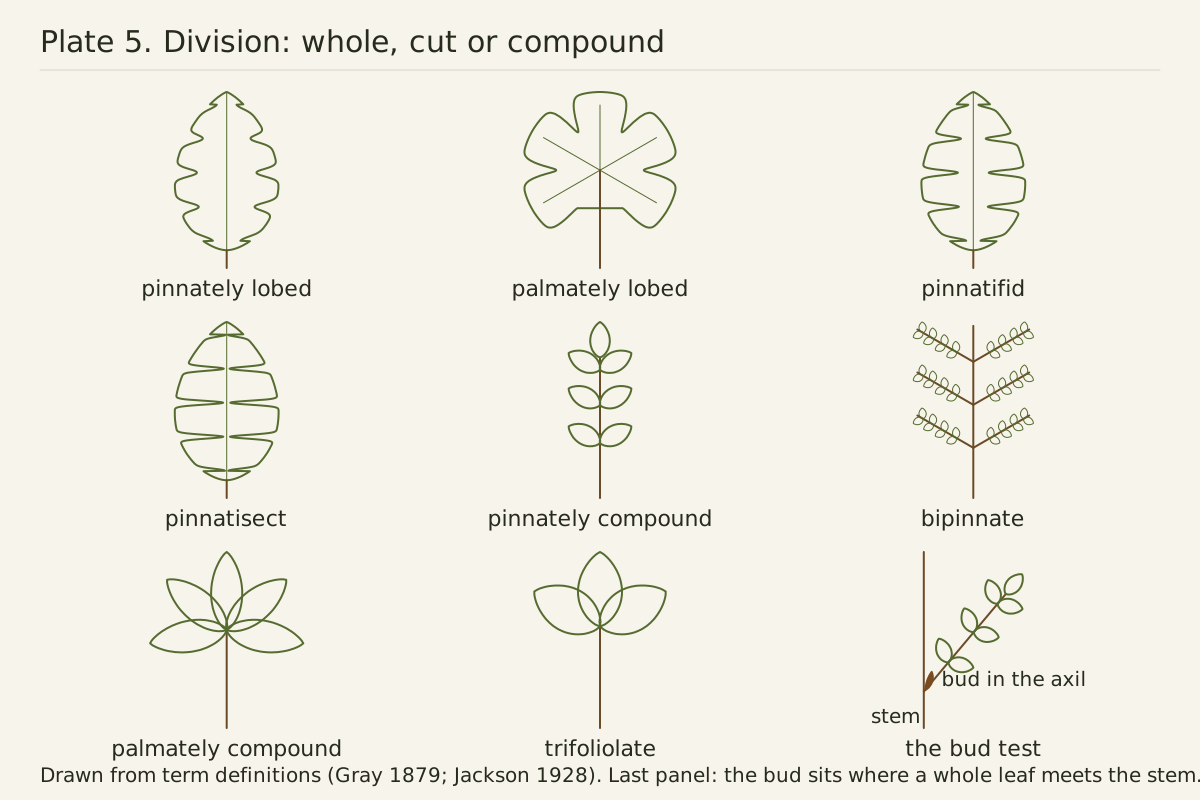
Plate 5. Eight degrees of division drawn from their definitions; the last panel shows a bud in the axil, below one whole compound leaf.
"Plate 5. Division: whole, cut or compound" by Botany for the Curious, https://botanyforthecurious.com/forms/leaf-shapes/, licensed under CC BY 4.0 (https://creativecommons.org/licenses/by/4.0/)data: definitions after B. D. Jackson, A Glossary of Botanic Terms, 4th ed. (1928), and A. Gray, Structural Botany (1879), computed 2026-10-21| Division term | What it means | Example in Flora of China |
|---|---|---|
| pinnately lobed | Lobes along the midrib, cut no more than halfway in. | Chrysanthemum indicum (Indian chrysanthemum) |
| palmately lobed | Lobes spread from the stalk's tip, cut no more than halfway. | Ricinus communis (castor bean) |
| pinnatifid | Pinnately cleft: the cuts reach halfway or more to the midrib. | Chrysanthemum indicum (Indian chrysanthemum) |
| pinnatisect | Cut pinnately right down to the midrib, the central axis. | Sonchus oleraceus (common sowthistle) |
| pinnately compound | Separate leaflets ranged along both sides of a common stalk. | Juglans regia (common walnut; stated for the whole genus) |
| bipinnate | Twice pinnate: each primary division is itself pinnate. | Albizia julibrissin (Persian silk tree; stated for the whole genus) |
| palmately compound | All the leaflets attached at the tip of the stalk. | Aesculus chinensis (Chinese horse chestnut; stated for the whole family) |
| trifoliolate | Compound, with three leaflets. | Trifolium repens (white clover) |
To tell a whole leaf from one leaflet, look for the bud: Gray's 1879 textbook notes that a bud usually sits in the axil of a leaf, the angle where the leaf stalk meets the stem. Follow the stalk back to the stem. If the bud sits below a whole set of blades, they are leaflets of one compound leaf. Gray also warns that the line between simple and compound "cannot be both natural and absolute", though most leaves leave no doubt.
The English oak in the photo below has a simple, lobed blade. Flora of China describes Quercus robur with five to seven rounded or retuse lobes on each side and a base that is narrowly rounded to auriculate.
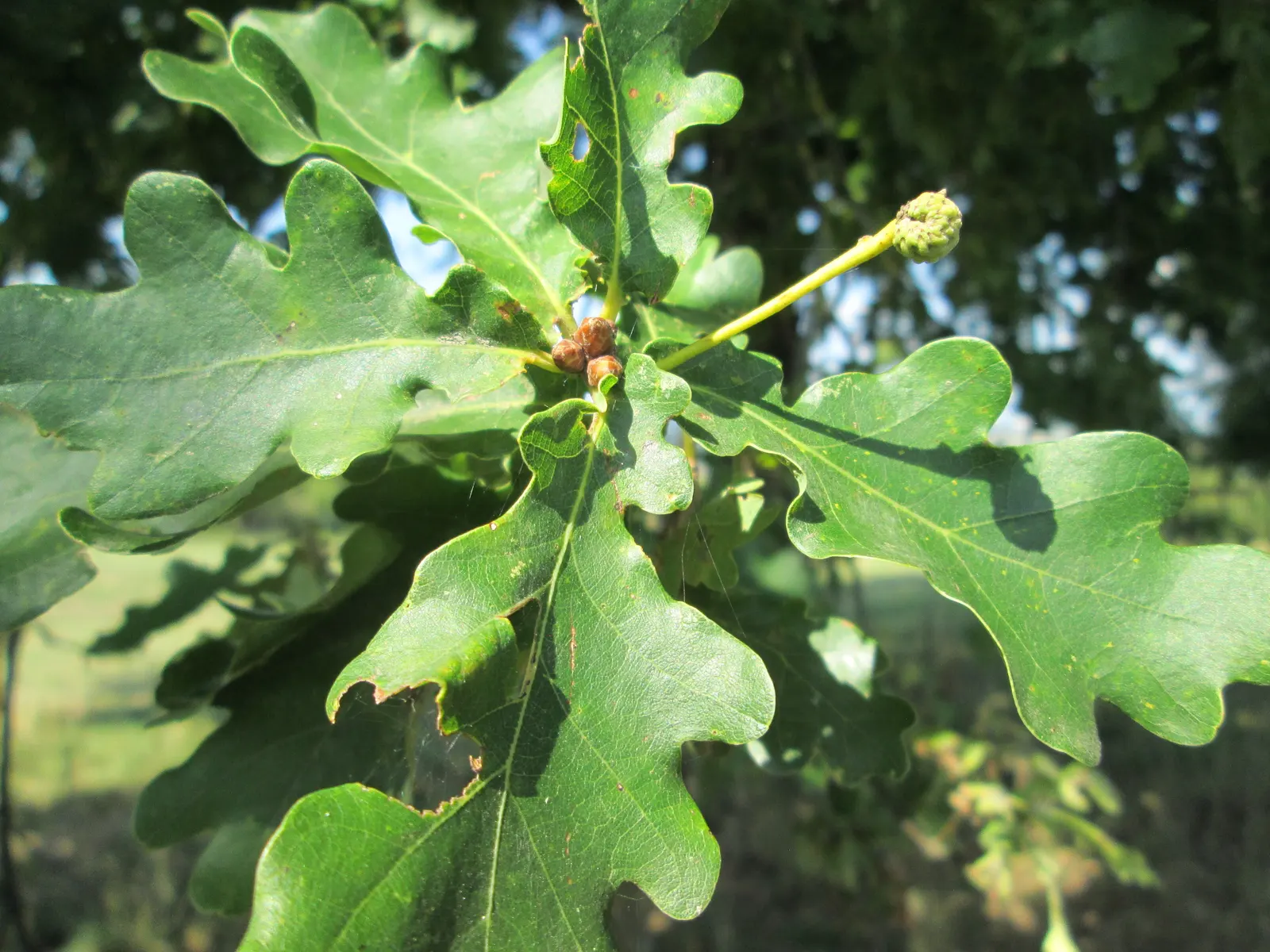
Leaves of English oak, Quercus robur, which Flora of China describes with five to seven rounded or retuse lobes on each side.
"20190826Quercus robur4" by AnRo0002 — https://commons.wikimedia.org/wiki/File:20190826Quercus_robur4.jpg — CC0 1.0 (https://creativecommons.org/publicdomain/zero/1.0/)
Terms people mix up
Ovate and obovate are mirror images. Find the widest point, then see which end it is nearer: nearer the stalk is ovate, nearer the tip is obovate. The prefix "ob-" means inverse in Jackson's glossary, and it works the same way in obcordate and oblanceolate.
Serrate and dentate are both toothed. In Gray's usage, followed here, serrate teeth lean toward the tip like a saw and dentate teeth point straight out, though Jackson's 1928 definition of dentate does not draw that line.
A lobed leaf and a compound leaf can look alike from a distance. A lobed blade is one continuous piece, however deep the cuts. In a compound leaf the leaflets are separate blades, and Gray notes that they may sit directly on the common stalk or have small stalks of their own; either way, the bud sits below the whole leaf.
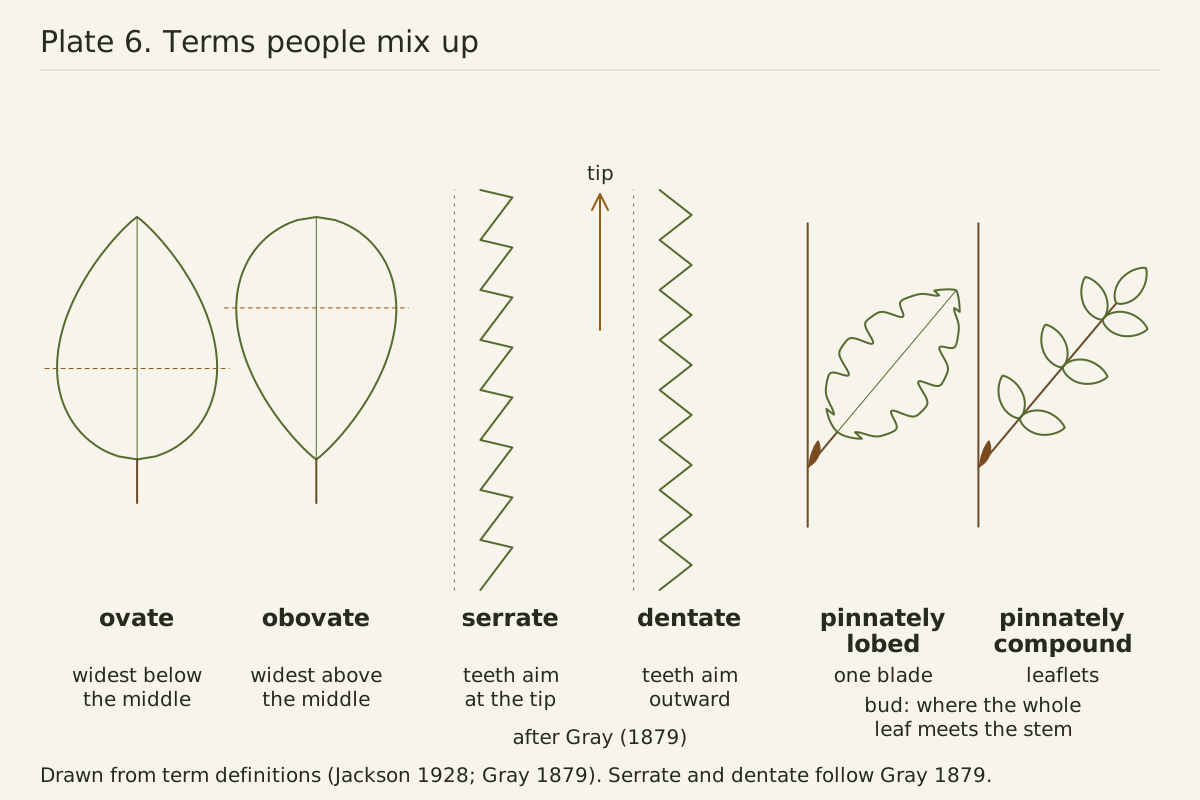
Plate 6. Three pairs that are easy to confuse: which end is broader, which way the teeth point, and whether the blade is one piece.
"Plate 6. Terms people mix up" by Botany for the Curious, https://botanyforthecurious.com/forms/leaf-shapes/, licensed under CC BY 4.0 (https://creativecommons.org/licenses/by/4.0/)data: definitions after B. D. Jackson, A Glossary of Botanic Terms, 4th ed. (1928), and A. Gray, Structural Botany (1879), computed 2026-10-21When one word is not enough
Most leaves fit the grammar, but some resist a single phrase. One plant can carry more than one leaf form: Flora of China describes ginkgo leaves on long shoots as split by a deep notch into two lobes, and those on short shoots as notched at the apex.
A hyphen or a range is part of the grammar too: it tells the reader that the leaf sits between two words. Flora of China joins terms this way when a leaf falls between two of them, describing the tea plant's blade as elliptic, oblong-elliptic or oblong, and the lamb's quarters blade as rhombic-ovate to broadly lanceolate.
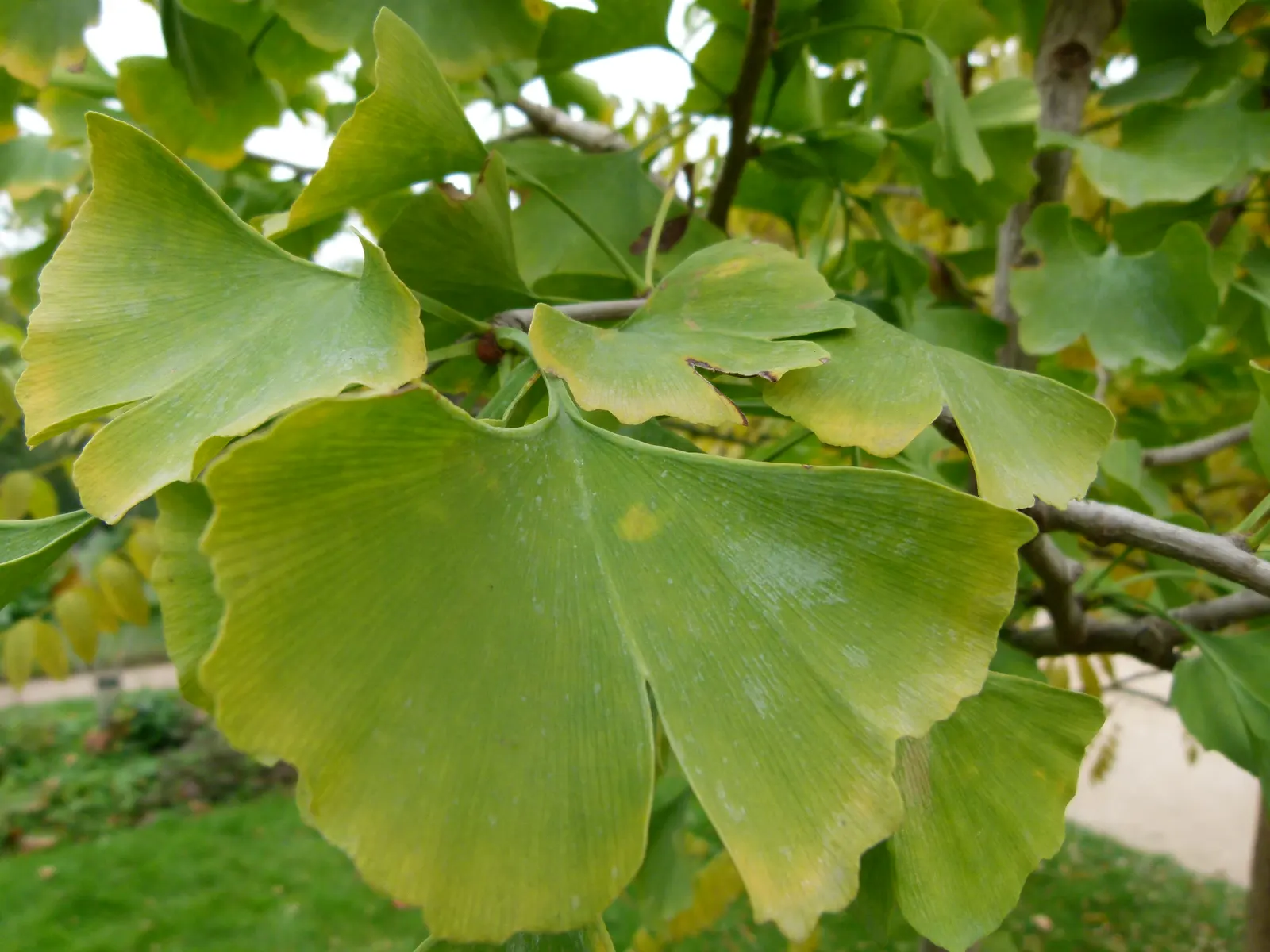
Ginkgo leaves on a branch, photographed in October 2011; the large blade at the centre has a deep notch in its outer edge.
"Feuilles de Gingko Biloba" by Dinkum — https://commons.wikimedia.org/wiki/File:Feuilles_de_Gingko_Biloba.jpg — CC0 1.0 (https://creativecommons.org/publicdomain/zero/1.0/)
Sources
- Jackson, B. D. (1928). A Glossary of Botanic Terms with Their Derivation and Accent, 4th edition, revised and enlarged. London: Gerald Duckworth; New York: Hafner Publishing. Reprinted January 1953. https://archive.org/details/glossaryofbotani1928jack entries cited by page in the terms table, 4th edition (1953 reprint); p. 106 checked on the printed page
- Gray, A. (1879). Gray's Botanical Text-Book, 6th edition, vol. 1: Structural Botany, or Organography on the Basis of Morphology. New York: American Book Company (later printing of the edition copyrighted 1879). https://archive.org/details/graysbotanicalte01gray pp. 43 and 90-101 (leaf venation, outline, extremity, margin, lobation and compound leaves); pp. 98 and 100 checked on the printed page
- Flora of China, online edition at eFloras.org. Species, genus and family treatments cited by volume, page and taxon number in the terms table and on this page. http://www.efloras.org/flora_page.aspx?flora_id=2 leaf descriptions in 40 treatments (33 species, 4 genera, 3 families), cited in the terms table and on this page
- Linnaeus, C. (1751). Philosophia Botanica, 1st edition, Tab. I, leaf figures drawn by J. G. Hallman. https://commons.wikimedia.org/wiki/File:Philosophia_botanica_1751_Tab_1.JPG plate image only, as reproduced on Wikimedia Commons
- The World Checklist of Vascular Plants (WCVP), version 16.0 (2026-06-04). Facilitated by the Royal Botanic Gardens, Kew. CC BY 3.0. doi:10.34885/egs6-cp24. https://doi.org/10.34885/egs6-cp24 names file: accepted status, authors and IPNI identifiers for the 40 species named on this page Text licence: CC BY 3.0
- World Flora Online Plant List, version 2026-06 (CC0). World Flora Online Consortium. doi:10.5281/zenodo.7460141. https://doi.org/10.5281/zenodo.7460141 name records for the 40 species named on this page
- English Wikipedia, articles on the example species in the tables on this page, consulted for English common names only (read 2026-10-21); the article behind each name is listed per row in the terms table (CSV, column common_name_source). https://en.wikipedia.org/ lead sections of the species articles; names summarized here
- English Wikipedia, "Fagus sylvatica" (read 2026-10-21). https://en.wikipedia.org/wiki/Fagus_sylvatica lead section; the common name European beech, summarized here
- English Wikipedia, "Sweet chestnut" (read 2026-10-21). https://en.wikipedia.org/wiki/Sweet_chestnut lead section; the common name sweet chestnut for Castanea sativa, summarized here
Related
- Fibonacci in Nature: The Sunflowers That Break the Sequence Deep explainer
- Inflorescence Types: The First Flower to Open Is the Clue Specimen entry
Cite this page
Botany for the Curious. “Leaf Shapes: A Leaf's Name Is a Phrase, Not a Single Word.” Published 2026-10-22; last substantive revision 2026-10-22. https://botanyforthecurious.com/forms/leaf-shapes/ (accessed: add the date you read it).
- Published
- Last substantive revision