Plant Forms & StructuresSpecimen entry
Inflorescence Types: The First Flower to Open Is the Clue
- Published
- Last substantive revision
Spec card
- Term
- Inflorescence (racemose and cymose types)Source: Jackson 1928; Gray 1879
- Example species
- Daucus carota (wild carrot): compound umbelSource: Flora of China vol. 14 (Daucus); WCVP (Kew); World Flora Online
- Structure
- Flowering shoot: the floral axis and the flowers it carriesSource: Jackson 1928; Gray 1879
- Not to be confused with
- A single flower; a flower head (capitulum) is many floretsSource: Jackson 1928; Gray 1879
- Diagrams
- Plates 1–5
Download this card as CSV inflorescence-types-spec-card.csv data: B. D. Jackson (1928) and A. Gray (1879), retrieved 2026-10-21; Flora of China vol. 14, Daucus (taxon 109376), retrieved 2026-10-21; WCVP (Kew), CC BY 3.0, doi:10.34885/egs6-cp24, retrieved 2026-10-21; World Flora Online Plant List 2026-06 (CC0), retrieved 2026-10-21
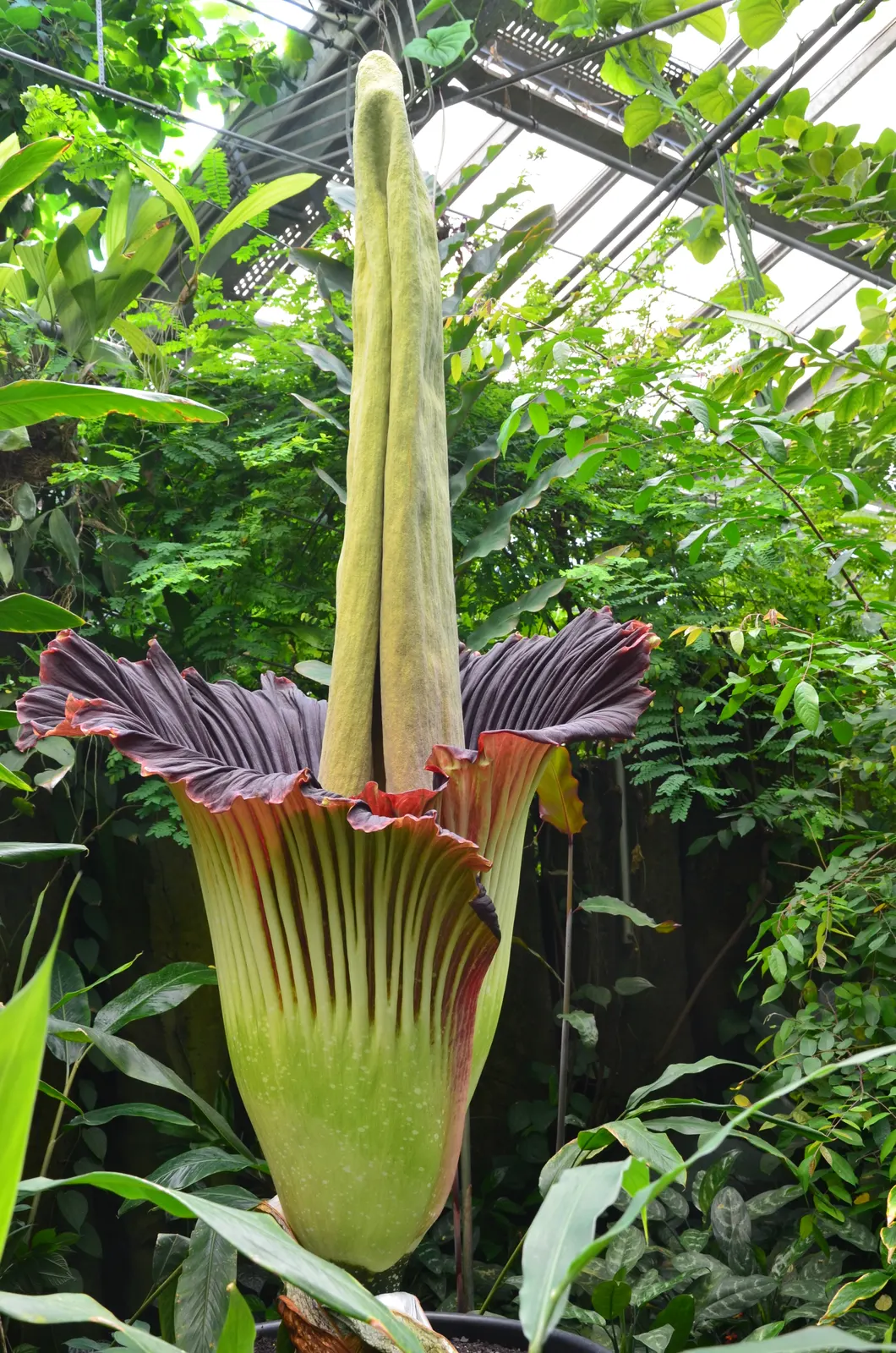
A titan arum, Amorphophallus titanum, in flower at the University of Bayreuth's botanical garden, Germany, in June 2015.
"Titan Arum at Bayreuth University 19" by Fbianh — https://commons.wikimedia.org/wiki/File:Titan_Arum_at_Bayreuth_University_19.JPG — CC0 1.0 (https://creativecommons.org/publicdomain/zero/1.0/)
Most inflorescences belong to one of two families, and the first flower to open usually tells you which. An inflorescence is the arrangement of flowers on a flowering shoot and, less strictly, the cluster itself. In the racemose family the main axis keeps growing, so its lowest or outermost flowers are the oldest and usually open first. In the cymose family the axis ends in a flower, and that top or central flower usually opens before the rest.
Both families, and the 15 named types inside them, are defined here after Asa Gray's textbook of 1879 and B. D. Jackson's glossary of 1928. Plates 1 to 4 draw them, and each type comes with a species whose Flora of China account uses the term; Sources and Standards explains how the plates are checked. The corpse flower in the photo is an inflorescence too.
Download Download the terms table (CSV) inflorescence-types-terms.csv data: definitions after B. D. Jackson, A Glossary of Botanic Terms, 4th ed. (1928), and A. Gray, Structural Botany (1879), computed 2026-10-21; Flora of China (eFloras), volume, page and taxon references only, retrieved 2026-10-21; WCVP (Kew), CC BY 3.0, doi:10.34885/egs6-cp24, retrieved 2026-10-21; World Flora Online Plant List 2026-06 (CC0), retrieved 2026-10-21; English common names after English Wikipedia species articles, addresses listed per row, retrieved 2026-10-21
One stem, many flowers
An inflorescence has its own small vocabulary of parts. In Gray's terms, the stalk of a whole cluster is the peduncle, the stalk of a single flower is the pedicel, and the axis that runs through a long cluster is the rachis. A bract is a leaf that sits below a flower or a cluster, usually different in shape or size from the ordinary leaves. A ring of bracts around a cluster is an involucre, and a single large bract that encloses one is a spathe.
Read a flower cluster part by part, the way Leaf Shapes reads a leaf: first the axis, then the stalks, then the bracts. In wild carrot, Daucus carota, the stalks of the main cluster spread from one point. Each ends in a smaller cluster of white flowers. Flora of China describes the umbels of the carrot genus as loosely compound, with many-flowered umbellets.
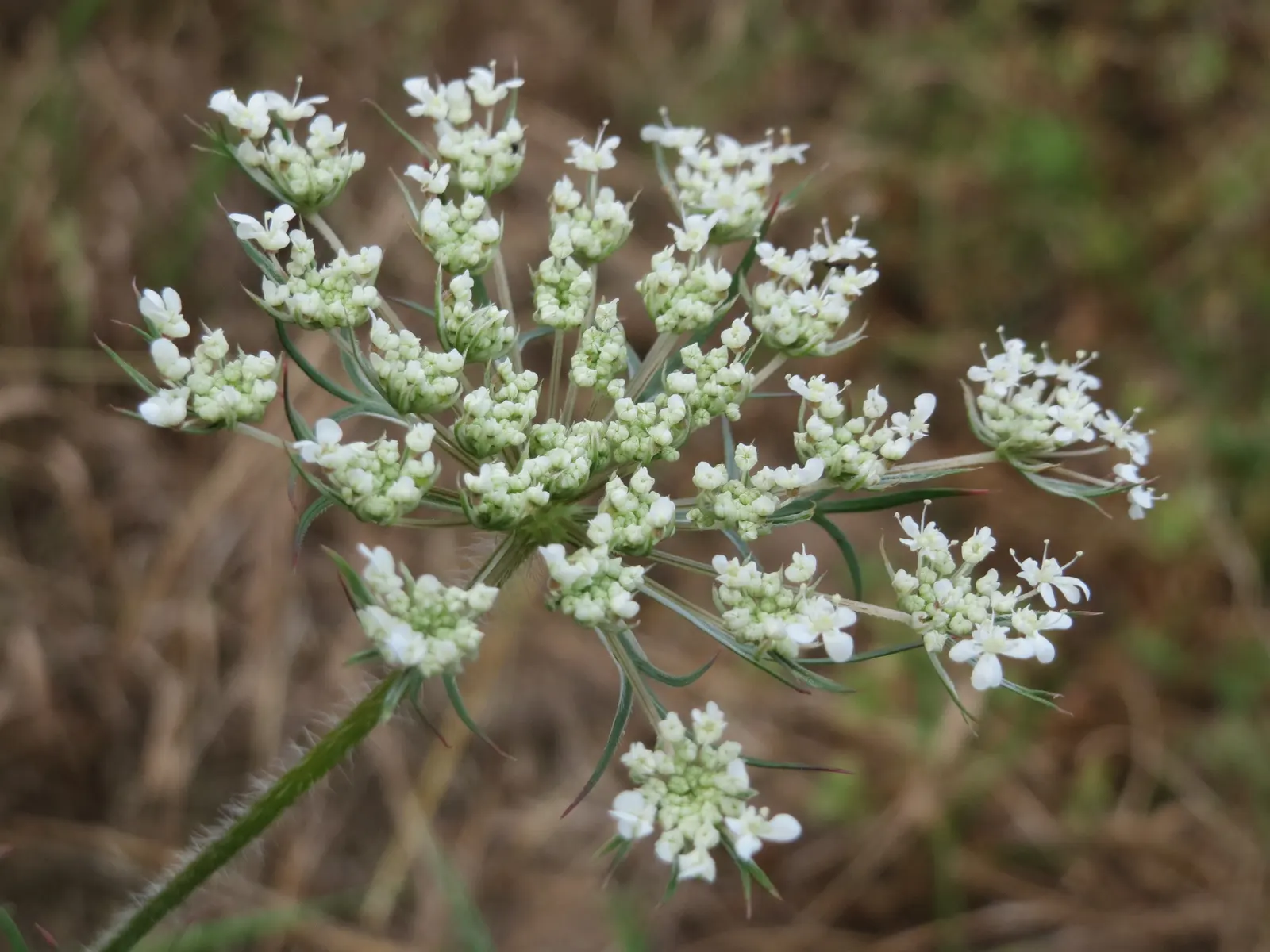
Wild carrot, Daucus carota, seen from above: each stalk of the main umbel ends in a smaller umbel of white flowers.
"20150721Daucus carota1" by AnRo0002 — https://commons.wikimedia.org/wiki/File:20150721Daucus_carota1.jpg — CC0 1.0 (https://creativecommons.org/publicdomain/zero/1.0/)
A cluster easily taken for a single flower is the head, or capitulum. Gray noted that earlier botanists called the head of the daisy family a compound flower, and that its ring of bracts imitates a calyx while its strap-shaped corollas imitate petals. Flora of China gives one head of common sunflower, Helianthus annuus, usually 17 to 30 ray florets and 150 to 1,000 disc florets, so one sunflower head holds well over a hundred flowers. How those florets fall into spirals is the subject of Fibonacci in Nature.
A dried flowering stem with loose petals scattered above it: one flowering shoot can carry many flowers.
Illustration: Botany for the Curious. Generated schematic image — not a photograph or botanical record. Reuse terms: no license is granted; any rights Botany for the Curious holds in this image are reserved.Which flower opens first?
Gray put the racemose rule in one line: "The lower flower-buds are evidently the oldest, and accordingly the first to expand." A racemose axis goes on adding flowers toward its tip, so opening runs from the bottom up. When the cluster is flat, as in a corymb or an umbel, the same order runs from the rim to the centre.
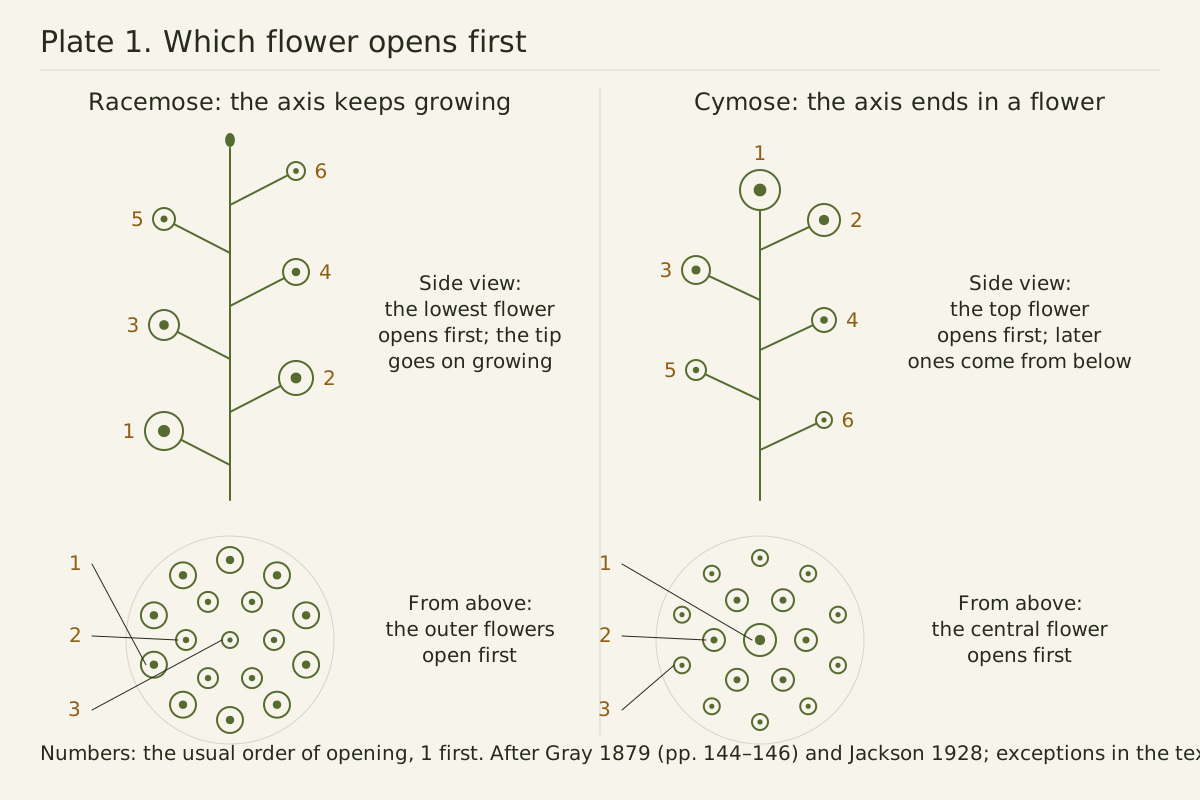
Plate 1. The usual order of opening in the two families, numbered from the first flower to open; drawn from the definitions in Gray's 1879 textbook.
"Plate 1. Which flower opens first" by Botany for the Curious, https://botanyforthecurious.com/forms/inflorescence-types/, licensed under CC BY 4.0 (https://creativecommons.org/licenses/by/4.0/)data: definitions after B. D. Jackson, A Glossary of Botanic Terms, 4th ed. (1928), and A. Gray, Structural Botany (1879), computed 2026-10-21In a cymose cluster the main axis ends in a flower, which opens first, and any later flowers grow from side branches below it. On an upright stem the order descends; on a flat-topped cluster it runs from the centre outward. Foxglove, Digitalis purpurea, shows the racemose order. In Flora of China, the foxglove genus bears its flowers in terminal, often one-sided racemes.
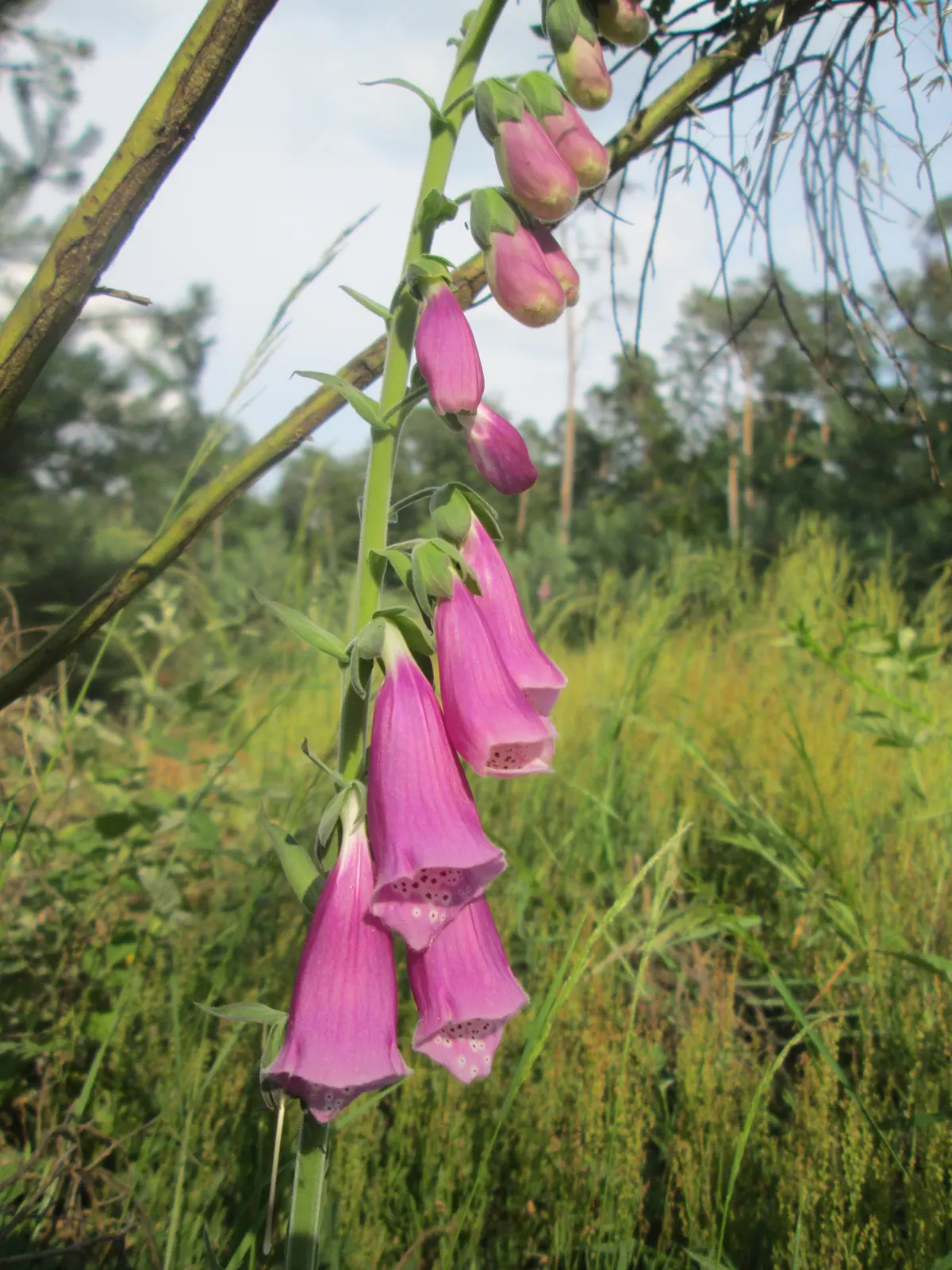
Foxglove, Digitalis purpurea, with its lower flowers open and its upper ones still in bud.
"20180607Digitalis purpurea08" by AnRo0002 — https://commons.wikimedia.org/wiki/File:20180607Digitalis_purpurea08.jpg — CC0 1.0 (https://creativecommons.org/publicdomain/zero/1.0/)
The clue usually holds, with exceptions. Gray wrote that the two families sometimes pass into each other and are not uncommonly combined in one large cluster. He noted that in elder and in hydrangeas, the genus Hydrangea, all the buds of a cyme form before the oldest flowers open, so the whole cluster blooms at almost the same time. A head of teasel, Dipsacus, starts flowering in the middle, and in dense blazing star, Liatris spicata, the heads along the stem open in an almost regular order from the top down.
The racemose family
Gray points out that the racemose names were fixed from Linnaeus's time on but defined without reference to the order in which the flowers open. In all of the types below, the main axis does not end in a flower.
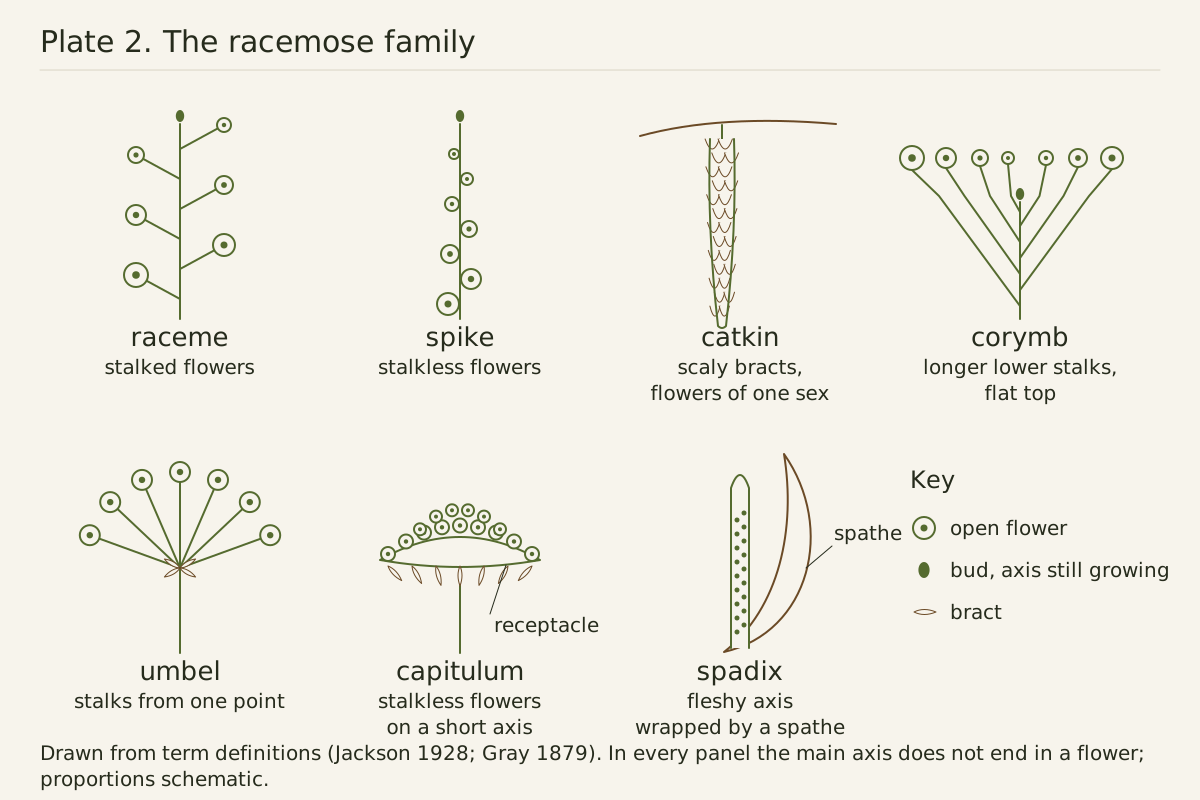
Plate 2. Seven racemose types drawn from their definitions; in each, the main axis does not end in a flower.
"Plate 2. The racemose family" by Botany for the Curious, https://botanyforthecurious.com/forms/inflorescence-types/, licensed under CC BY 4.0 (https://creativecommons.org/licenses/by/4.0/)data: definitions after B. D. Jackson, A Glossary of Botanic Terms, 4th ed. (1928), and A. Gray, Structural Botany (1879), computed 2026-10-21| Racemose term | What it looks like | Example in Flora of China |
|---|---|---|
| raceme | Flowers on stalks of about equal length along a long, unbranched axis. | Digitalis purpurea (foxglove; stated for the whole genus) |
| spike | Like a raceme, but the flowers sit on the axis without stalks. | Plantago major (greater plantain) |
| catkin | A spike of unisexual flowers among scaly bracts, usually shed whole. | Salix babylonica (weeping willow) |
| corymb | A racemose cluster whose lower stalks are longer, so the top is flat or domed. | Crataegus pinnatifida (Chinese hawthorn) |
| umbel | Flower stalks of about equal length, all rising from one point. | Primula malacoides (fairy primrose) |
| capitulum | A head: stalkless flowers crowded on a short axis, the receptacle. | Helianthus annuus (common sunflower) |
| spadix | A spike with a thick, fleshy axis, usually wrapped in a large bract, the spathe. | Amorphophallus konjac (konjac) |
The difference between a raceme and a spike is in the flower stalks: each flower of a raceme has its own pedicel, while the flowers of a spike sit directly on the axis. Gray treats several types as points on one scale. An umbel whose stalks shorten becomes a head, and a head whose axis lengthens becomes a spike. A spadix is a spike with a fleshy axis, a name that Gray says is almost restricted to the arum family and palms.
A catkin is a spike of flowers of one sex among scaly bracts, and Gray adds that catkins usually fall off in one piece. Jackson's glossary lists the hazel among catkin-bearing plants. Flora of China describes the male clusters of the hazel genus as hanging and cylindric, with many overlapping bracts, each usually holding one male flower; the female flowers form a compact cluster of several flowers. Below is common hazel, Corylus avellana.
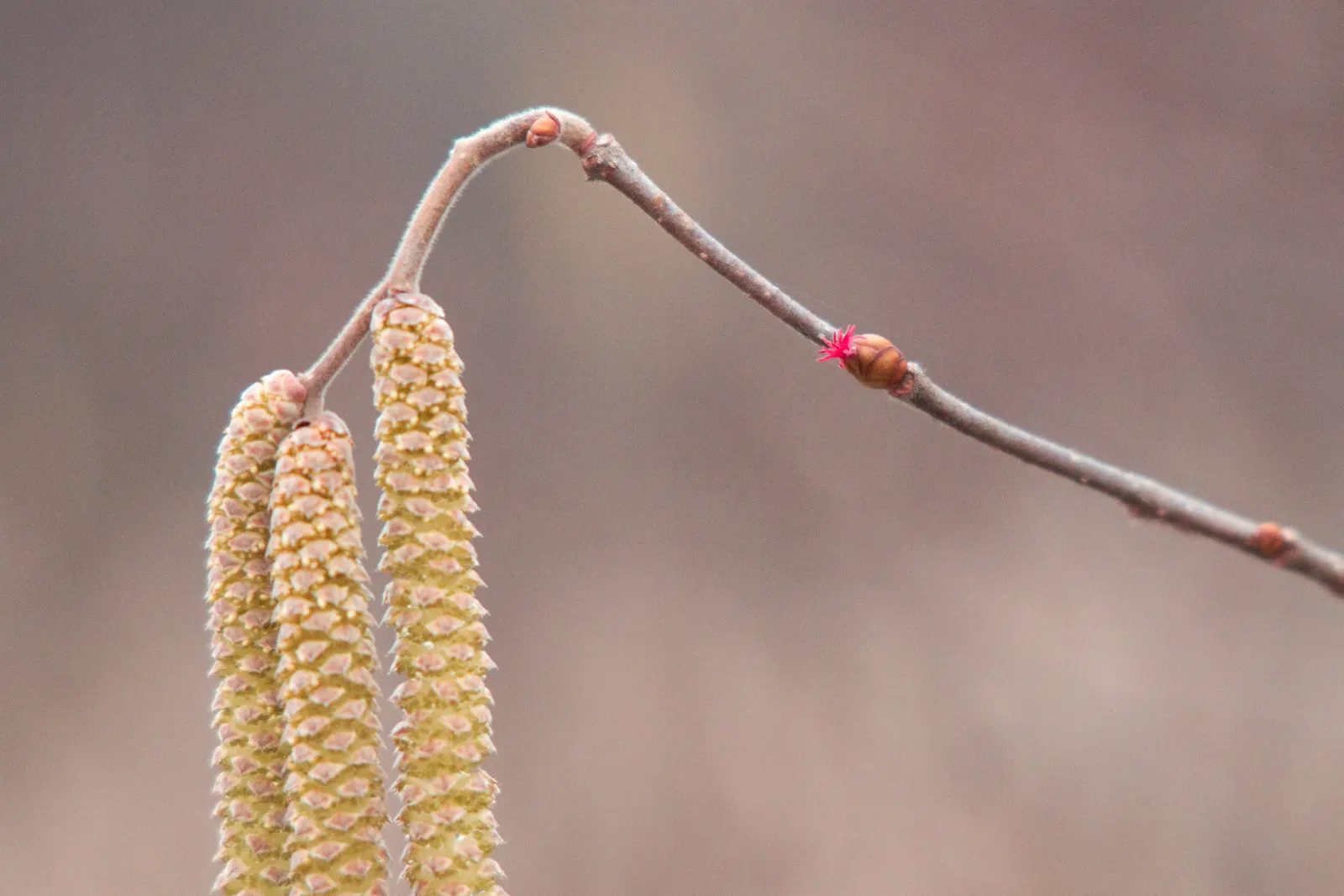
Common hazel, Corylus avellana, in February: hanging male catkins and, on the twig, a female flower cluster with red styles.
"Corylus avellana male and female flowers 2" by Nefronus — https://commons.wikimedia.org/wiki/File:Corylus_avellana_male_and_female_flowers_2.jpg — CC0 1.0 (https://creativecommons.org/publicdomain/zero/1.0/)
The cymose family
In a cyme every axis ends in a flower. New flowers come only from side branches. Gray sorts cymes by counting those branches: one below each flower in a monochasium, two in a dichasium, three or more in a pleiochasium. He credits the three names to Eichler, and Jackson's glossary, which has the first two, calls the third a multiparous cyme.
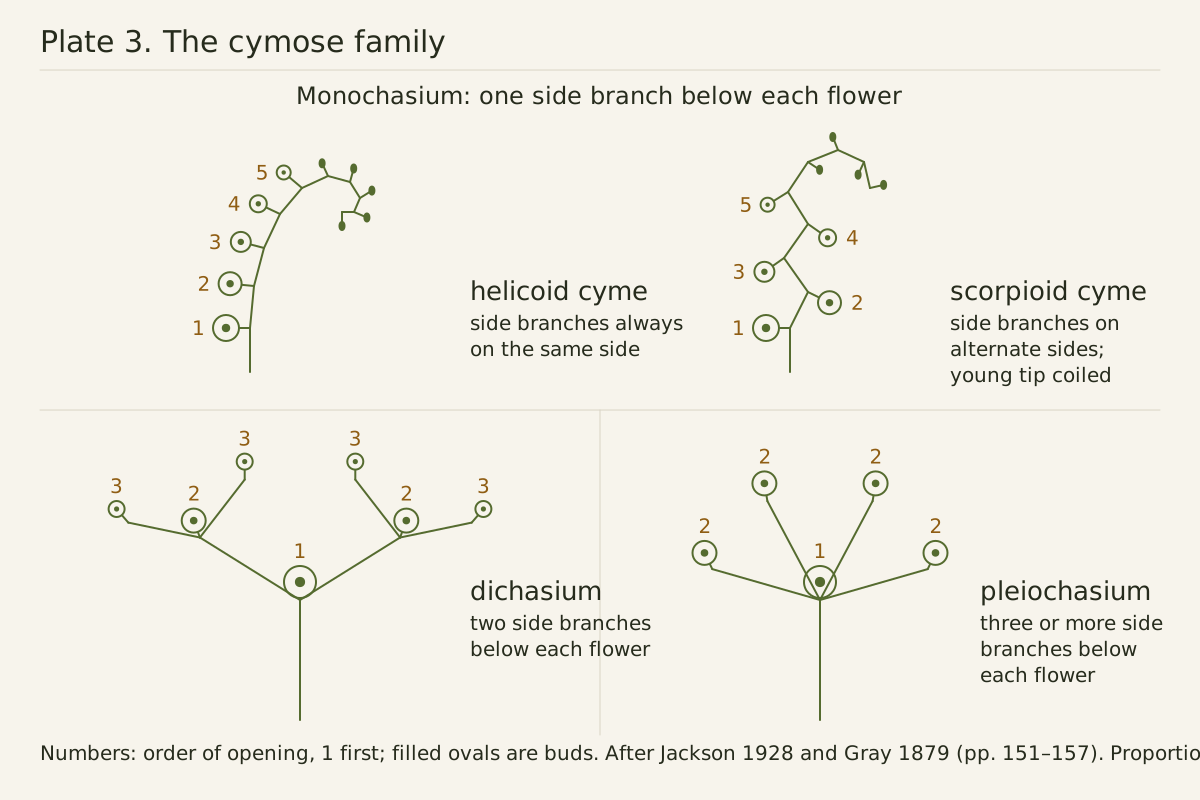
Plate 3. Four cymose inflorescences drawn from their definitions: the helicoid and scorpioid cymes, both monochasia, with a dichasium and a pleiochasium; numbers give the order in which the flowers open.
"Plate 3. The cymose family" by Botany for the Curious, https://botanyforthecurious.com/forms/inflorescence-types/, licensed under CC BY 4.0 (https://creativecommons.org/licenses/by/4.0/)data: definitions after B. D. Jackson, A Glossary of Botanic Terms, 4th ed. (1928), and A. Gray, Structural Botany (1879), computed 2026-10-21| Cymose term | What it looks like | Example in Flora of China |
|---|---|---|
| monochasium | A cyme in which each flowering axis gives rise to a single side branch. | Ranunculus repens (creeping buttercup) |
| helicoid cyme | A monochasium whose side branches all form on the same side, so it coils. | Hemerocallis fulva (orange day-lily) |
| scorpioid cyme | A monochasium whose side branches form on alternate sides; the young tip is coiled. | Heliotropium europaeum (European heliotrope) |
| dichasium | A terminal flower with two side branches below it, the pattern repeating on each. | Silene latifolia (white campion) |
| pleiochasium | A cyme with three or more side branches below each terminal flower. | Rodgersia aesculifolia (Chinese name qi ye gui deng qing) |
A monochasium can fool the clue. When each new branch forms on the same side, the cluster coils into a helicoid cyme; when the branches alternate, it tends to zigzag as a scorpioid cyme, named for a tip that is curled like a scorpion's tail when young. Gray describes the younger end as the coiled one, so the older flowers sit lower down and the cluster passes for a raceme. He notes that earlier botanists described these one-sided clusters as racemes or spikes.
The two coil names have also been mixed up. Gray in 1879 preferred scorpioid as a general name for both, while Jackson's 1928 glossary says some textbooks wrongly call a helicoid cyme scorpioid. According to Flora of China, the cymes of the forget-me-not genus become raceme-like after flowering. The photo shows the curled tip of changing forget-me-not, Myosotis discolor.
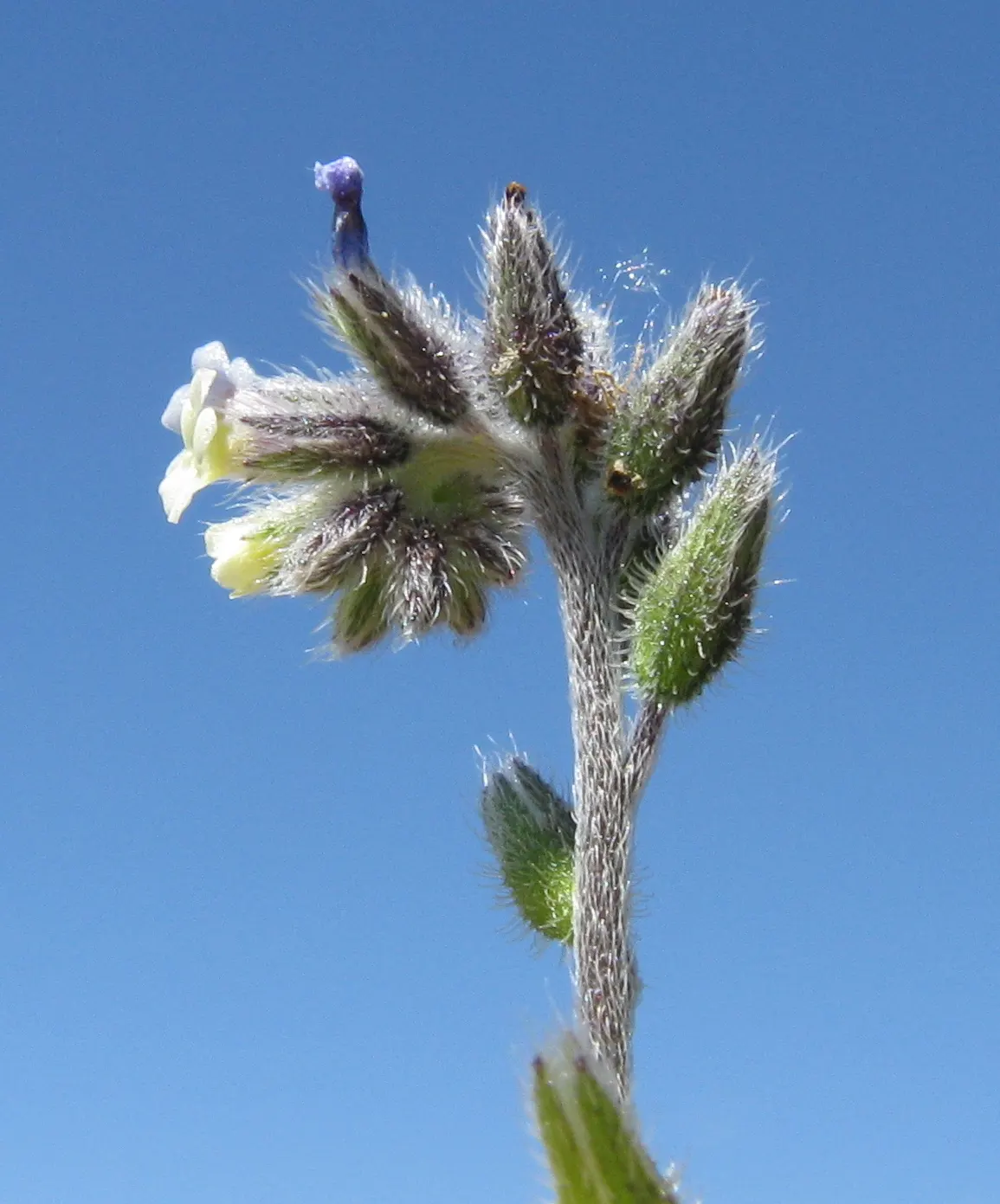
The coiled tip of a flower cluster of changing forget-me-not, Myosotis discolor, with its first flowers open below the buds.
"Myosotis discolor flowerhead1 ST (14999519453)" by Harry Rose — https://commons.wikimedia.org/wiki/File:Myosotis_discolor_flowerhead1_ST_(14999519453).jpg — CC BY 2.0 (https://creativecommons.org/licenses/by/2.0/)
Mixed and compound types
Large clusters often combine the two plans. In its simplest form a panicle is a raceme whose lower stalks branch and carry several flowers, though Gray admits the name is used for almost any loose, branched cluster. The difference between a raceme and a panicle is in those stalks: each stalk of a raceme carries one flower, while the lower stalks of a panicle carry several.
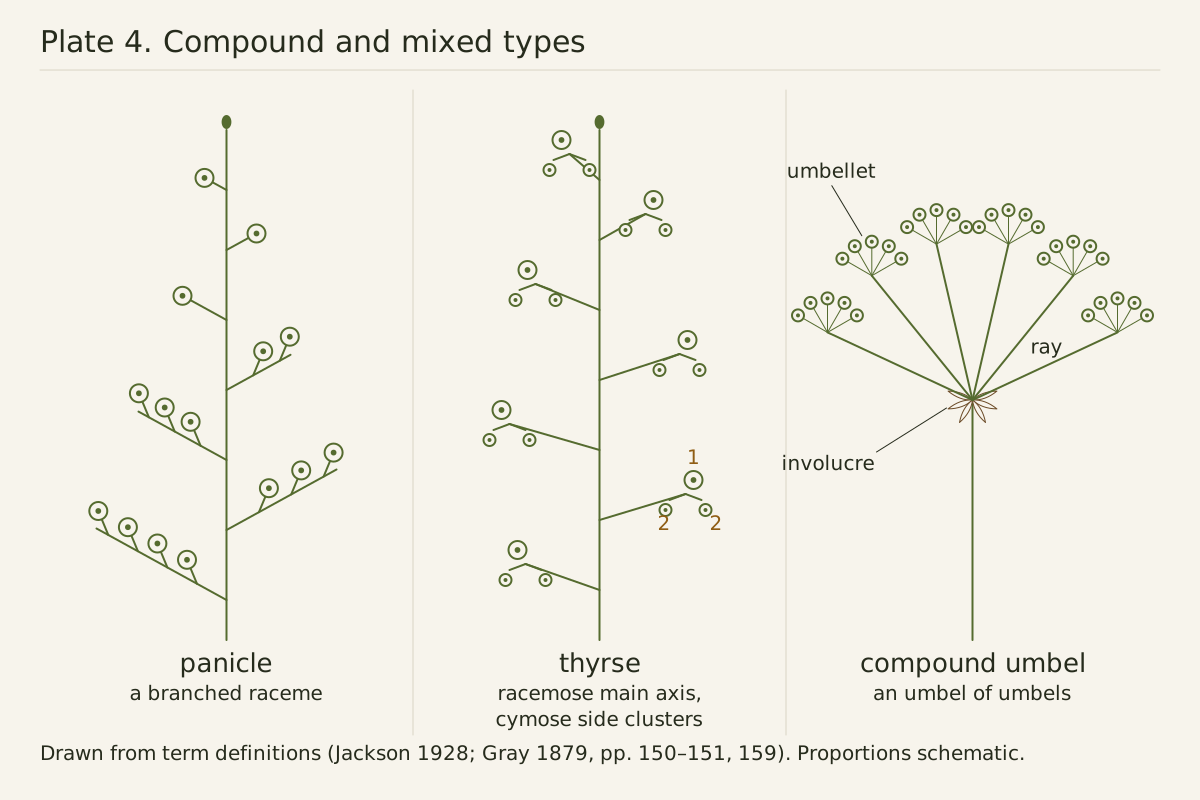
Plate 4. A panicle, a thyrse and a compound umbel, drawn from their definitions.
"Plate 4. Compound and mixed types" by Botany for the Curious, https://botanyforthecurious.com/forms/inflorescence-types/, licensed under CC BY 4.0 (https://creativecommons.org/licenses/by/4.0/)data: definitions after B. D. Jackson, A Glossary of Botanic Terms, 4th ed. (1928), and A. Gray, Structural Botany (1879), computed 2026-10-21| Compound or mixed term | What it looks like | Example in Flora of China |
|---|---|---|
| panicle | A branched raceme: the lower stalks branch again and carry several flowers. | Poa annua (annual meadow grass) |
| thyrse | A mixed cluster: a raceme-like main axis whose side branches are small cymes. | Aesculus hippocastanum (horse chestnut) |
| compound umbel | An umbel of umbels: each ray ends in a smaller umbel, an umbellet. | Daucus carota (wild carrot; stated for the whole genus) |
A thyrse mixes the two families: its main axis grows on like a raceme, and each side branch ends in a small cyme. Gray gives lilac and horse chestnut as examples, and in Flora of China the horse chestnut thyrse is 10 to 30 cm long. The daisy family, Asteraceae, runs the other way round. In Gray's account its flowers sit in heads that open from the rim inward, while the heads themselves are arranged like a cyme.
A compound umbel is an umbel of umbels. In wild carrot each ray of the main umbel carries an umbellet, and a ring of divided bracts, the involucre, sits below the rays. Flora of China gives the carrot genus numerous pinnate bracts and many-flowered umbellets whose central flowers are usually sterile, with enlarged purple petals.
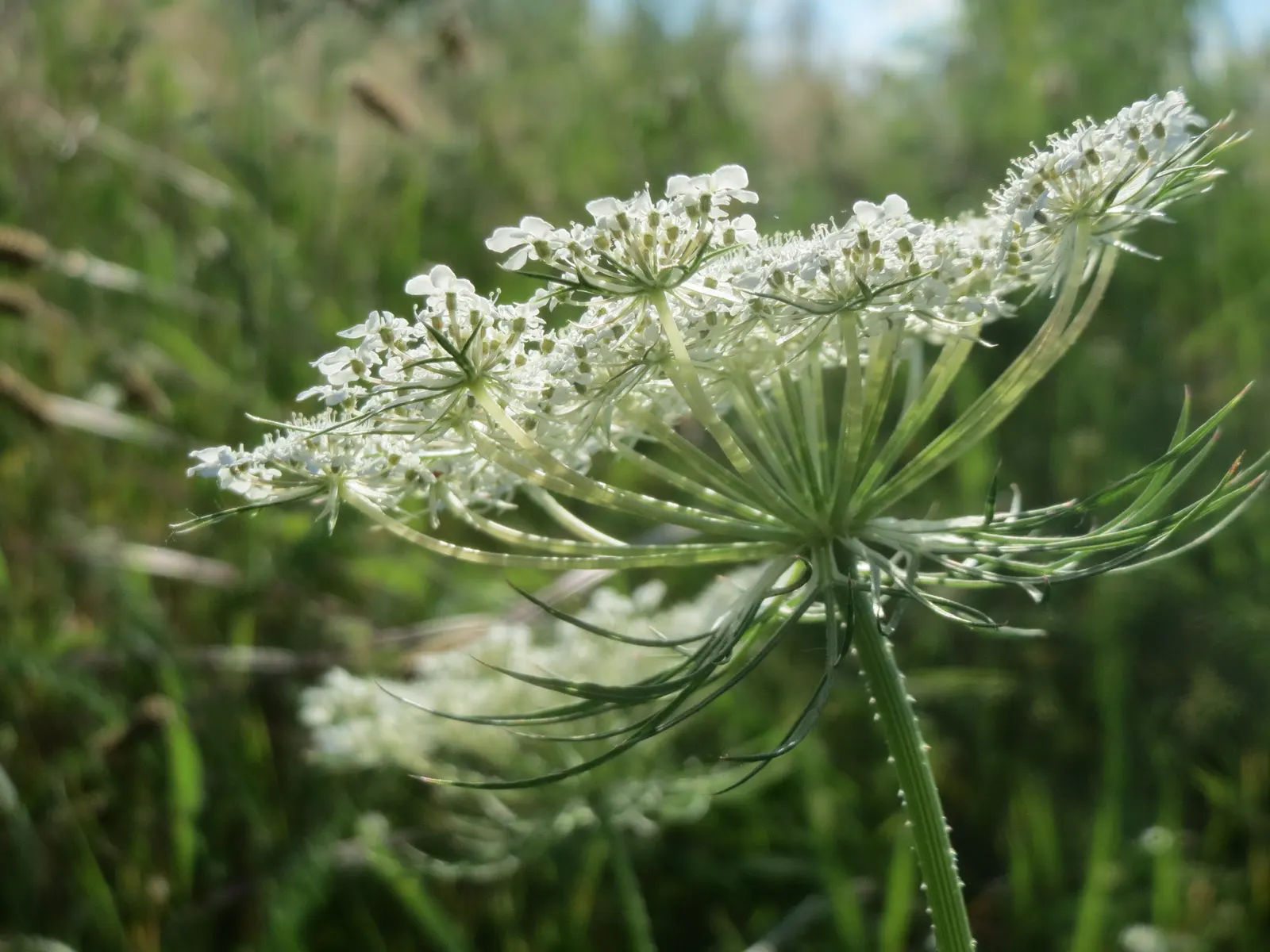
The underside of a wild carrot umbel: the rays spread from one point, above a ring of narrow, divided bracts.
"20160718Daucus carota2" by AnRo0002 — https://commons.wikimedia.org/wiki/File:20160718Daucus_carota2.jpg — CC0 1.0 (https://creativecommons.org/publicdomain/zero/1.0/)
Is the corpse flower a single flower?
The titan arum, Amorphophallus titanum, commonly known as the corpse flower, is not one flower but an inflorescence: a fleshy spadix wrapped at the base by a single huge bract, the spathe. Flora of China does not treat the titan arum itself, but its account of the genus divides the spadix into a female zone, a male zone and an appendix, with the base of the spathe rolled around it. Kirschner (2023), summarising research on heat production across the genus, places the female flowers lowest, the male flowers above them and the appendix on top (Plate 5). WCVP records the titan arum as native only to Sumatra, as of June 2026.
Barthlott and colleagues (2009) describe the bloom as up to 3 m high, and a 2024 study of its chemistry calls it the world's biggest unbranched inflorescence. Opening order matters here too. Korotkova and Barthlott (2009) describe two nights of flowering, a female phase on the first and a male phase on the second, with a phase of heating in each.
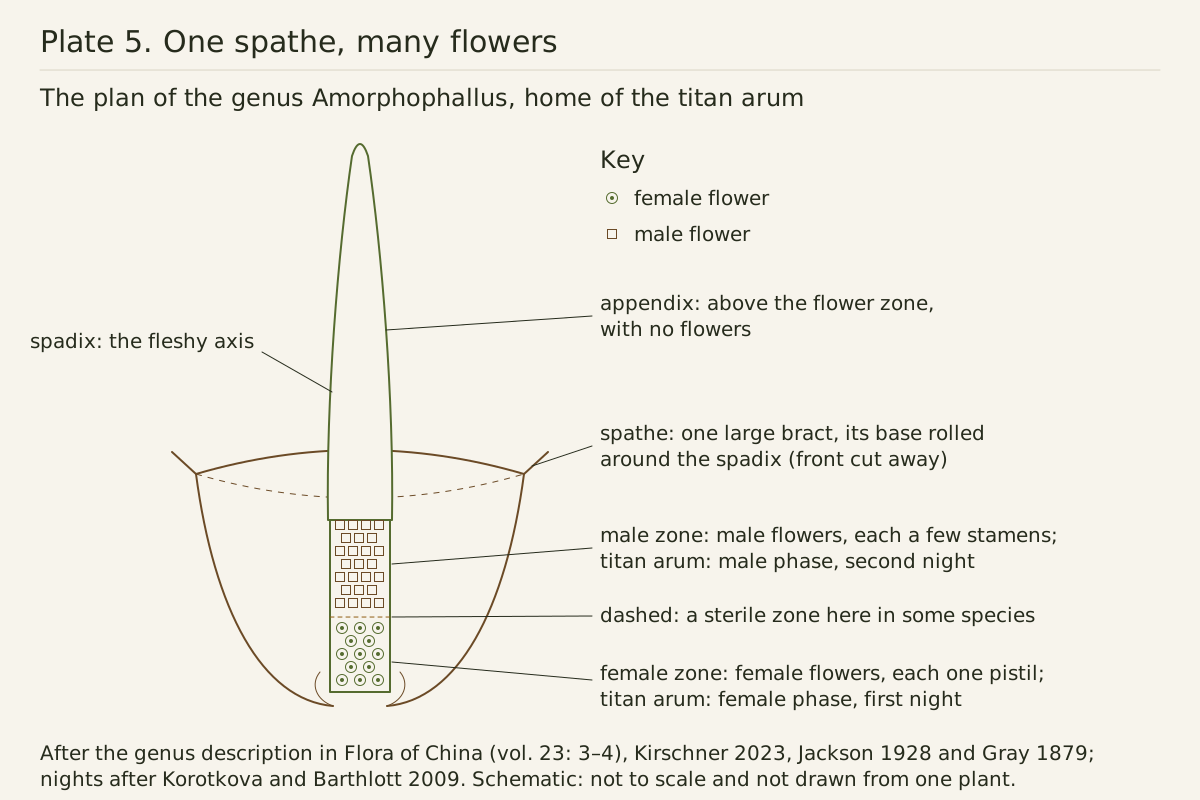
Plate 5. The plan of the genus Amorphophallus, home of the corpse flower: one spathe wraps a spadix with female flowers lowest, male flowers above them and a flowerless appendix on top.
"Plate 5. One spathe, many flowers" by Botany for the Curious, https://botanyforthecurious.com/forms/inflorescence-types/, licensed under CC BY 4.0 (https://creativecommons.org/licenses/by/4.0/)data: genus description of Amorphophallus in Flora of China, vol. 23: 3–4, retrieved 2026-10-21; order of the flower zones after G. K. Kirschner (2023), The Plant Journal 115: 872–873, retrieved 2026-10-21; flowering nights of the titan arum after N. Korotkova and W. Barthlott (2009), Plant Signaling & Behavior 4: 1096–1098, retrieved 2026-10-21; spathe and spadix after B. D. Jackson (1928) and A. Gray (1879), computed 2026-10-21In their 2009 study, Barthlott and colleagues filmed the spadix with a thermal camera and saw its surface warm in pulses from the base to over 36 °C in air at 27 °C, with waves of the carrion-like smell timed to the pulses. They suggest the plant creates its own convection. Shirasu and colleagues (2010), who describe the smell as one that draws insects for pollination, identified its main odorant during opening as dimethyl trisulfide, C2H6S3 (CID 19310 via Wikidata).
Sources
- Gray, A. (1879). Gray's Botanical Text-Book, 6th edition, vol. 1: Structural Botany, or Organography on the Basis of Morphology. New York: American Book Company (later printing of the edition copyrighted 1879). Chapter V, Anthotaxy, or Inflorescence. https://archive.org/details/graysbotanicalte01gray chapter V, Anthotaxy or Inflorescence, pp. 141–159; the quotation on p. 145 checked on the printed page
- Jackson, B. D. (1928). A Glossary of Botanic Terms with Their Derivation and Accent, 4th edition, revised and enlarged. London: Gerald Duckworth; New York: Hafner Publishing. Reprinted January 1953. https://archive.org/details/glossaryofbotani1928jack entries cited by page in the terms table and the plate notes, 4th edition (1953 reprint)
- Flora of China, online edition at eFloras.org. Species and genus treatments cited by volume, page and taxon number in the terms table and on this page. http://www.efloras.org/flora_page.aspx?flora_id=2 inflorescence descriptions in 18 treatments (13 species, 5 genera), cited in the terms table and on this page
- Barthlott, W., Szarzynski, J., Vlek, P., Lobin, W. & Korotkova, N. (2009). A torch in the rain forest: thermogenesis of the Titan arum (Amorphophallus titanum). Plant Biology 11(4): 499–505. doi:10.1111/j.1438-8677.2008.00147.x https://doi.org/10.1111/j.1438-8677.2008.00147.x abstract
- Korotkova, N. & Barthlott, W. (2009). On the thermogenesis of the Titan arum (Amorphophallus titanum). Plant Signaling & Behavior 4(11): 1096–1098. doi:10.4161/psb.4.11.9872 https://doi.org/10.4161/psb.4.11.9872 abstract
- Shirasu, M., Fujioka, K., Kakishima, S., Nagai, S., Tomizawa, Y., Tsukaya, H., Murata, J., Manome, Y. & Touhara, K. (2010). Chemical identity of a rotting animal-like odor emitted from the inflorescence of the titan arum (Amorphophallus titanum). Bioscience, Biotechnology, and Biochemistry 74(12): 2550–2554. doi:10.1271/bbb.100692 https://doi.org/10.1271/bbb.100692 abstract
- Zulfiqar, A., Azhar, B. J., Shakeel, S. N., Thives Santos, W., Barry, T. D., Ozimek, D., DeLong, J., Angelovici, R., Greenham, K., Schenck, C. A. & Schaller, G. E. (2024). Molecular basis for thermogenesis and volatile production in the titan arum. PNAS Nexus 3(11): pgae492. doi:10.1093/pnasnexus/pgae492 https://doi.org/10.1093/pnasnexus/pgae492 abstract
- Kirschner, G. K. (2023). A hot topic: thermogenesis in Amorphophallus. The Plant Journal 115(4): 872–873. doi:10.1111/tpj.16413 https://doi.org/10.1111/tpj.16413 opening paragraph
- The World Checklist of Vascular Plants (WCVP), version 16.0 (2026-06-04). Facilitated by the Royal Botanic Gardens, Kew. CC BY 3.0. doi:10.34885/egs6-cp24. https://doi.org/10.34885/egs6-cp24 names and distribution files: accepted status, authors and IPNI identifiers for the 21 names on this page; native range of the titan arum Text licence: CC BY 3.0
- World Flora Online Plant List, version 2026-06 (CC0). World Flora Online Consortium. doi:10.5281/zenodo.7460141. https://doi.org/10.5281/zenodo.7460141 name records for the 21 names on this page; for Liatris spicata the WFO author is (L.) Willd., where WCVP gives (L.) Martyn
- Wikidata, "dimethyl trisulfide" (Q5277321), statements for PubChem CID and chemical formula (read 2026-10-21). https://www.wikidata.org/wiki/Q5277321 item statements: PubChem CID 19310, chemical formula C2H6S3
- English Wikipedia, articles on the example species in the terms table, consulted for English common names only and listed per row in the terms table (read 2026-10-21). https://en.wikipedia.org/ lead sections of 14 species articles, one per row of the terms table; summarized here
- English Wikipedia, "Corylus avellana" (read 2026-10-21). https://en.wikipedia.org/wiki/Corylus_avellana lead section, for the English common name; summarized here
- English Wikipedia, "Myosotis discolor" (read 2026-10-21). https://en.wikipedia.org/wiki/Myosotis_discolor lead section, for the English common name; summarized here
- English Wikipedia, "Liatris spicata" (read 2026-10-21). https://en.wikipedia.org/wiki/Liatris_spicata lead section, for the English common name; summarized here
Related
- Fibonacci in Nature: The Sunflowers That Break the Sequence Deep explainer
- Leaf Shapes: A Leaf's Name Is a Phrase, Not a Single Word Comparison and chart
Cite this page
Botany for the Curious. “Inflorescence Types: The First Flower to Open Is the Clue.” Published 2026-10-22; last substantive revision 2026-10-22. https://botanyforthecurious.com/forms/inflorescence-types/ (accessed: add the date you read it).
- Published
- Last substantive revision