Garden Design HistoryComparison and chart
History of Garden Design: Styles Overlapped for Centuries
- Published
- Last substantive revision
Spec card
- Garden
- —
- Location
- Iran, Afghanistan, India, Pakistan, China, Japan, Italy, Vatican City, France, England, United StatesSource: Dated examples table on this page (59 rows)
- Style
- Seven lanes: chahar bagh, Chinese scholar garden, Japanese garden, Italian Renaissance terraces, French formal, English landscape, 1800 to 1930Source: Dated examples table on this page
- Design date
- Dated examples in this table run from the 6th century BCE (Pasargadae, later account) to 1925–1931 (the water terraces at Blenheim Palace, later account)Source: English Wikipedia, "Pasargadae" and "Blenheim Palace", retrieved 2026-10-21
- Designer
- —
- Base plan source
- —
Download this card as CSV garden-style-timeline-spec-card.csv data: Dated examples table on this page (59 rows), computed 2026-10-21; English Wikipedia, "Pasargadae" and "Blenheim Palace" (dates), retrieved 2026-10-21
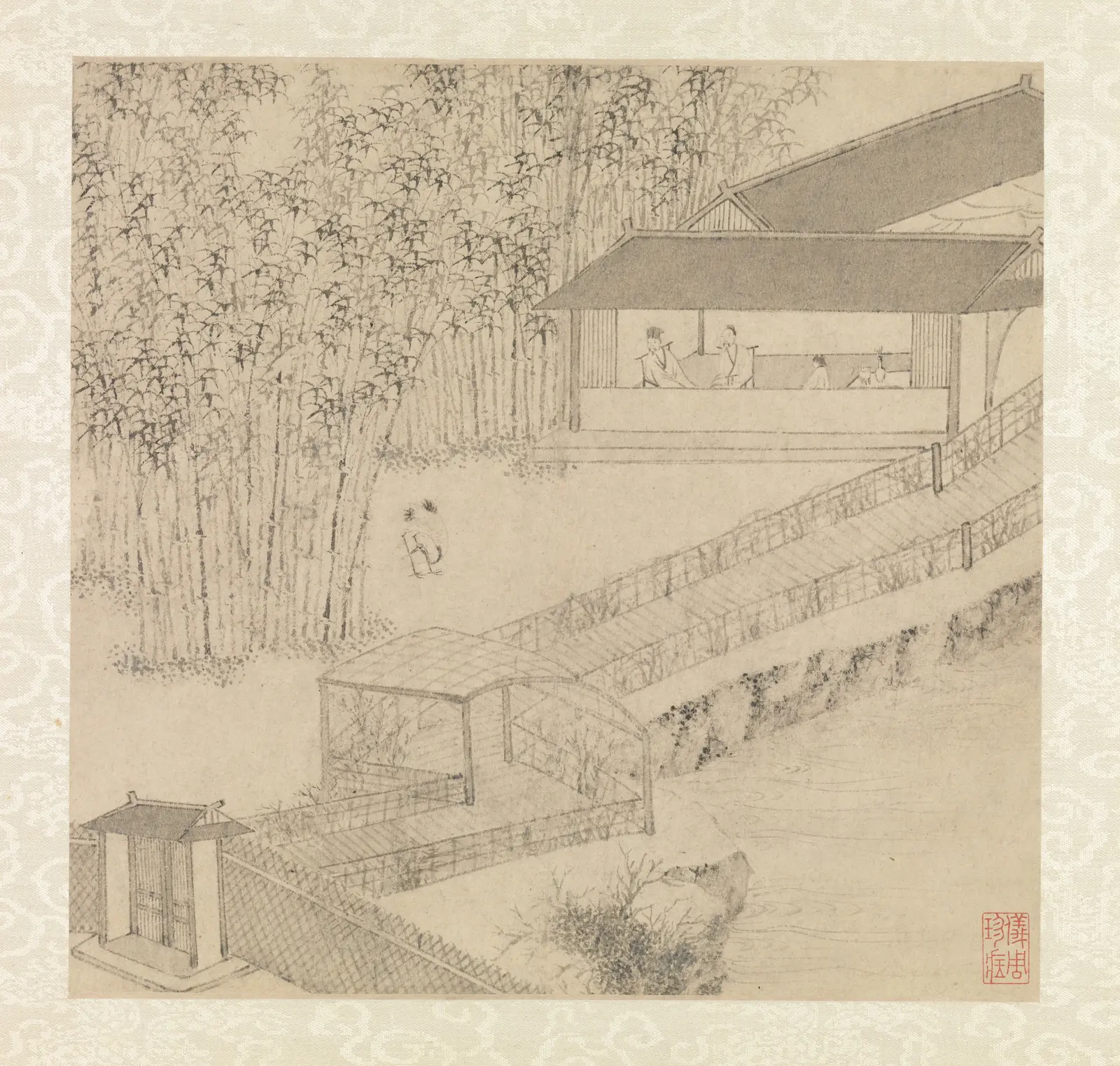
One leaf of Wen Zhengming's 1551 album of the Humble Administrator's Garden in Suzhou: a pavilion with seated figures beside bamboo, fenced paths, a trellis shelter and water.
Credit and licence
"Wen Zhengming - Garden of the Inept Administrator - 1979.458.1a–ii - Metropolitan Museum of Art" by Wen Zhengming (Metropolitan Museum of Art) — https://commons.wikimedia.org/wiki/File:Wen_Zhengming_-_Garden_of_the_Inept_Administrator_-_1979.458.1a%E2%80%93ii_-_Metropolitan_Museum_of_Art.jpg — Public domain (Wen Zhengming (1470–1559), album dated 1551; US: the artist died more than 70 years ago and the work long predates 1931; EU: 70 years after the artist's death; a faithful photograph of a two-dimensional work adds no new rights)
Versailles finished its formal Neptune basin in 1741, the year Henry Hoare II began the landscape garden at Stourhead. English Wikipedia describes the English landscape garden as replacing the French formal garden as Europe's main style. The history of garden design looks different when dated examples from seven traditions share one timeline. The styles overlapped for centuries: by this page's count, from 1500 to 1799 at least two traditions had a garden under construction in every 50-year window.
One timeline, many lanes
Each lane in Fig. 1 holds one tradition. Six are styles: the four-part chahar bagh of Persia and Mughal India, Chinese scholar gardens, Japanese gardens, Italian Renaissance terraces, French formal gardens and English landscape parks. The seventh lane covers 1800 to about 1930, and its last garden in this table was finished in 1931.
A garden, text or picture enters the table only with a date and a named source. Each row also carries an evidence level, as the sources and standards page explains. A contemporary record was made at the time; a later account was written down afterwards.
Most rows here are later accounts, read through Wikipedia in English, Chinese, Japanese or French. The contemporary records are period books and pictures dated by their museums, such as the album leaf above. A lane that starts later is not a step up from one that started earlier: the timeline records dates, not ranks.
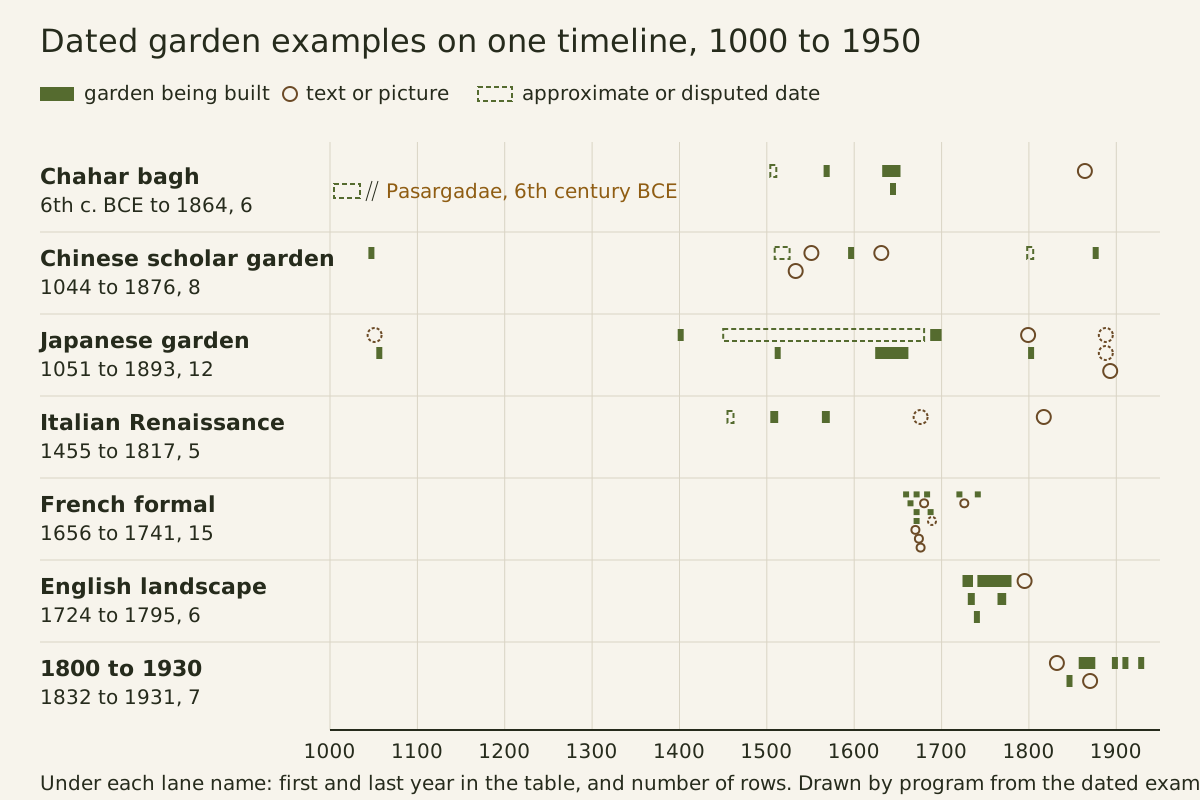
Fig. 1. Dated garden examples from the table on this page, 1000 to 1950, one lane per tradition: bars are gardens being built, circles are texts and pictures, dashed outlines are approximate or disputed dates.
"Dated garden examples on one timeline, 1000 to 1950" by Botany for the Curious, https://botanyforthecurious.com/gardens/garden-style-timeline/, licensed under CC BY 4.0 (https://creativecommons.org/licenses/by/4.0/)data: Dates from English, Chinese, Japanese and French Wikipedia, Wikidata (CC0), museum object records, Conder 1893 and Félibien 1674, retrieved 2026-10-21; lane layout computed 2026-10-21Download Dated examples table, all lanes (CSV) garden-style-timeline-dated-examples.csv data: English Wikipedia articles on the gardens, designers and styles named in each row (dates), retrieved 2026-10-21; Chinese Wikipedia (article on the Yuanye), Japanese Wikipedia (articles on the Sakuteiki and Ryōan-ji) and French Wikipedia, "Manière de montrer les jardins de Versailles" (dating), retrieved 2026-10-21; Wikidata (CC0), Q61094, Q587371, Q1377689, Q189648 and Q160409 inception dates, retrieved 2026-10-21; André Félibien, Description sommaire du chasteau de Versailles, 1674 (public domain), retrieved 2026-10-21; Louis XIV, Manière de montrer les jardins de Versailles, 1899 printing (public domain), retrieved 2026-10-21; Josiah Conder, Landscape Gardening in Japan and Supplement, 1893 (public domain), retrieved 2026-10-21; Ai Sato 2025, Landscape Research Japan Online 18: 126–134 (abstract), retrieved 2026-10-21; Metropolitan Museum of Art, Cleveland Museum of Art and Rijksmuseum object records (CC0), retrieved 2026-10-21
Read down a column of Fig. 1 instead of along a lane. In the 1560s, Humayun's Tomb and its garden in Delhi and the terraces of Villa d'Este near Rome were going up in the same years.
| Lane | Rows | First and last year in this table | What the sources describe |
|---|---|---|---|
| Chahar bagh | 6 | 6th century BCE to 1864 | Four parts divided by waterways or walkways |
| Chinese scholar garden | 8 | 1044 to 1876 | Gardens of officials, some made after leaving office |
| Japanese garden | 12 | 1051 to 1893 | Pond gardens first, dry rock gardens later |
| Italian Renaissance | 5 | 1455 to 1817 | Terraces on a slope, joined by ramps and stairs |
| French formal | 15 | 1656 to 1741 | Symmetry, with order laid over nature |
| English landscape | 6 | 1724 to 1795 | Lake, lawns and groves arranged as an idealised nature |
| 1800 to 1930 | 7 | 1832 to 1931 | Several approaches at once, from public parks to wild gardens |
Plants do different work in each lane. Low clipped box drew the patterns of French parterres, and English parks often set sweeps of lawn against groves of trees. In Italy, Leon Battista Alberti (1404–1472), in his books on architecture, asked for planters where vines could climb, set on marble columns. Clipping and training act on one plant at a time, so this site counts them as handling, not breeding.
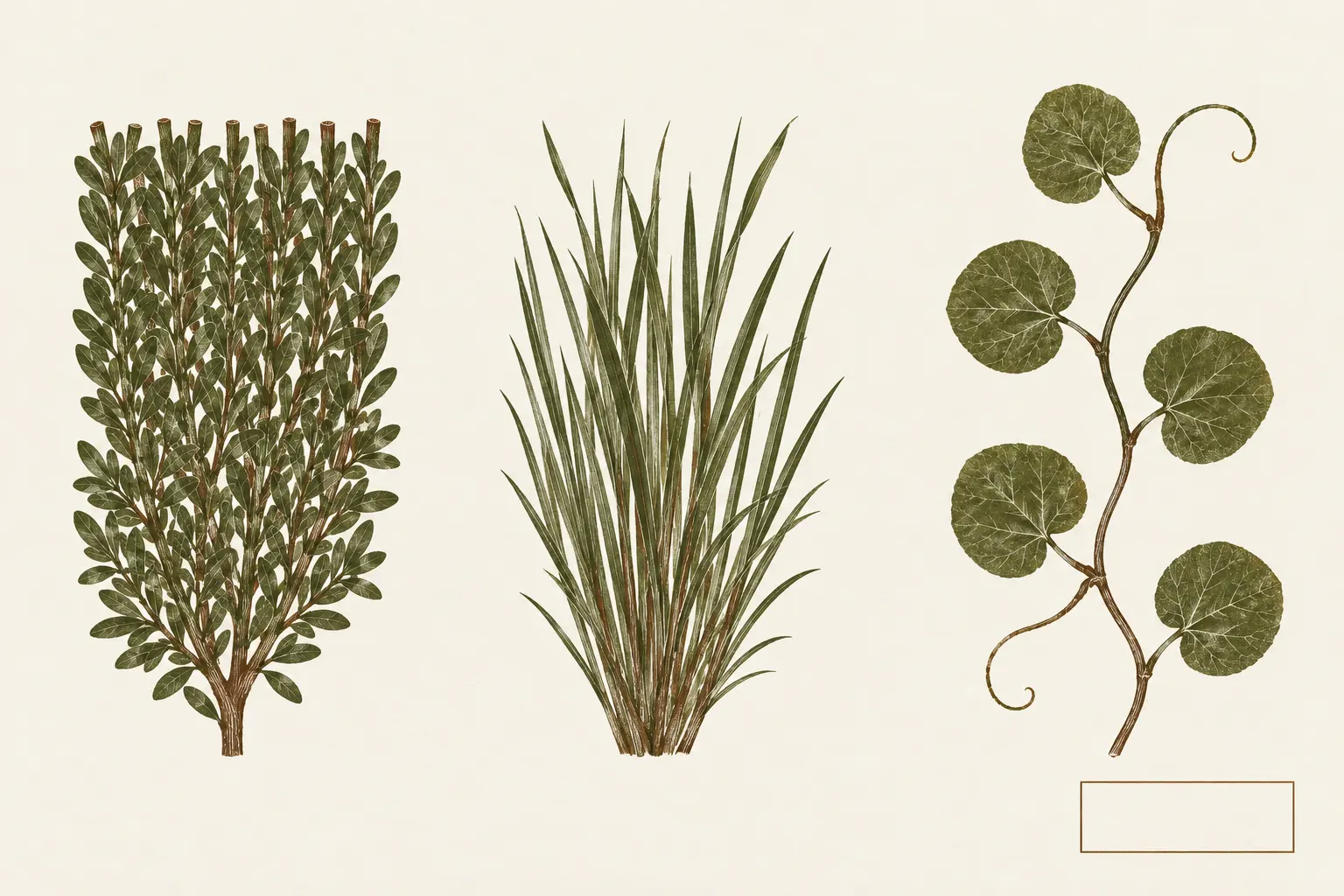
A clipped evergreen sprig, a tuft of grass and a length of vine; clipping and training act on one plant at a time.
Illustration: Botany for the Curious. Generated schematic image — not a photograph or botanical record. Reuse terms: no license is granted; any rights Botany for the Curious holds in this image are reserved.Four-part gardens: the chahar bagh
A chahar bagh, Persian for "four gardens", is a garden split into four parts, traditionally by waterways, though walkways can do the same job. Pasargadae was the capital Cyrus the Great founded in the 6th century BCE. English Wikipedia calls its gardens the earliest known example of the layout, and its article on Persian gardens puts the outline of Pasargadae at around 500 BCE. In this table, Pasargadae is the earliest dated example, recorded as a later account.
The Mughal dynasty founded by Babur brought the layout from Iran to the Indian subcontinent in the 16th century. Babur's garden in Kabul is thought to date from around 1504. Humayun's Tomb in Delhi, set in a charbagh, was built from 1565 to 1572 (Wikidata gives 1560). The Shalimar Gardens in Lahore took 1641 to 1642, and the Taj Mahal's garden was finished in 1653, five years after the tomb itself.
In the panorama below, the Taj Mahal's central water channel and raised marble tank lead from the gateway to the tomb.
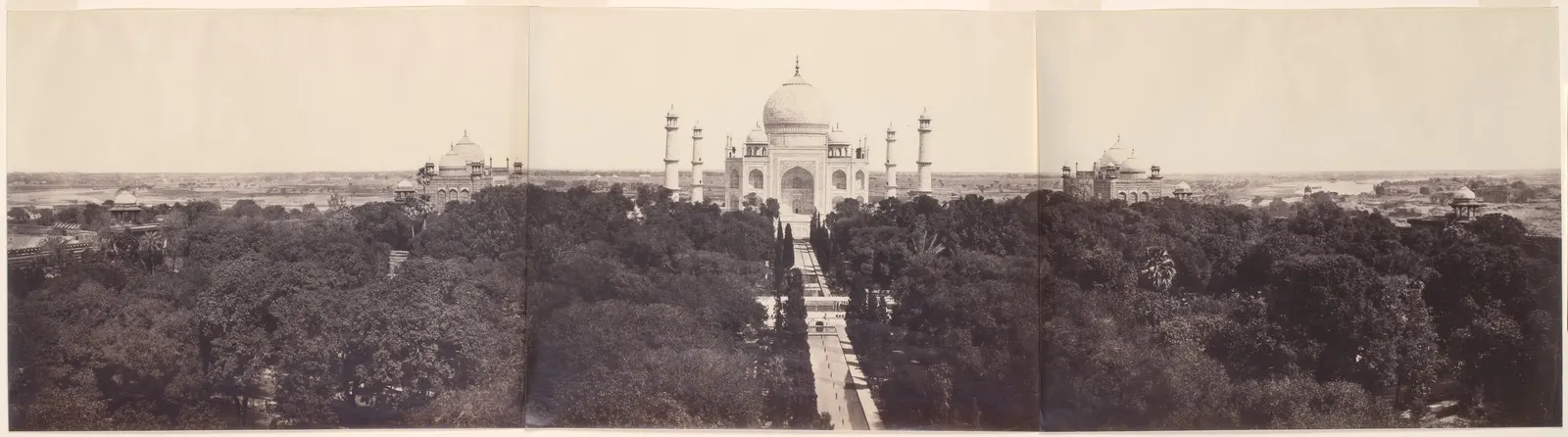
The Taj Mahal and its garden seen from the gateway, a three-part panorama by John Murray from 1864: the central water channel and raised tank run between trees to the tomb.
"-The Taj Mahal from the Gateway- MET DP143015" by John Murray (Metropolitan Museum of Art) — https://commons.wikimedia.org/wiki/File:-The_Taj_Mahal_from_the_Gateway-_MET_DP143015.jpg — CC0 1.0 (https://creativecommons.org/publicdomain/zero/1.0/)
China's scholar gardens
The Chinese lane in this table opens in 1044. That year the poet Su Shunqin built the Canglang Pavilion garden in Suzhou after his removal from office. English Wikipedia traces its name to a verse about an honest official who steps away from politics rather than act corruptly.
The Humble Administrator's Garden (拙政園) in Suzhou carries the same idea in its name. Wang Xianchen, an official who retired to Suzhou, began it between about 1509 and 1513 and finished it in 1526. Two English Wikipedia articles disagree on the start.
The name comes from a verse by Pan Yue about the quiet life that suits a retired official. Read that way, the garden is a statement about retiring from politics, the kind of reading this site also gives the axis of Versailles.
The painter Wen Zhengming (文徵明), a friend of Wang's, painted albums of the garden. His album of 31 views dates from 1533. A second album of eight leaves, from 1551, shows different views with the same poems. The leaf at the top of this page and the one below are from the 1551 album.
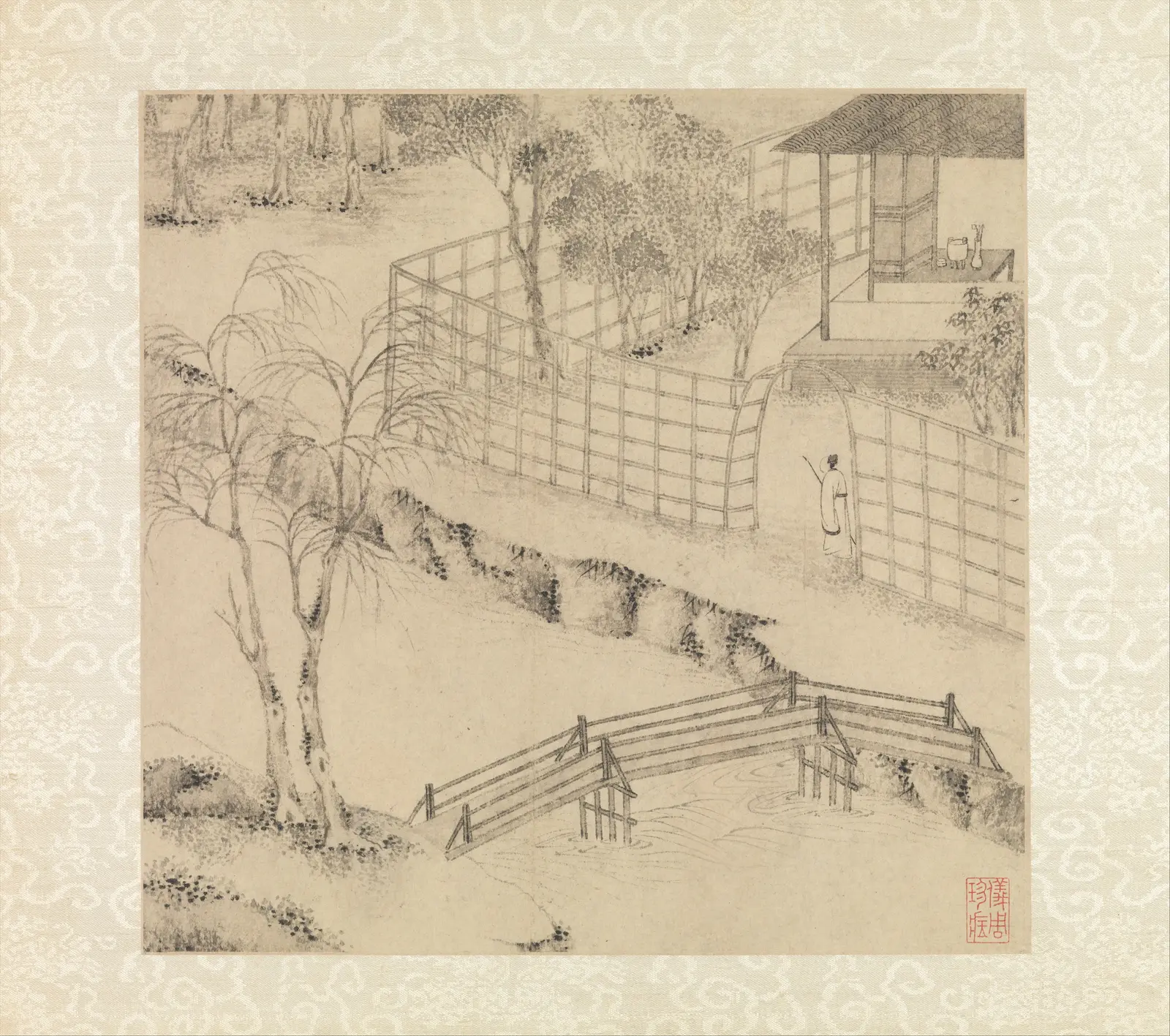
Another leaf of Wen Zhengming's 1551 album: a robed figure stands between fences below a pavilion with a table, near trees with drooping branches and a small bridge over water.
Credit and licence
"Garden of the Inept Administrator - leaf b" by Wen Zhengming (Metropolitan Museum of Art) — https://commons.wikimedia.org/wiki/File:Garden_of_the_Inept_Administrator_-_leaf_b.jpg — Public domain (Wen Zhengming (1470–1559), album dated 1551; US: the artist died more than 70 years ago and the work long predates 1931; EU: 70 years after the artist's death; a faithful photograph of a two-dimensional work adds no new rights)
The lane keeps going. Ji Cheng's garden manual 園冶 (Yuanye, The Craft of Gardens) was written in 1631 and printed in 1634, by Chinese Wikipedia's dating; English Wikipedia gives 1631. Suzhou's Lingering Garden, commissioned in 1593, was rebuilt after a new owner took it over in 1798, and repaired again from 1873 to 1876.
Japan's lane
In Japan, the lane begins with ponds. At Byōdō-in in Uji, a villa made into a temple in 1052, the Phoenix Hall was completed beside its pond in 1053. Kinkaku-ji in Kyoto, built in 1398, was set in a water garden.
The dry rock garden of Ryōan-ji, a kind of garden called 枯山水 (karesansui), is dated by most sources to the second half of the 15th century. That order, ponds first and raked gravel later, is the subject of the Japanese garden entry.
The Japanese lane runs alongside the others instead of ending. In English Wikipedia's Japanese garden article, the stroll garden of Katsura Imperial Villa in Kyoto is dated 1641 to 1662, overlapping the last years of work on the Taj Mahal's garden. Ryōan-ji's garden was remade after a fire and pictured in 1799. English Wikipedia dates the fire to 1779 and Japanese Wikipedia to 1797.
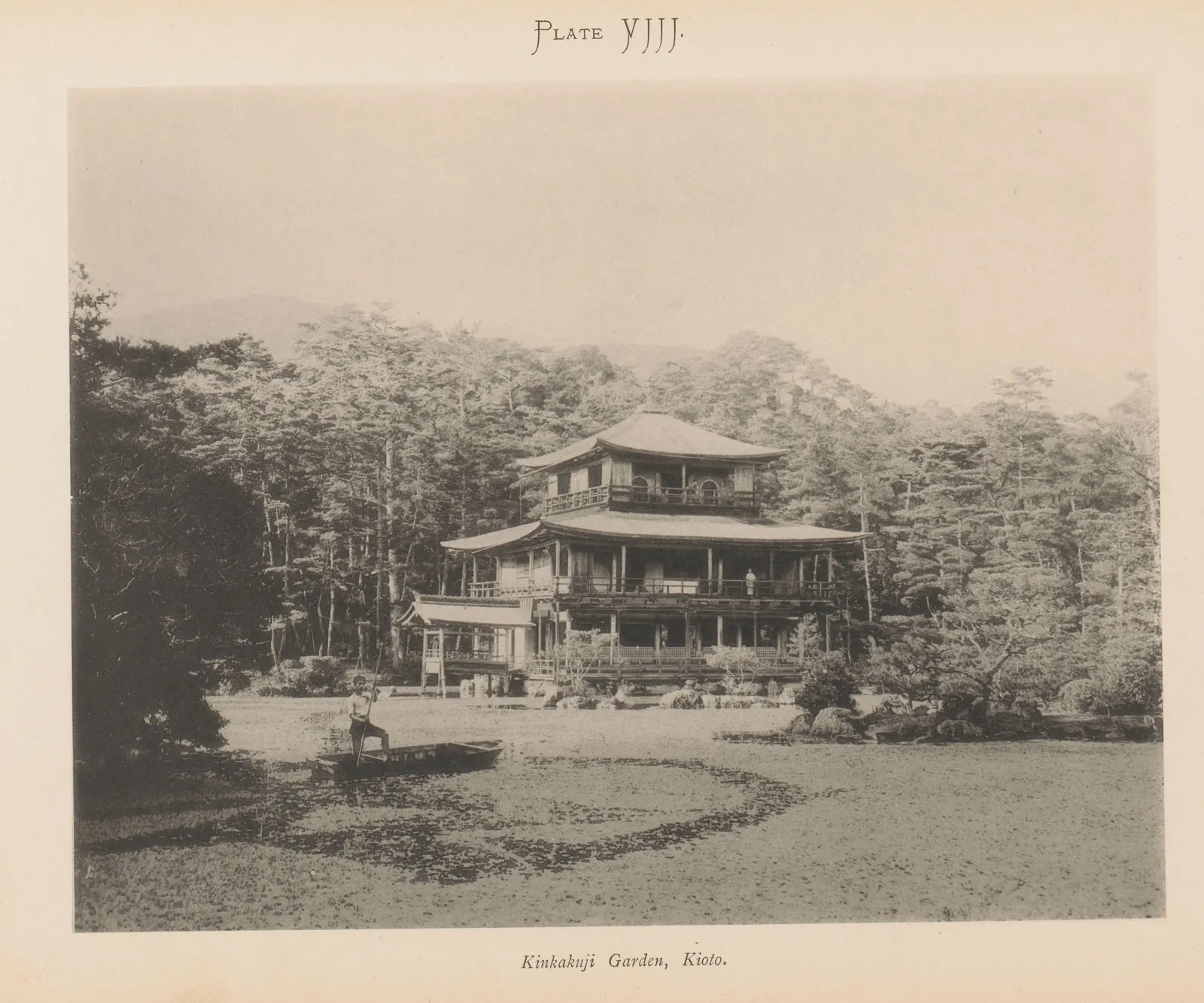
Kinkaku-ji in Kyoto across its pond, Plate VIII of the 1893 "Supplement to Landscape Gardening in Japan", a collotype by Kazumasa Ogawa, with a boatman poling a small boat.
"Gezicht op de Kinkaku-ji in Kyoto, Japan, RP-F-2001-7-1565-8" by Kazumasa Ogawa (Rijksmuseum) — https://commons.wikimedia.org/wiki/File:Gezicht_op_de_Kinkaku-ji_in_Kyoto,_Japan,_RP-F-2001-7-1565-8.jpg — CC0 1.0 (https://creativecommons.org/publicdomain/zero/1.0/); modified: cropped to the plate, removing the blank facing page and the book edges
Italian terraces
Italian Renaissance gardens climb. The Villa Medici at Fiesole was made between 1455 and 1461 on a rocky hillside, with two large terraces and a view over Florence. English Wikipedia calls it the oldest existing Italian Renaissance garden. In 1504 Pope Julius II had Donato Bramante lay out the Belvedere Courtyard in the Vatican on a central axis, with terraces joined by double ramps.
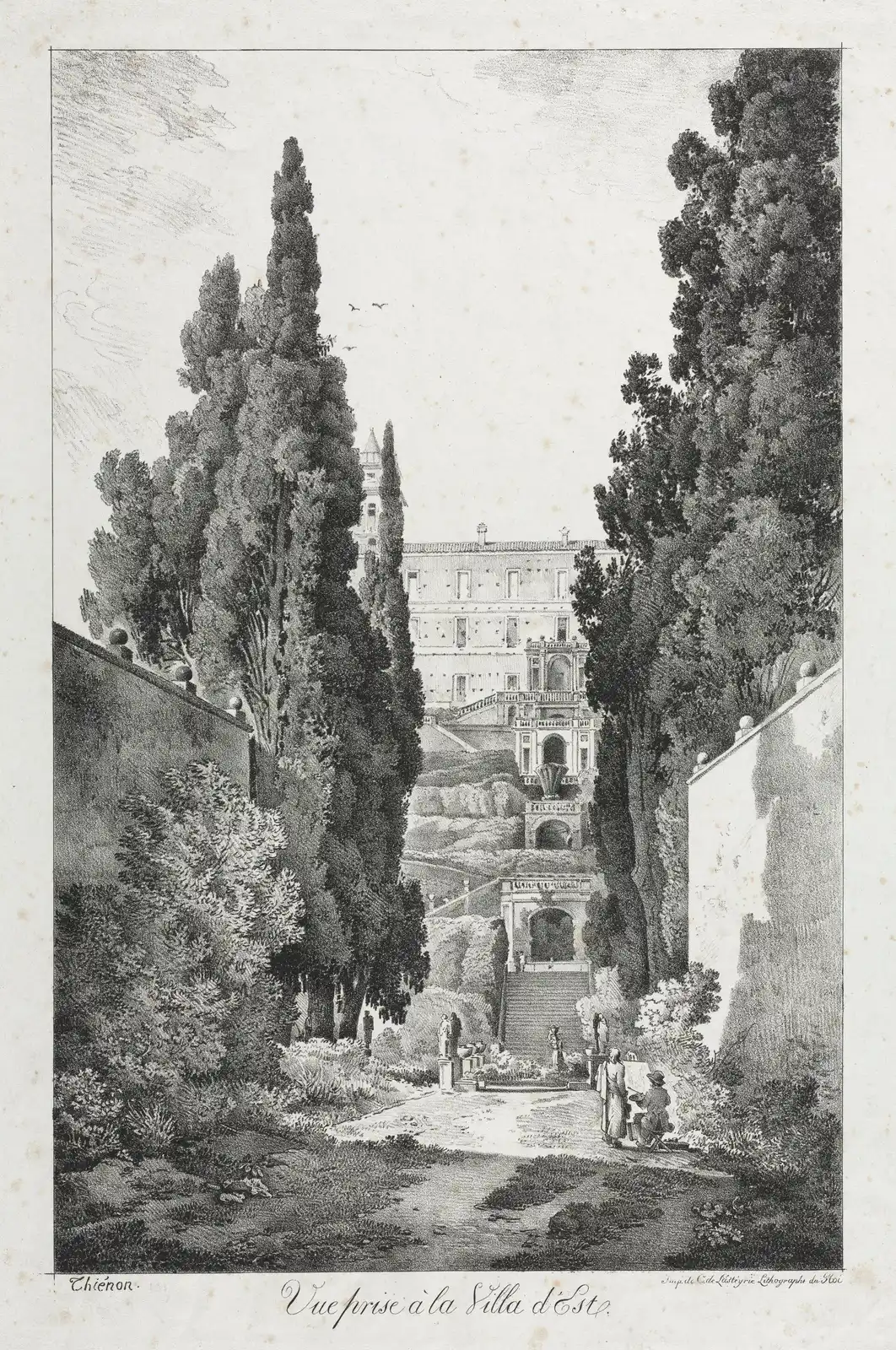
"View at Villa d'Este, Tivoli", an 1817 lithograph by Claude Thiénon: stairs and fountains climb between tall trees toward the villa, with figures in the foreground.
"Claude Thiénon - View at Villa d'Este, Tivoli - 1941.261 - Cleveland Museum of Art" by Claude Thiénon (Cleveland Museum of Art) — https://commons.wikimedia.org/wiki/File:Claude_Thi%C3%A9non_-_View_at_Villa_d'Este,_Tivoli_-_1941.261_-_Cleveland_Museum_of_Art.tif — CC0 1.0 (https://creativecommons.org/publicdomain/zero/1.0/)Pirro Ligorio designed Villa d'Este in Tivoli for Cardinal Ippolito II d'Este. Earth was moved for new terraces from 1563 to 1565, and the Oval Fountain was built from 1565 to 1570. The cardinal died in 1572, but artists kept drawing the garden long after: Giovanni Francesco Venturini etched the fountain sometime between about 1676 and 1700, and Claude Thiénon's lithograph above dates from 1817.
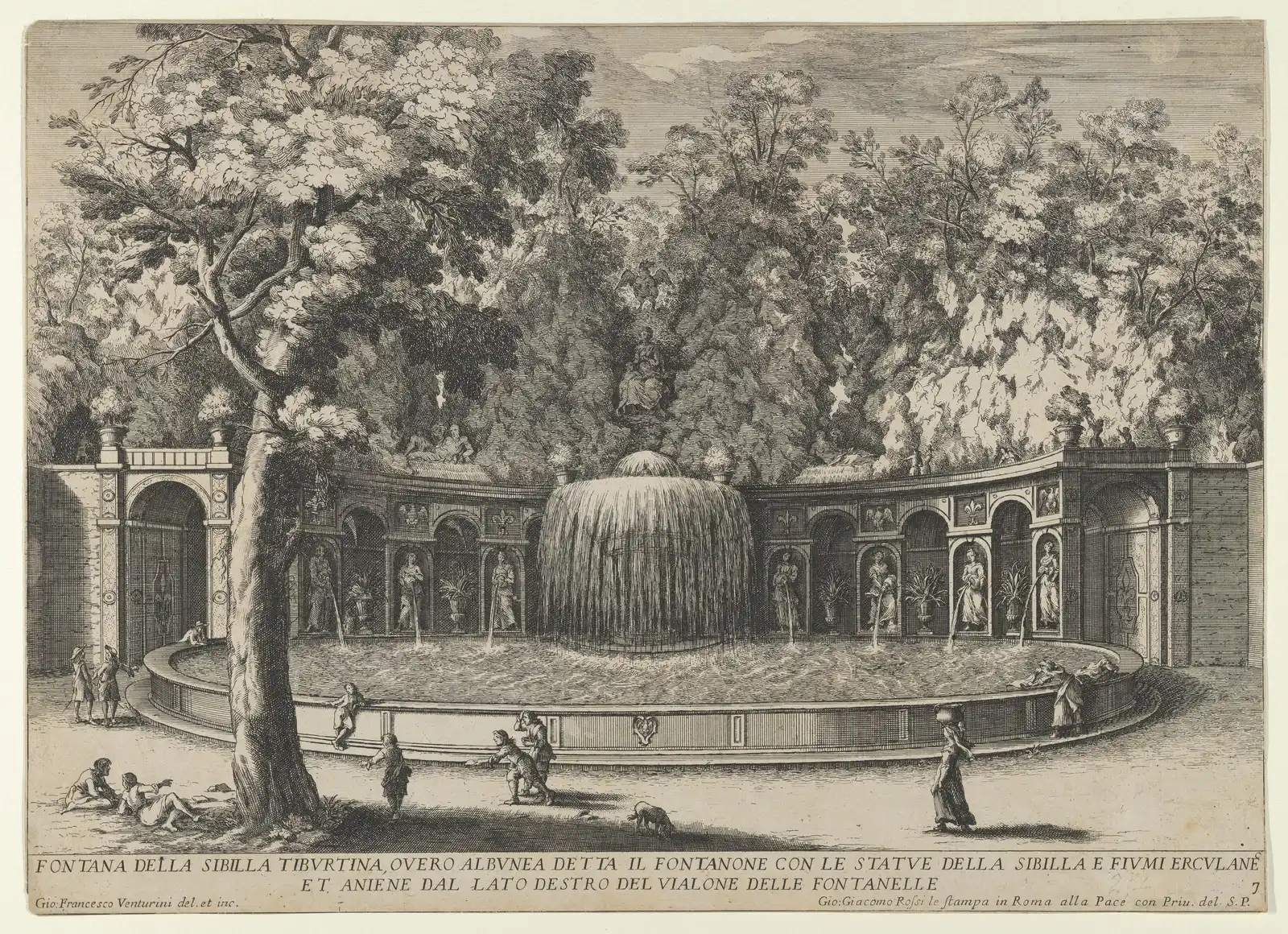
The Oval Fountain at Villa d'Este, etched by Giovanni Francesco Venturini and published by Giovanni Giacomo De Rossi around 1676 to 1700, with figures strolling before its curved arcade of statues.
Credit and licence
"Book IV, plate 7- the fountain of the Tiburtine sibyl in the garden at Villa d'Este, Tivoli, from the series 'The fountains of the Este garden in Tivoli' (Le fontane del Giardino Estense in Tivoli) MET DP841297" by Giovanni Francesco Venturini and Giovanni Giacomo De Rossi (Metropolitan Museum of Art) — https://commons.wikimedia.org/wiki/File:Book_IV,_plate_7-_the_fountain_of_the_Tiburtine_sibyl_in_the_garden_at_Villa_d'Este,_Tivoli,_from_the_series_'The_fountains_of_the_Este_garden_in_Tivoli'_(Le_fontane_del_Giardino_Estense_in_Tivoli)_MET_DP841297.jpg — CC0 1.0 (https://creativecommons.org/publicdomain/zero/1.0/)
French formal: order laid over nature
English Wikipedia's article on the French formal garden, the jardin à la française, describes a style built on symmetry and on imposing order on nature. It names Vaux-le-Vicomte, begun in 1656 for Nicolas Fouquet with gardens by André Le Nôtre, as the first important example. In 1661, after Fouquet's disgrace, Louis XIV turned to Versailles, with the help of Fouquet's architect, painter and garden designer.
The Versailles rows in this table come from the Versailles page, which follows the king's own written route through the gardens. The print below, from a series published in 1676 with text by André Félibien, shows the Grand Canal lit up for the festivities after the conquest of Franche-Comté in 1674. Here the garden is the setting for a royal celebration.
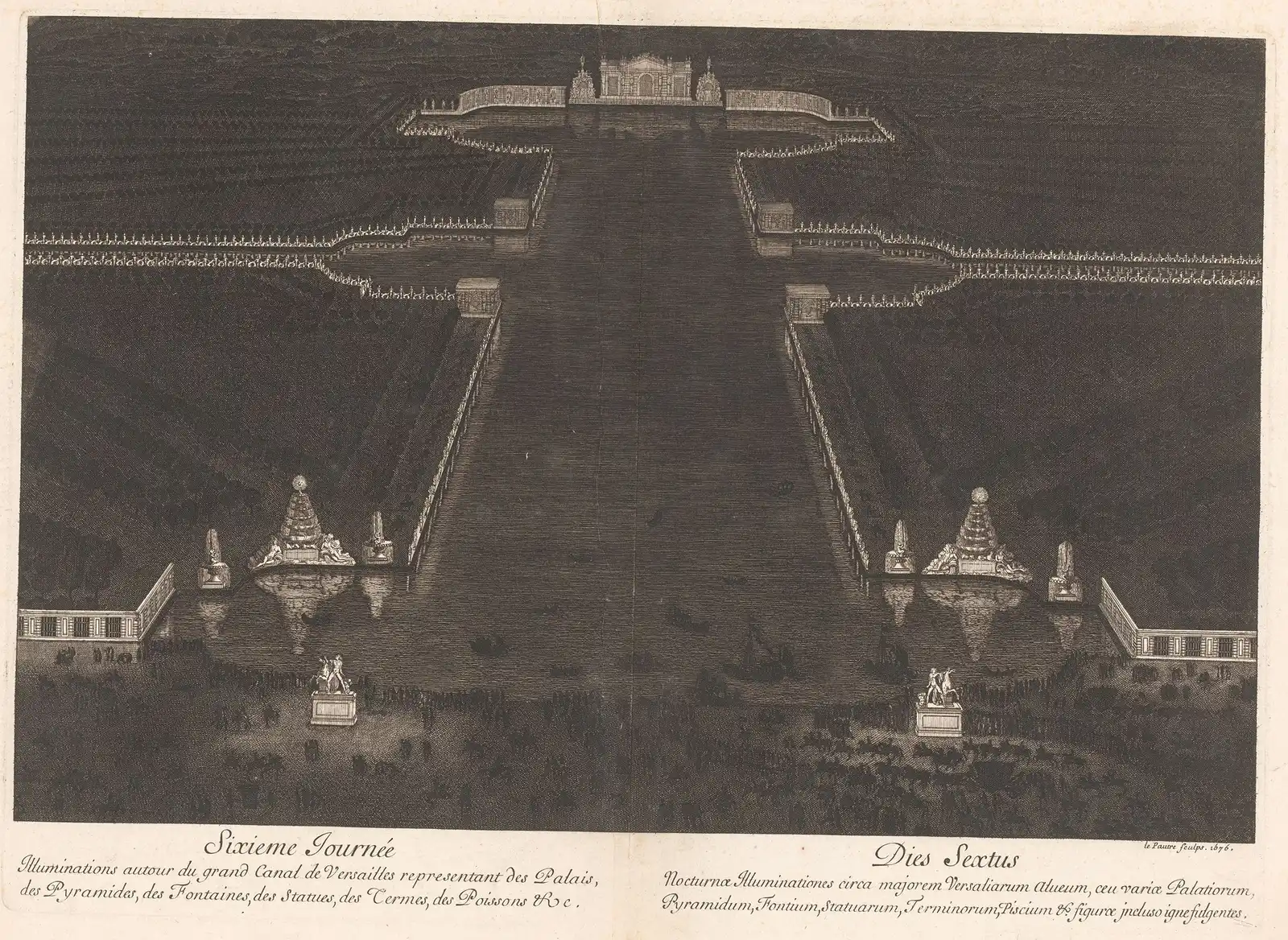
The Grand Canal of Versailles lit up at night, a 1676 etching by Jean Le Pautre for the sixth day of the festivities: lights outline the canal, pyramids and statues.
Credit and licence
"Verlichting rond het Grand Canal van Versailles, RP-P-OB-69.324" by Jean Le Pautre (Rijksmuseum) — https://commons.wikimedia.org/wiki/File:Verlichting_rond_het_Grand_Canal_van_Versailles,_RP-P-OB-69.324.jpg — CC0 1.0 (https://creativecommons.org/publicdomain/zero/1.0/); modified: cropped to the plate and its printed title, removing the colour chart, pencil notes and sheet edges
The French lane did not stop when Le Nôtre died in 1700. By English Wikipedia's account, his pupils and his ideas dominated French garden design through the reign of Louis XV. His nephew Claude Desgots laid out the garden at Bagnolet in 1717, and Versailles completed its Neptune basin between 1738 and 1741.
English landscape: the park as property
English Wikipedia dates the English landscape garden to the early 18th century, a revolt against the architectural garden that drew on landscape painting and Chinese gardens. William Kent's garden at Chiswick House was laid out from 1724 with many formal elements. It was redesigned from 1733 to 1736 with lawns sloping to the river. Stowe followed from 1730 to 1738, Rousham from 1737, and Stourhead, made to resemble the paintings of Claude Lorrain, from 1741 to 1780.
These gardens were estates as much as gardens. At Rousham, Kent used a ha-ha, a hidden ditch that stopped grazing animals from entering the garden without blocking the view. Capability Brown is estimated to have worked on more than 170 gardens around country houses and estates. At Blenheim, after 1764, he grassed over the great parterre.
At Milton Abbey, English Wikipedia says, Joseph Damer found the nearby market town of Middleton at odds with his idea of rural peace. Most villagers were moved to a new village by William Chambers and Brown; the old town was demolished and its site landscaped.
Humphry Repton, the next designer in this lane, showed clients watercolours with overlays that gave "before" and "after" views. The two plates below show one scene from his 1795 book with its overlay in each position.
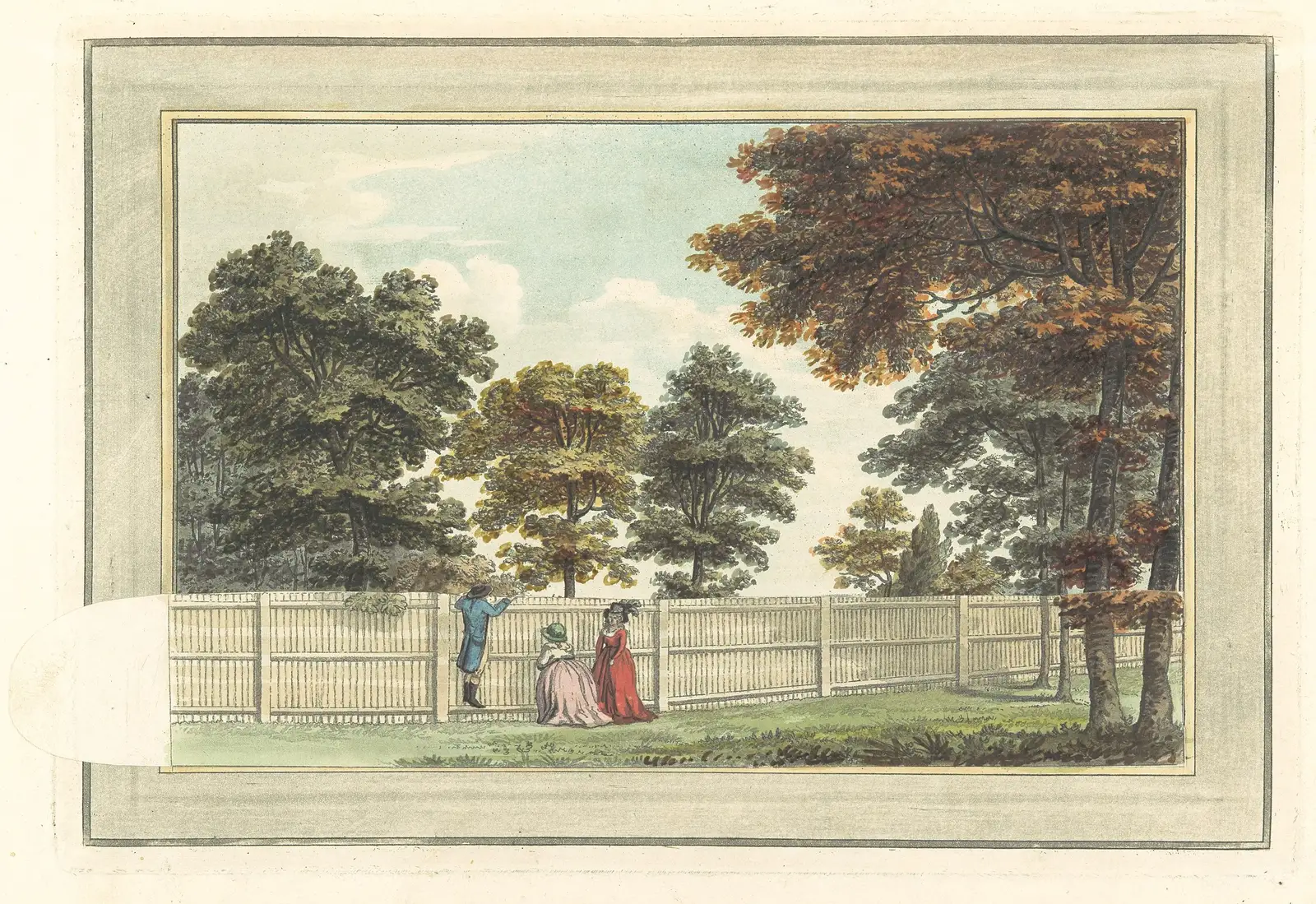
A plate from Humphry Repton's 1795 "Sketches and Hints on Landscape Gardening" with its overlay in place: three figures stand at a tall paling fence, with trees beyond.
"Sketches and Hints on Landscape Gardening MET DP105013" by Humphry Repton (Metropolitan Museum of Art) — https://commons.wikimedia.org/wiki/File:Sketches_and_Hints_on_Landscape_Gardening_MET_DP105013.jpg — CC0 1.0 (https://creativecommons.org/publicdomain/zero/1.0/)
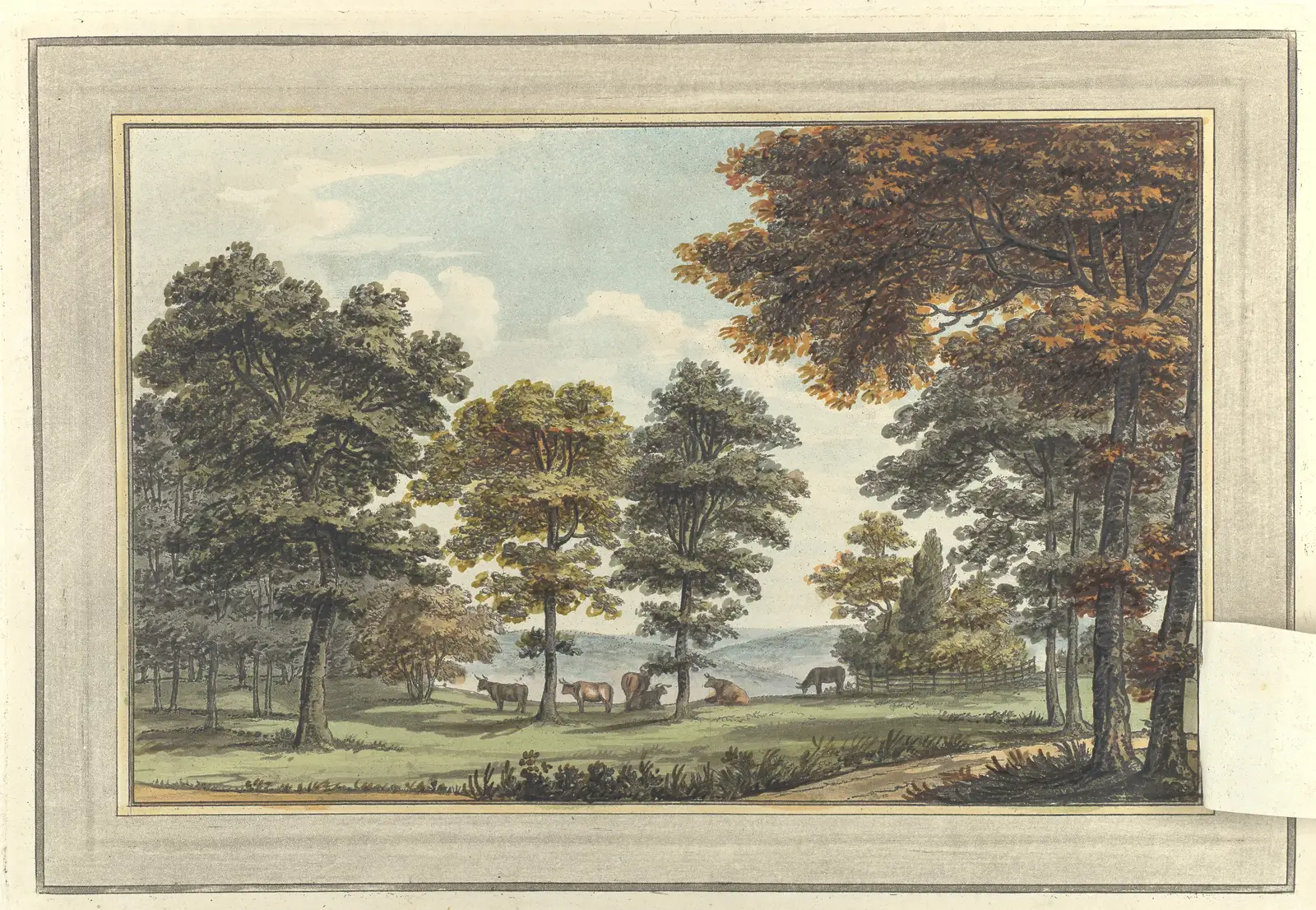
The same plate with the overlay turned back: open parkland with grazing cattle, clumps of trees and hills in the distance.
"Sketches and Hints on Landscape Gardening MET DP109549" by Humphry Repton (Metropolitan Museum of Art) — https://commons.wikimedia.org/wiki/File:Sketches_and_Hints_on_Landscape_Gardening_MET_DP109549.jpg — CC0 1.0 (https://creativecommons.org/publicdomain/zero/1.0/)
The 1800s to 1930: many lanes at once
After 1800 the table's last lane is a period, not a style. John Claudius Loudon introduced the term gardenesque in 1832 for planting meant to be recognised as a work of art, not mistaken for natural growth. Birkenhead Park, designed by Joseph Paxton under a local act of 1843 that allowed public money for it, opened in 1847. New York's Central Park was built from 1857 to 1876 to the Greensward Plan of Frederick Law Olmsted and Calvert Vaux; Wikidata gives 1856 as its start.
William Robinson published The Wild Garden in 1870. Gertrude Jekyll built her house at Munstead Wood in 1895, her first house-and-garden collaboration with Edwin Lutyens. Hidcote, on an estate bought in 1907, was laid out as linked garden rooms walled with hedges and planted with rare trees, shrubs and borders. From 1925 to 1931 the French landscape architect Achille Duchêne built water terraces at Blenheim, in the park Brown had landscaped.
Fig. 2 counts the overlap. Down each column, count the traditions with a garden being built in that 50-year window. There are four in 1500 to 1549, and two or more in every window from 1500 to 1799. An empty window means only that this table has no dated construction row for it.
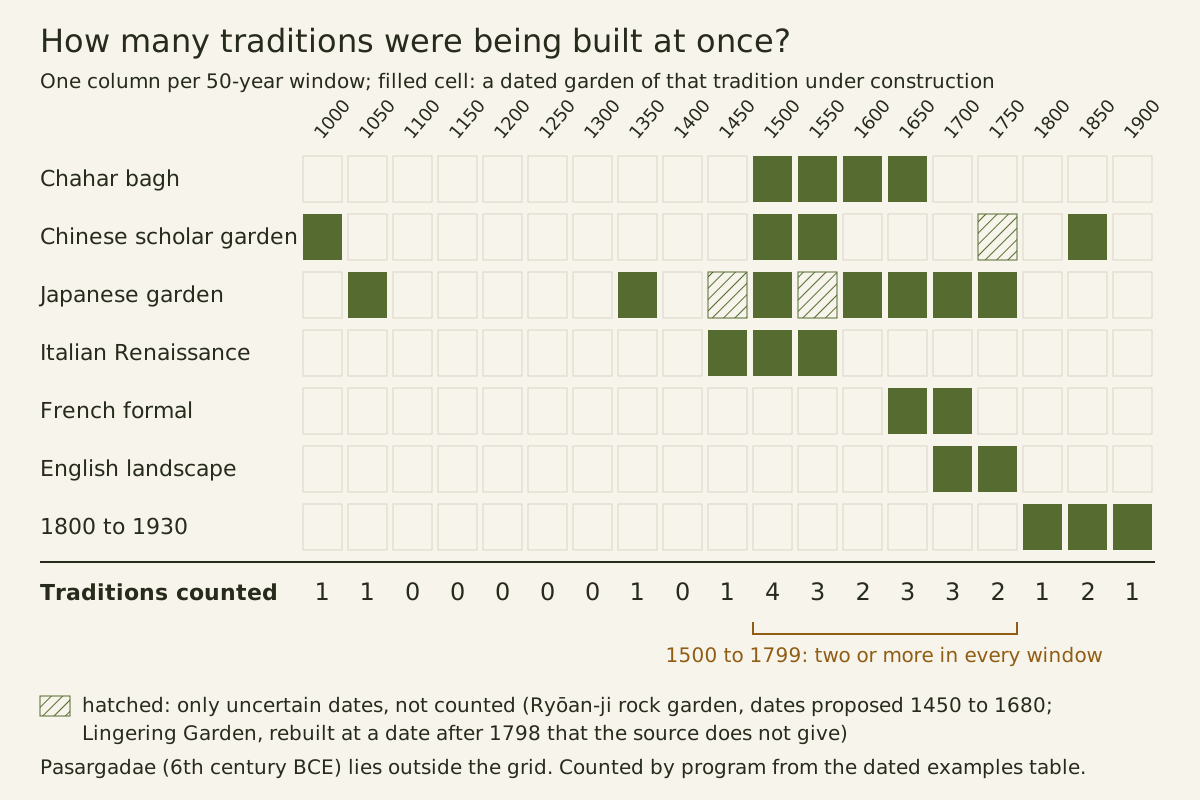
Fig. 2. Garden traditions with a dated garden under construction in each 50-year window, 1000 to 1949, counted from the table on this page; hatched cells rest only on uncertain dates and are not counted.
"Garden traditions under construction in each 50-year window, 1000 to 1949" by Botany for the Curious, https://botanyforthecurious.com/gardens/garden-style-timeline/, licensed under CC BY 4.0 (https://creativecommons.org/licenses/by/4.0/)data: Dated examples table on this page, retrieved 2026-10-21; counts per 50-year window computed 2026-10-21Garden style questions
What are the main garden design styles?
This page follows seven traditions with dated examples: the Persian and Mughal chahar bagh, Chinese scholar gardens, Japanese gardens, Italian Renaissance terraces, French formal gardens, English landscape gardens and the mixed period from 1800 to about 1930. On the timeline most of them overlap.
What is the difference between French and English gardens?
A French formal garden, in English Wikipedia's description, rests on symmetry and on imposing order on nature, as at Versailles. An English landscape garden usually arranges a lake, lawns and groves of trees into an idealised version of nature, as at Stourhead. In this table the two overlap: Versailles completed its Neptune basin between 1738 and 1741, as Stowe was finished and Stourhead begun.
Which garden style is the oldest?
In this table, the earliest dated example is a chahar bagh: the gardens of Pasargadae in Iran, from the 6th century BCE. English Wikipedia calls them the earliest known example of that layout, and the date is a later account. The earliest construction dates in the Chinese and Japanese lanes are 1044 and 1053.
Sources
- Wen Zhengming. Garden of the Inept Administrator, album of eight painted leaves with facing leaves inscribed with poems, ink on paper, dated 1551. Metropolitan Museum of Art, 1979.458.1a–ii (object record on its Wikimedia Commons file page, read 2026-10-21). https://commons.wikimedia.org/wiki/File:Garden_of_the_Inept_Administrator_-_leaf_b.jpg object record: date, medium, number of leaves, accession number
- John Murray. [The Taj Mahal from the Gateway], panorama, albumen silver prints from waxed paper negatives, January–March 1864. Metropolitan Museum of Art, 2005.100.315a–c (object record on its Wikimedia Commons file page, read 2026-10-21). https://commons.wikimedia.org/wiki/File:-The_Taj_Mahal_from_the_Gateway-_MET_DP143015.jpg object record: title, date, medium, accession number
- Giovanni Francesco Venturini (etcher) and Giovanni Giacomo De Rossi (publisher). Book IV, plate 7: the fountain of the Tiburtine sibyl in the garden at Villa d'Este, Tivoli, from the series Le fontane del Giardino Estense in Tivoli, etching and engraving, c. 1676–1700. Metropolitan Museum of Art, 2012.136.406 (object record on its Wikimedia Commons file page, read 2026-10-21). https://commons.wikimedia.org/wiki/File:Book_IV,_plate_7-_the_fountain_of_the_Tiburtine_sibyl_in_the_garden_at_Villa_d'Este,_Tivoli,_from_the_series_'The_fountains_of_the_Este_garden_in_Tivoli'_(Le_fontane_del_Giardino_Estense_in_Tivoli)_MET_DP841297.jpg object record: title, date, medium, accession number
- Claude Thiénon. View at Villa d'Este, Tivoli, lithograph, 1817. Cleveland Museum of Art, 1941.261 (object record on its Wikimedia Commons file page, read 2026-10-21). https://commons.wikimedia.org/wiki/File:Claude_Thi%C3%A9non_-_View_at_Villa_d'Este,_Tivoli_-_1941.261_-_Cleveland_Museum_of_Art.tif object record: title, date, medium, accession number
- Jean Le Pautre (printmaker). Sixieme Journée. Illuminations autour du grand Canal de Versailles, etching, 1676, from Les divertissements de Versailles, Paris: Imprimerie Royale. Rijksmuseum, RP-P-OB-69.324 (object record on its Wikimedia Commons file page, read 2026-10-21). https://commons.wikimedia.org/wiki/File:Verlichting_rond_het_Grand_Canal_van_Versailles,_RP-P-OB-69.324.jpg object record (in Dutch): title, maker, date, series note
- Repton, Humphry. Sketches and Hints on Landscape Gardening. Printed by W. Bulmer and Co., 1795; hand-coloured aquatints with overlays. Metropolitan Museum of Art, 45.10.1 (object record on its Wikimedia Commons file pages, read 2026-10-21). https://commons.wikimedia.org/wiki/File:Sketches_and_Hints_on_Landscape_Gardening_MET_DP105013.jpg object record: title, date, medium, accession number; two plate images
- Wikidata, "Humayun's tomb" (Q189648), inception statement (read 2026-10-21). https://www.wikidata.org/wiki/Q189648 item page, inception statement
- Wikidata, "Central Park" (Q160409), inception statement (read 2026-10-21). https://www.wikidata.org/wiki/Q160409 item page, inception statement
- English Wikipedia, "English landscape garden" (read 2026-10-21). https://en.wikipedia.org/wiki/English_landscape_garden summarised here through English Wikipedia
- English Wikipedia, "Stourhead" (read 2026-10-21). https://en.wikipedia.org/wiki/Stourhead summarised here through English Wikipedia
- English Wikipedia, "Gardens of Versailles" (read 2026-10-21). https://en.wikipedia.org/wiki/Gardens_of_Versailles summarised here through English Wikipedia
- English Wikipedia, "French formal garden" (read 2026-10-21). https://en.wikipedia.org/wiki/French_formal_garden summarised here through English Wikipedia
- English Wikipedia, "Italian Renaissance garden" (read 2026-10-21). https://en.wikipedia.org/wiki/Italian_Renaissance_garden summarised here through English Wikipedia
- English Wikipedia, "Charbagh" (read 2026-10-21). https://en.wikipedia.org/wiki/Charbagh summarised here through English Wikipedia
- English Wikipedia, "Pasargadae" (read 2026-10-21). https://en.wikipedia.org/wiki/Pasargadae summarised here through English Wikipedia
- English Wikipedia, "Persian gardens" (read 2026-10-21). https://en.wikipedia.org/wiki/Persian_gardens summarised here through English Wikipedia
- English Wikipedia, "Gardens of Babur" (read 2026-10-21). https://en.wikipedia.org/wiki/Gardens_of_Babur summarised here through English Wikipedia
- English Wikipedia, "Humayun's tomb" (read 2026-10-21). https://en.wikipedia.org/wiki/Humayun's_tomb summarised here through English Wikipedia
- English Wikipedia, "Taj Mahal" (read 2026-10-21). https://en.wikipedia.org/wiki/Taj_Mahal summarised here through English Wikipedia
- English Wikipedia, "Shalimar Gardens, Lahore" (read 2026-10-21). https://en.wikipedia.org/wiki/Shalimar_Gardens,_Lahore summarised here through English Wikipedia
- English Wikipedia, "Canglang Pavilion" (read 2026-10-21). https://en.wikipedia.org/wiki/Canglang_Pavilion summarised here through English Wikipedia
- English Wikipedia, "Humble Administrator's Garden" (read 2026-10-21). https://en.wikipedia.org/wiki/Humble_Administrator's_Garden summarised here through English Wikipedia
- English Wikipedia, "Wen Zhengming" (read 2026-10-21). https://en.wikipedia.org/wiki/Wen_Zhengming summarised here through English Wikipedia
- Chinese Wikipedia, "Yuanye" (read 2026-10-21). https://zh.wikipedia.org/wiki/%E5%9C%92%E5%86%B6 summarised here through Chinese Wikipedia
- English Wikipedia, "Ji Cheng (Ming dynasty)" (read 2026-10-21). https://en.wikipedia.org/wiki/Ji_Cheng_(Ming_dynasty) summarised here through English Wikipedia
- English Wikipedia, "Lingering Garden" (read 2026-10-21). https://en.wikipedia.org/wiki/Lingering_Garden summarised here through English Wikipedia
- English Wikipedia, "Byōdō-in" (read 2026-10-21). https://en.wikipedia.org/wiki/By%C5%8Dd%C5%8D-in summarised here through English Wikipedia
- English Wikipedia, "Japanese garden" (read 2026-10-21). https://en.wikipedia.org/wiki/Japanese_garden summarised here through English Wikipedia
- English Wikipedia, "Ryōan-ji" (read 2026-10-21). https://en.wikipedia.org/wiki/Ry%C5%8Dan-ji summarised here through English Wikipedia
- Japanese Wikipedia, "Ryōan-ji" (read 2026-10-21). https://ja.wikipedia.org/wiki/%E9%BE%8D%E5%AE%89%E5%AF%BA summarised here through Japanese Wikipedia
- English Wikipedia, "Villa d'Este" (read 2026-10-21). https://en.wikipedia.org/wiki/Villa_d'Este summarised here through English Wikipedia
- English Wikipedia, "Capability Brown" (read 2026-10-21). https://en.wikipedia.org/wiki/Capability_Brown summarised here through English Wikipedia
- English Wikipedia, "Blenheim Palace" (read 2026-10-21). https://en.wikipedia.org/wiki/Blenheim_Palace summarised here through English Wikipedia
- English Wikipedia, "Milton Abbas" (read 2026-10-21). https://en.wikipedia.org/wiki/Milton_Abbas summarised here through English Wikipedia
- English Wikipedia, "Humphry Repton" (read 2026-10-21). https://en.wikipedia.org/wiki/Humphry_Repton summarised here through English Wikipedia
- English Wikipedia, "Gardenesque" (read 2026-10-21). https://en.wikipedia.org/wiki/Gardenesque summarised here through English Wikipedia
- English Wikipedia, "Birkenhead Park" (read 2026-10-21). https://en.wikipedia.org/wiki/Birkenhead_Park summarised here through English Wikipedia
- English Wikipedia, "Central Park" (read 2026-10-21). https://en.wikipedia.org/wiki/Central_Park summarised here through English Wikipedia
- English Wikipedia, "William Robinson (gardener)" (read 2026-10-21). https://en.wikipedia.org/wiki/William_Robinson_(gardener) summarised here through English Wikipedia
- English Wikipedia, "Gertrude Jekyll" (read 2026-10-21). https://en.wikipedia.org/wiki/Gertrude_Jekyll summarised here through English Wikipedia
- English Wikipedia, "Hidcote Manor Garden" (read 2026-10-21). https://en.wikipedia.org/wiki/Hidcote_Manor_Garden summarised here through English Wikipedia
Related
- Gardens of Versailles: The King Wrote Where to Stop and Look Deep explainer
- Japanese Garden: The Pond Came Centuries Before Raked Gravel Specimen entry
Cite this page
Botany for the Curious. “History of Garden Design: Styles Overlapped for Centuries.” Published 2026-10-22; last substantive revision 2026-10-22. https://botanyforthecurious.com/gardens/garden-style-timeline/ (accessed: add the date you read it).
- Published
- Last substantive revision