Garden Design HistorySpecimen entry
Japanese Garden: The Pond Came Centuries Before Raked Gravel
- Published
- Last substantive revision
Spec card
- Garden
- —
- Location
- JapanSource: English Wikipedia, "Japanese garden"; Conder 1893
- Style
- Pond garden; dry landscape (karesansui); tea garden (roji); stroll gardenSource: English Wikipedia, "Japanese garden"; Conder 1893
- Design date
- Dated gardens in the table on this page run from 1053 (Byōdō-in, Uji) to 1700 (Kōraku-en, Okayama, completed)Source: English Wikipedia, "Byōdō-in" and "Kōraku-en"; Wikidata Q1377689
- Designer
- —
- Base plan source
- —
Download this card as CSV japanese-garden-spec-card.csv data: English Wikipedia, "Japanese garden", "Byōdō-in" and "Kōraku-en" (style list and dates), retrieved 2026-10-21; Wikidata (CC0), Q1377689 inception, retrieved 2026-10-21; Josiah Conder, Landscape Gardening in Japan, 1893 (public domain), retrieved 2026-10-21
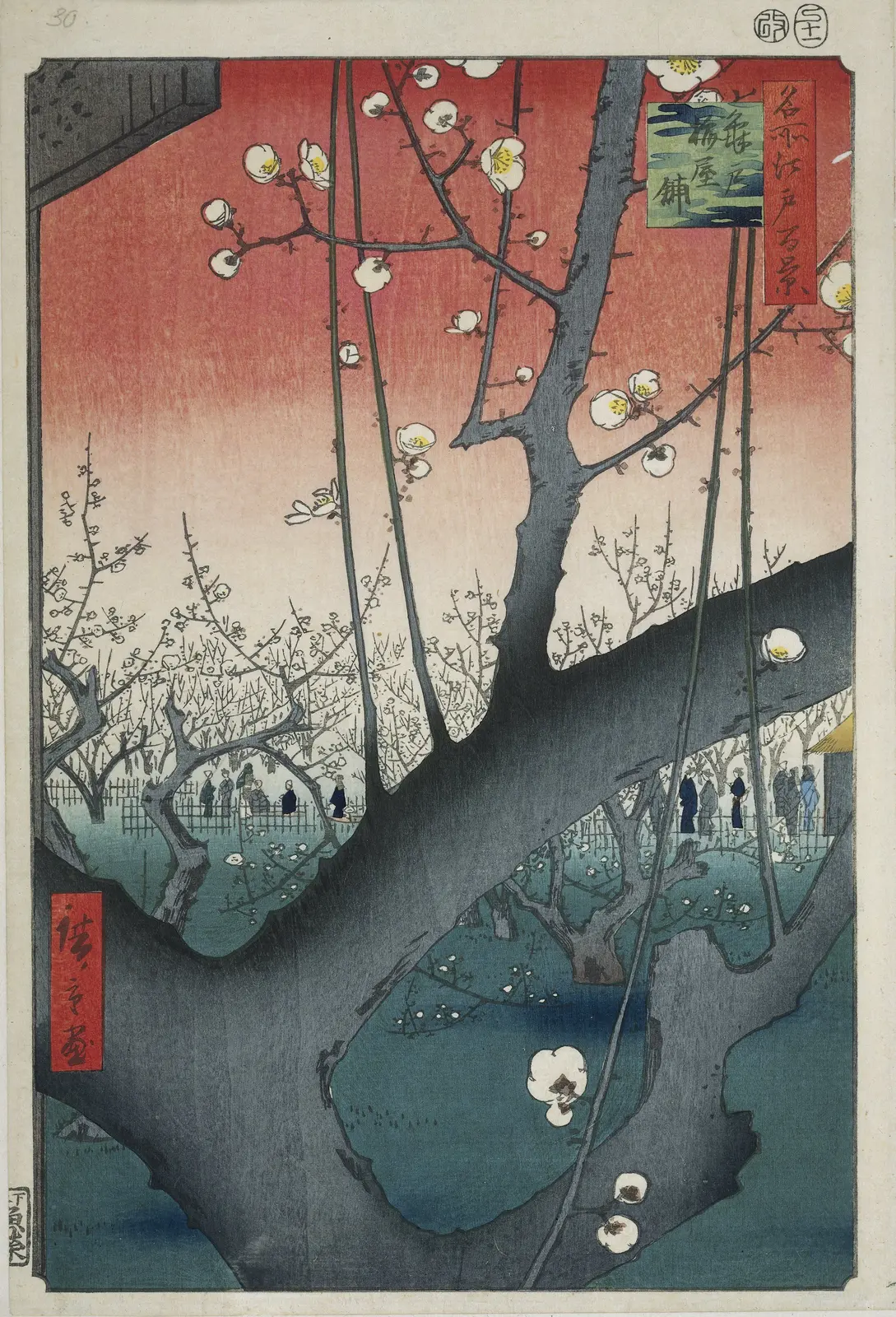
"Plum Garden in Kameido", a woodblock print by Utagawa Hiroshige from "One Hundred Famous Views of Edo", 1857: a plum branch in front, with blossoming trees and visitors behind.
Credit and licence
"De pruimenboomgaard te Kameido Kameido umeyashiki (titel op object) Honderd beroemde gezichten op Edo (serietitel) Meisho Edo hyakkei (serietitel op object), RP-P-1956-743" by Utagawa Hiroshige (Rijksmuseum) — https://commons.wikimedia.org/wiki/File:De_pruimenboomgaard_te_Kameido_Kameido_umeyashiki_(titel_op_object)_Honderd_beroemde_gezichten_op_Edo_(serietitel)_Meisho_Edo_hyakkei_(serietitel_op_object),_RP-P-1956-743.jpg — CC0 1.0 (https://creativecommons.org/publicdomain/zero/1.0/)
Raked gravel is a latecomer to the Japanese garden. The Phoenix Hall at Byōdō-in in Uji has stood beside its pond since 1053, while the raked-gravel garden at Ryōan-ji in Kyoto, one of the best known of all Japanese gardens, is dated no earlier than 1450.
Japanese gardens come in several historical types, and a single garden can combine them. Four anchor this page: the pond garden, built around water and islands; the dry landscape, or karesansui (枯山水), where gravel and stones stand in for water; the tea garden, or roji, on the path to a tea room; and the stroll garden, made to be walked around. Japan's oldest known garden manual is about setting stones by ponds, islands, waterfalls and streams.
What makes a garden Japanese
Josiah Conder's Landscape Gardening in Japan, printed in Tokyo in 1893, sets out the rules of Japanese garden-making from ancient to modern times, gathered from Japanese garden books and from surviving gardens (preface, p. v). For Conder, an ideal Japanese landscape joins mountains and water, and the word for such views, sansui, also names the best man-made ones (p. 133). The model he describes for the fullest garden is the hill garden, or tsukiyama, with hills, a lake and a cascade, while the flat garden, or hira-niwa, suits small city plots (pp. 133, 140). Kare-sansui uses the same word: Conder glosses it as water scenery that has dried up (p. 15).
Plants carry much of the design. English Wikipedia's overview says evergreens give the garden its structure while flowering shrubs and trees mark the seasons, and that trees are often clipped hard. Clipping changes one tree at a time, so this site counts it as handling, not breeding.
Conder's album of photographs, printed the same year, shows such a garden. Its Plate XXXV is the lake at Kōraku-en in Okayama. The album text gives it two islands, clipped bushes and a winding stream, while the main volume counts three islets (p. 38).
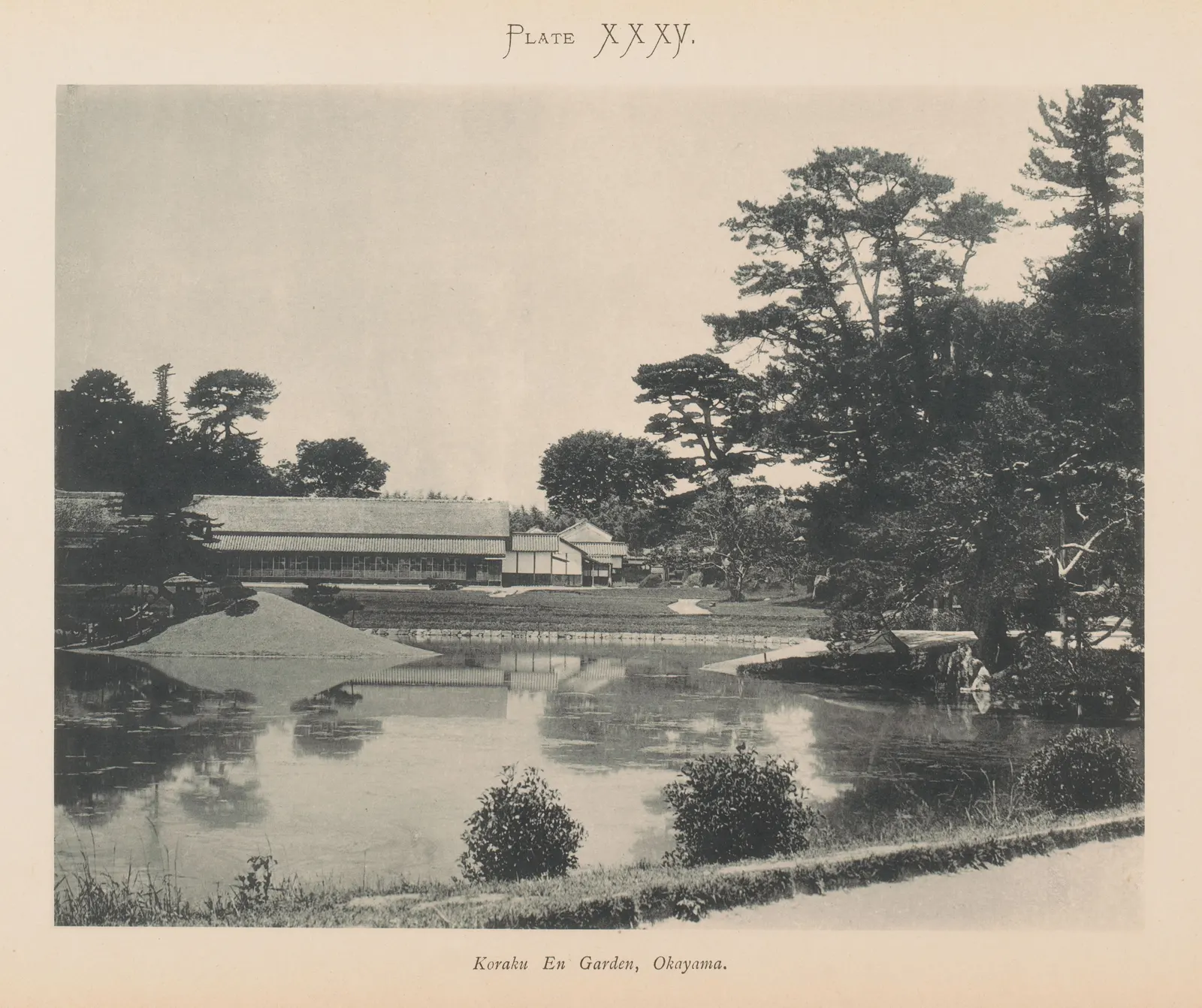
Kōraku-en at Okayama, Plate XXXV in Josiah Conder's 1893 "Supplement to Landscape Gardening in Japan", collotype by Kazumasa Ogawa: a lake with a grassy mound, low buildings and tall trees beyond.
Credit and licence
"Gezicht op de Koraku-en tuinen in Okayama, Japan, RP-F-2001-7-1565-35" by Kazumasa Ogawa (Rijksmuseum) — https://commons.wikimedia.org/wiki/File:Gezicht_op_de_Koraku-en_tuinen_in_Okayama,_Japan,_RP-F-2001-7-1565-35.jpg — CC0 1.0 (https://creativecommons.org/publicdomain/zero/1.0/); modified: cropped to the plate, removing the blank facing page and the book edges
The oldest known manual is about water
The Sakuteiki (作庭記, "Records of Garden Making") is the oldest known Japanese text on making gardens. It is attributed to Tachibana no Toshitsuna (1028–1094) and usually dated to the second half of the eleventh century. Japanese Wikipedia notes several theories about its editor and date, with Toshitsuna the accepted one; a 2025 study describes it as compiled in the late Heian to early Kamakura period.
Its chapters, as Japanese Wikipedia lists them, cover setting stones, island shapes, waterfalls, garden streams, taboos, trees and springs, and the manual has no drawings at all. English Wikipedia lists five landscape styles in it: ocean, mountain torrent, broad river, wetland and reed. Four are named after kinds of water and the fifth after a plant.
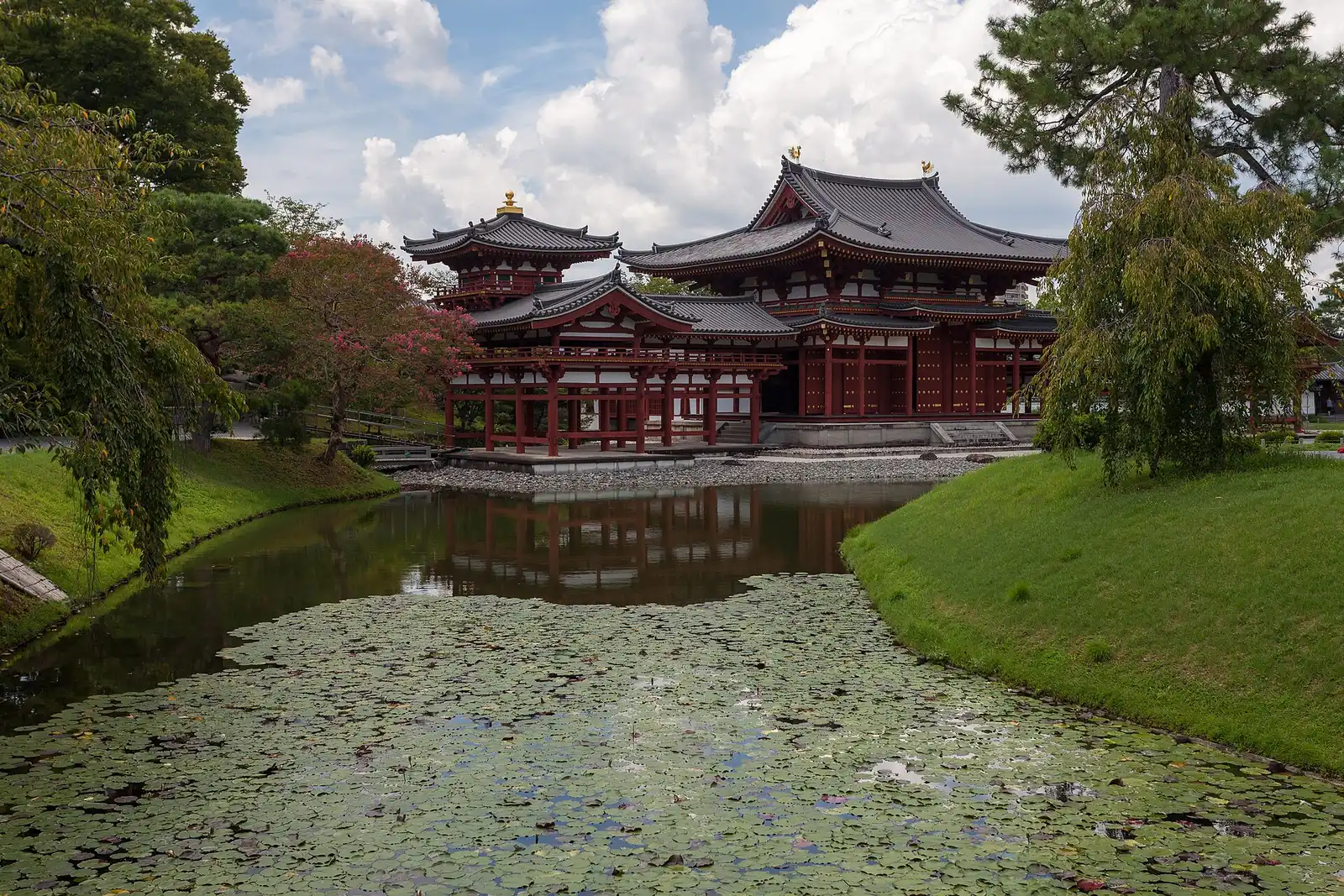
The Phoenix Hall of Byōdō-in in Uji, completed in 1053, the century to which the manual is usually dated, seen across its pond in a photograph from 2019.
"Byōdō-in, Phoenix Hall" by Marco Almbauer — https://commons.wikimedia.org/wiki/File:Byōdō-in,_Phoenix_Hall.jpg — CC0 1.0 (https://creativecommons.org/publicdomain/zero/1.0/)
The dry garden appears in the manual too, as an exception. Japanese Wikipedia, citing a 2009 garden history by Ono Kenkichi, calls the Sakuteiki the first text to use the word karesansui. English Wikipedia quotes it placing a kare-sansui where there is neither a lake nor a stream. Mi-Ja Lee's 2019 study, read here in its abstract, describes that karesansui as a hill built in one part of the garden, with stones of different sizes set to suit the ground.
Trees stand in for landforms as well. In a passage on the four guardian spirits (shijin sōō), the manual recommends three plantings north of a house that has no hill there, according to the abstract of Ai Sato's 2025 study. The character naming that tree has been read as hinoki (Japanese cypress), natsume (jujube) or nire (elm), and Sato argues for elm. Because the name itself is in doubt, this page gives the tree no scientific name.
Ponds first, gravel later
Pond gardens are older than the manual: English Wikipedia reports an eighth-century garden built around a pond and a stream, found in digs at Nara. A pond garden from the century to which the manual is usually dated survives at Byōdō-in in Uji. A villa there became a temple in 1052, and its Phoenix Hall, a hall of the Amida Buddha, was finished in 1053 beside a large man-made pond. English Wikipedia counts it as the best surviving Heian paradise garden, a type built to represent the Buddhist Paradise of the West.
Fig. 1 puts the examples in this page's table in date order. The earliest dated garden there, Byōdō-in in 1053, comes 397 years before the earliest date proposed for the Ryōan-ji rock garden, about 1450, by this page's count. It comes 456 years before Daisen-in, a dry garden whose temple was built in 1509–1513.
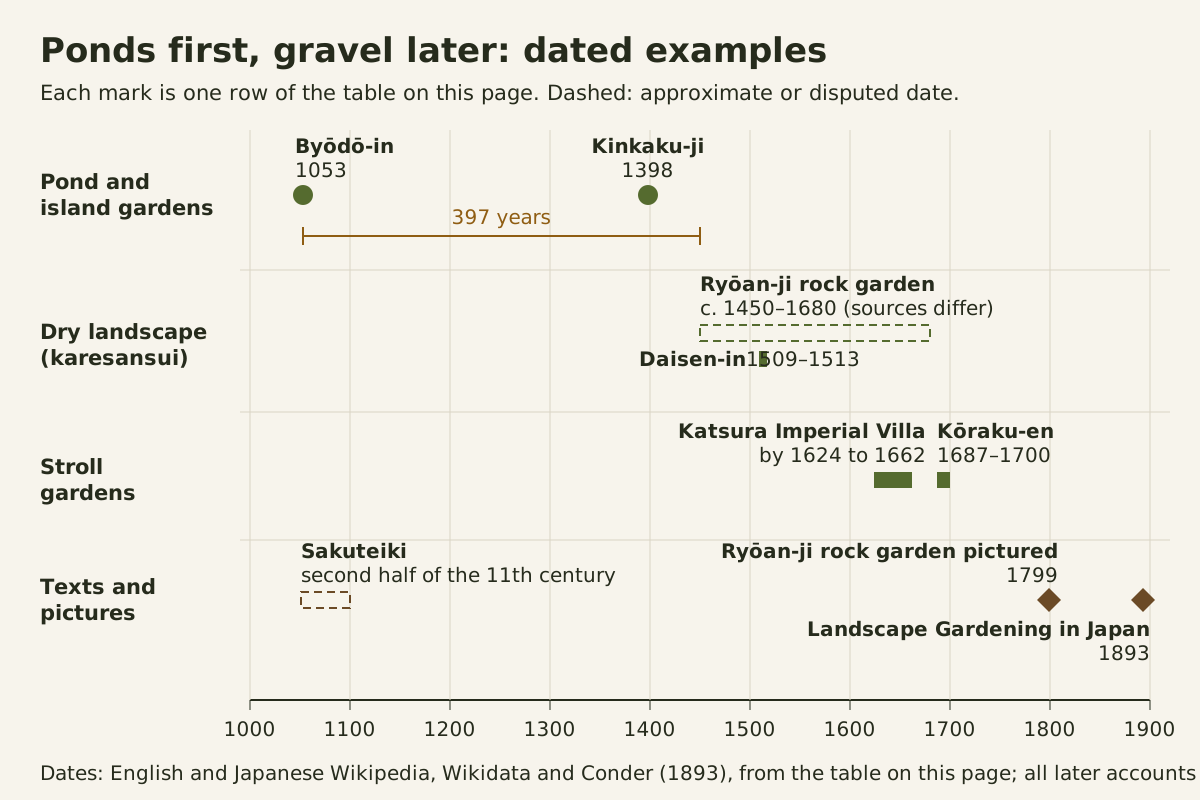
Fig. 1. Dated Japanese garden examples from the table on this page, 1000 to 1900: pond, dry landscape and stroll gardens, with two texts and the 1799 picture; dashed bars mark approximate or disputed dates.
"Ponds first, gravel later: dated Japanese garden examples" by Botany for the Curious, https://botanyforthecurious.com/gardens/japanese-garden/, licensed under CC BY 4.0 (https://creativecommons.org/licenses/by/4.0/)data: Dates from English Wikipedia, Japanese Wikipedia, Wikidata (CC0) and Ai Sato 2025 (abstract), retrieved 2026-10-21; Josiah Conder, Landscape Gardening in Japan, 1893 (public domain), retrieved 2026-10-21; year gaps computed 2026-10-21Download Dated examples (CSV) japanese-garden-dated-examples.csv data: English Wikipedia articles on Byōdō-in, Sakuteiki, the Japanese garden, the Japanese dry garden, Ryōan-ji, Daisen-in, Katsura Imperial Villa and Kōraku-en (dates), retrieved 2026-10-21; Japanese Wikipedia, "作庭記" and "龍安寺" (dating), retrieved 2026-10-21; Wikidata (CC0), Q61094, Q587371 and Q1377689 inception dates, retrieved 2026-10-21; Ai Sato 2025, Landscape Research Japan Online 18: 126–134 (abstract), retrieved 2026-10-21; Josiah Conder, Landscape Gardening in Japan and Supplement, 1893 (public domain), retrieved 2026-10-21; Rijksmuseum object records (CC0), retrieved 2026-10-21
Most dates in the table come from English Wikipedia and Wikidata rather than from documents of the time, so they carry the evidence level later account. The Sources and Standards page sets out the three levels.
Ponds did not give way to gravel. Kinkaku-ji, built in 1398, stands in a water garden, and the stroll gardens at Katsura and Kōraku-en were laid out around ponds in the seventeenth century. The same gardens appear beside other traditions on the garden-style timeline.
Conder's history gives the dry garden a different beginning. He placed the first dry-water scenery in the Kamakura period, from the mid-twelfth century to the early fourteenth: lakes and rivers drawn in sand, pebbles and boulders, like shallow streams dried by drought (pp. 15–16). That is later than the eleventh-century date usually given for the Sakuteiki, and earlier than the gravel gardens of Kyoto's temples.
When gravel filled the courtyard
Gravel itself is old in Japanese gardens. In the Heian period the south garden of the imperial residence held a large open area of white sand or gravel for ceremonies, according to English Wikipedia. What came later was the dry landscape garden, often called a Zen garden in English. In it, raked gravel stands for water, and a wall or buildings usually enclose the scene.
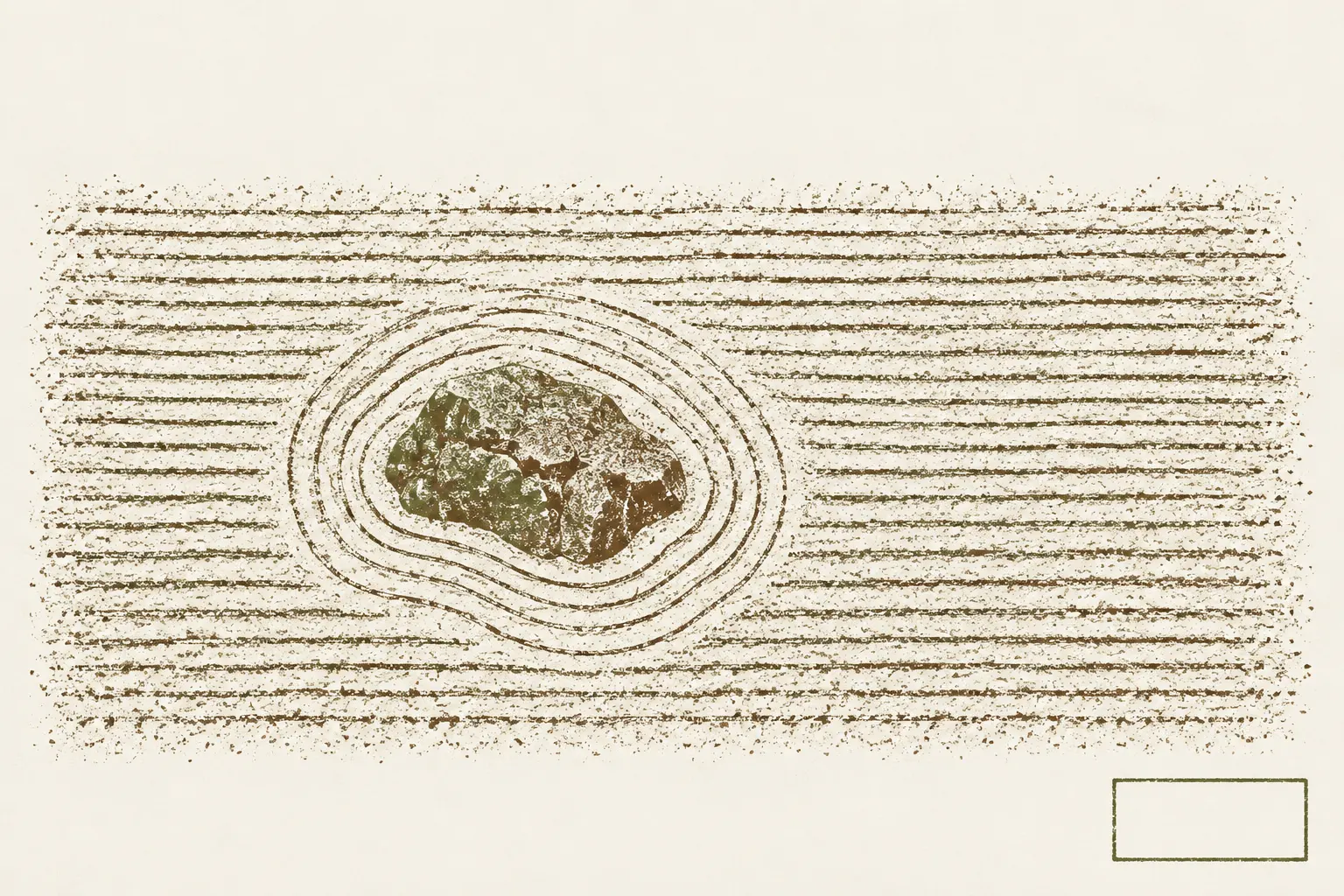
Gravel raked in lines around a single stone, the way raked gravel stands for water in a dry landscape garden.
Illustration: Botany for the Curious. Generated schematic image — not a photograph or botanical record. Reuse terms: no license is granted; any rights Botany for the Curious holds in this image are reserved.Ryōan-ji, a Kyoto temple founded in 1450, holds the best-known example in the city: fifteen stones in five groups set in raked white gravel, with moss around the stones as the only plants. Its date is disputed. English Wikipedia reports that most sources place the garden in the second half of the fifteenth century, and others in the first half of the sixteenth or in 1618–1680. The earliest known description of a garden in front of the main hall is from 1680–1682.
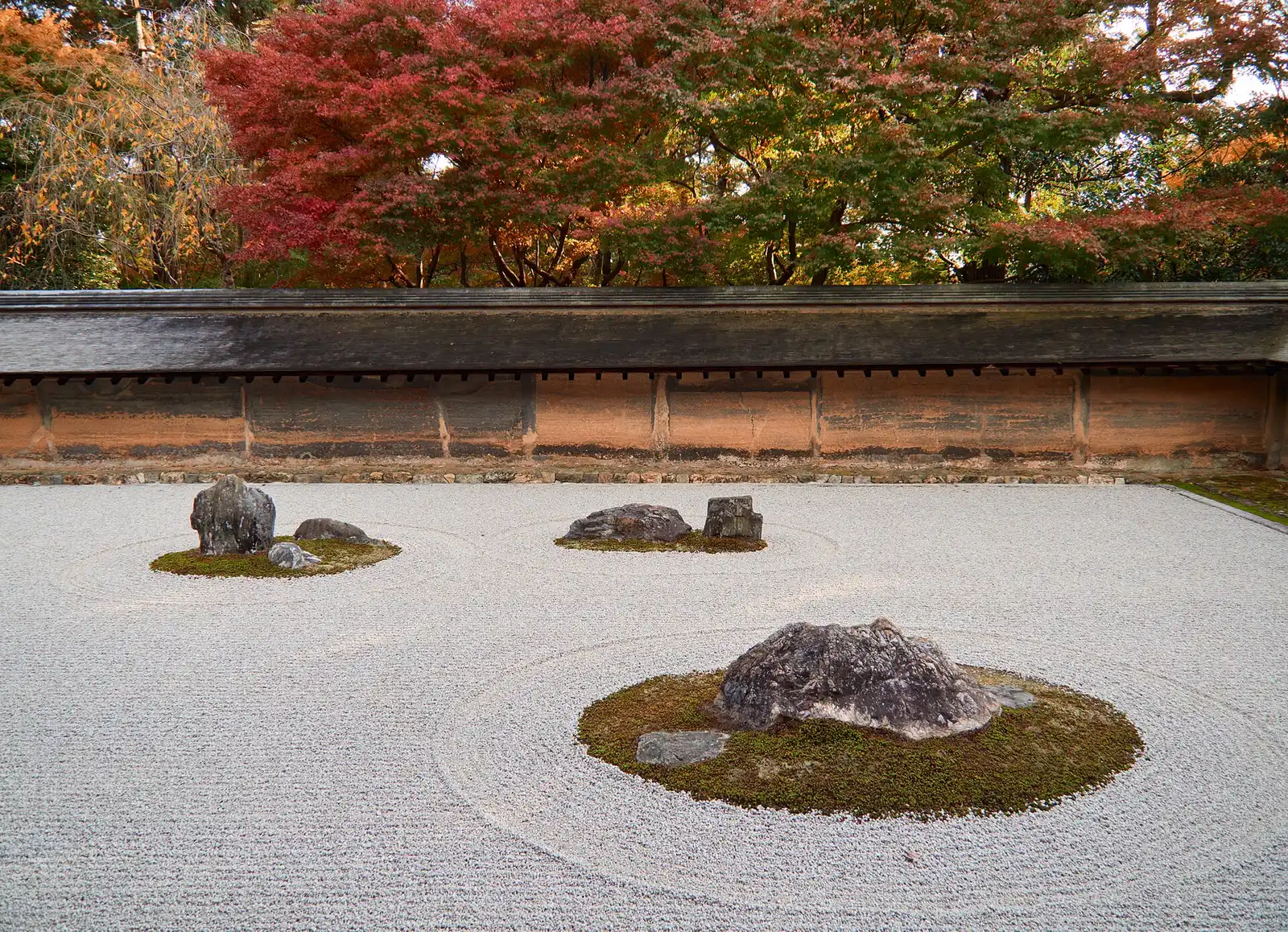
The raked gravel and rock garden at Ryōan-ji in Kyoto, with moss around the stones and trees in autumn colour behind the wall.
"Ninna-ji and Ryoan-ji, Kyoto - Ryoanji7753" by lumoplank — https://commons.wikimedia.org/wiki/File:Ninna-ji_and_Ryoan-ji,_Kyoto_-_Ryoanji7753.jpg — CC0 1.0 (https://creativecommons.org/publicdomain/zero/1.0/)
That description lists nine large stones, not today's fifteen. English Wikipedia, citing Wybe Kuitert, says the garden was remade after a fire in 1779 and pictured in its present layout in Miyako rinsen meisho zue in 1799; Japanese Wikipedia dates the fire to 1797. Conder's 1893 account credits it to the painter Sōami and calls it an ocean scene made without a single tree (pp. 16–17). That later account was written nearly a century after the rebuilding.
Daisen-in, also in Kyoto, is dated more narrowly. Its temple was built in 1509–1513, and its garden uses raked white gravel as a river; English Wikipedia notes that the gravel "Ocean" and "Middle Sea" are thought to be later additions. That garden is also credited to Sōami, though there is no written evidence that he made gardens.
Tea paths and stroll gardens
Tea gardens were made to be walked through on the way to a tea room. Conder wrote that from the late fourteenth century to the end of the sixteenth, most famous garden designs were tea gardens, laid out under the rules of the tea ceremony (p. 19). English Wikipedia dates the tea garden to the Muromachi and Momoyama periods and credits Sen no Rikyū (1522–1591) with setting its rules: a small garden kept damp and green, a path to the tea house, and a stone basin where guests rinsed their hands.
Plants in the roji were kept quiet: the same account says the garden usually had a cherry tree or elm for spring colour, but otherwise no bright flowers or exotic plants. Conder's album shows a tea garden at Fukagawa in Tokyo shaded by maples and evergreens. A dry, rocky channel runs through it, with a naturally hollowed stone used as a water basin.
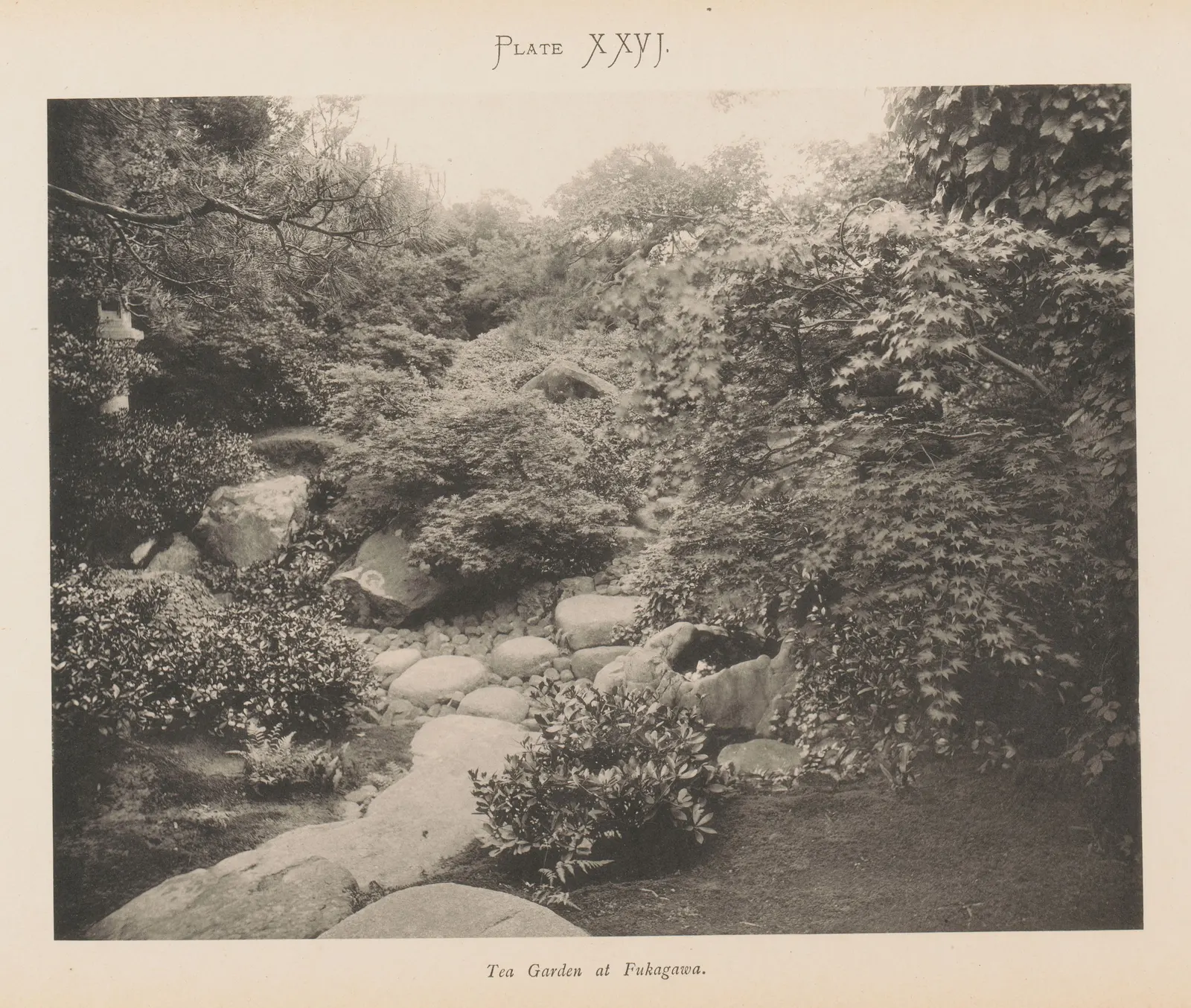
Tea garden at Fukagawa, Plate XXVI in Conder's 1893 "Supplement to Landscape Gardening in Japan", collotype by Kazumasa Ogawa: a rocky bed of rounded stones under dense foliage, with a stone lantern at the left.
Credit and licence
"Gezicht op een theetuin in Fukagawa in Tokyo, Japan, RP-F-2001-7-1565-26" by Kazumasa Ogawa (Rijksmuseum) — https://commons.wikimedia.org/wiki/File:Gezicht_op_een_theetuin_in_Fukagawa_in_Tokyo,_Japan,_RP-F-2001-7-1565-26.jpg — CC0 1.0 (https://creativecommons.org/publicdomain/zero/1.0/); modified: cropped to the plate, removing the blank facing page and the book edges
The stroll garden spread in the Edo period. English Wikipedia describes large gardens seen from a path that circles them, with fixed viewing points and views borrowed from hills beyond. Kōraku-en in Okayama, begun in 1687 for Ikeda Tsunamasa and finished in 1700, lies around a central pond. Conder followed its stream from the lake into a shallow marsh planted with irises (p. 39).
Conder credited the garden at Katsura in Kyoto to the tea master Kobori Enshū (p. 18). English Wikipedia's article on the villa tells its history through the princes who owned it, with hills formed and a pond dug in the middle of the garden by 1624. The same encyclopedia's Japanese garden article dates the garden from 1641 to 1662.
Sources
- Conder, Josiah. Landscape Gardening in Japan. Tokyo: Kelly and Walsh, 1893. https://archive.org/details/landscapegarden1cond preface (p. v), pp. 15–19, 38–39 and 133–140 (1893 printing)
- Conder, Josiah. Supplement to Landscape Gardening in Japan. Collotypes by K. Ogawa. Tokyo: Kelly and Walsh, 1893. https://archive.org/details/supplementtoland00condrich preface and the text to Plates XXVI, XXXV and XXXVI (1893 printing)
- Sato, Ai (2025). A Study of the Unidentified Tree Species "X" in the "Sakuteiki". Landscape Research Japan Online 18: 126–134. doi:10.5632/jilaonline.18.126 https://doi.org/10.5632/jilaonline.18.126 abstract
- Lee, Mi-Ja (2019). A Study on the Karesansui and Ishigumi Culture in Sakuteiki. Japanese Cultural Studies 70: 87–105. doi:10.18075/jcs..70.201904.087 https://doi.org/10.18075/jcs..70.201904.087 abstract (in Korean)
- Wikidata, "Byōdō-in" (Q61094), inception statement (read 2026-10-21). https://www.wikidata.org/wiki/Q61094 item page, inception statement
- Wikidata, "Ryōan-ji" (Q587371), inception statement (read 2026-10-21). https://www.wikidata.org/wiki/Q587371 item page, inception statement
- Wikidata, "Kōraku-en" (Q1377689), inception statement (read 2026-10-21). https://www.wikidata.org/wiki/Q1377689 item page, inception statement
- Japanese Wikipedia, "作庭記" (Sakuteiki) (read 2026-10-21). https://ja.wikipedia.org/wiki/%E4%BD%9C%E5%BA%AD%E8%A8%98 summarised here through Japanese Wikipedia
- Japanese Wikipedia, "龍安寺" (Ryōan-ji) (read 2026-10-21). https://ja.wikipedia.org/wiki/%E9%BE%8D%E5%AE%89%E5%AF%BA summarised here through Japanese Wikipedia
- English Wikipedia, "Sakuteiki" (read 2026-10-21). https://en.wikipedia.org/wiki/Sakuteiki summarised here through English Wikipedia
- English Wikipedia, "Japanese garden" (read 2026-10-21). https://en.wikipedia.org/wiki/Japanese_garden summarised here through English Wikipedia
- English Wikipedia, "Japanese dry garden" (read 2026-10-21). https://en.wikipedia.org/wiki/Japanese_dry_garden summarised here through English Wikipedia
- English Wikipedia, "Byōdō-in" (read 2026-10-21). https://en.wikipedia.org/wiki/By%C5%8Dd%C5%8D-in summarised here through English Wikipedia
- English Wikipedia, "Ryōan-ji" (read 2026-10-21). https://en.wikipedia.org/wiki/Ry%C5%8Dan-ji summarised here through English Wikipedia
- English Wikipedia, "Daisen-in" (read 2026-10-21). https://en.wikipedia.org/wiki/Daisen-in summarised here through English Wikipedia
- English Wikipedia, "Katsura Imperial Villa" (read 2026-10-21). https://en.wikipedia.org/wiki/Katsura_Imperial_Villa summarised here through English Wikipedia
- English Wikipedia, "Kōraku-en" (read 2026-10-21). https://en.wikipedia.org/wiki/K%C5%8Draku-en summarised here through English Wikipedia
Related
- Gardens of Versailles: The King Wrote Where to Stop and Look Deep explainer
- History of Garden Design: Styles Overlapped for Centuries Comparison and chart
Cite this page
Botany for the Curious. “Japanese Garden: The Pond Came Centuries Before Raked Gravel.” Published 2026-10-22; last substantive revision 2026-10-22. https://botanyforthecurious.com/gardens/japanese-garden/ (accessed: add the date you read it).
- Published
- Last substantive revision