Tea & CoffeeDeep explainer
Types of Tea: One Leaf, Six Paths, Three Kinds of Change
- Published
- Last substantive revision
Spec card
- Subject
- The six tea types: green, white, yellow, oolong, black and dark teaSource: Y. Li et al. 2023
- Botanical name
- Camellia sinensis (L.) Kuntze, the tea plant (Theaceae). Var. sinensis and var. assamica are both accepted; the two checklists credit var. assamica to different authorsSource: WCVP (Kew) 2026-06; World Flora Online Plant List 2026-06
- Processing stage
- Withering, turning-over, fixing, rolling, oxidation, yellowing, piling, dryingSource: Y. Li et al. 2023; Fan et al. 2022; Q. Li et al. 2018
- Key compounds (PubChem CID)
- (−)-epigallocatechin gallate, EGCG (CID 65064, via Wikidata); theaflavin (CIDs 114777 and 135403798, both via Wikidata); thearubigins (a group of polymers with no single CID); caffeine (CID 2519, via Wikidata); theanine (CIDs 439378 and 25201220, both via Wikidata)Source: Wikidata Q393339, Q415677, Q5944537, Q60235, Q909931
- Earliest record (evidence level)
- Cha Jing 茶經 by Lu Yu (Tang dynasty): pick, steam, pound, pat, bake, string and seal the tea; contemporary record of Tang tea-making, the earliest tea-making record among the sources checked for this pageSource: Lu Yu, Cha Jing, chapter 3 (Chinese Wikisource)
Download this card as CSV tea-processing-spec-card.csv data: Y. Li et al. 2023, Food Chemistry: X 18: 100731 (step names only), retrieved 2026-10-21; WCVP (Kew), CC BY 3.0, doi:10.34885/egs6-cp24, retrieved 2026-10-21; World Flora Online Plant List 2026-06 (CC0), retrieved 2026-10-21; Fan et al. 2022, Molecules 27: 940 (CC BY 4.0), retrieved 2026-10-21; Q. Li et al. 2018, Frontiers in Microbiology 9: 1509 (CC BY 4.0), retrieved 2026-10-21; Wikidata (CC0), Q393339, Q415677, Q5944537, Q60235, Q909931, PubChem CIDs, retrieved 2026-10-21; Lu Yu, Cha Jing, chapter 3, Chinese Wikisource text (public domain), retrieved 2026-10-21
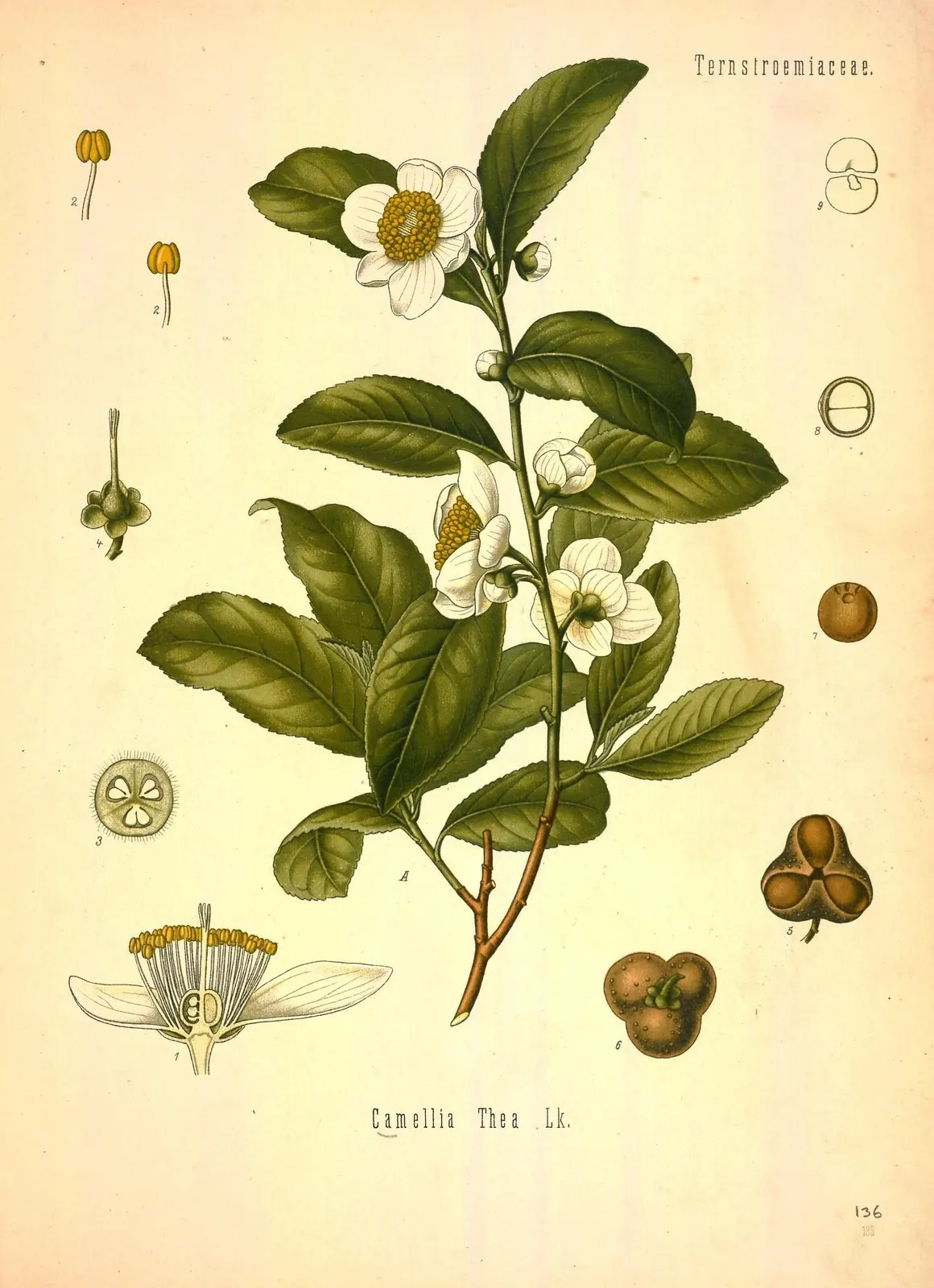
Plate 136 of Köhler's "Medizinal-Pflanzen" (1890) shows the tea plant under an older name, Camellia thea, with its flowers, fruit and seeds drawn in detail.
Credit and licence
"Köhler's Medizinal-Pflanzen in naturgetreuen Abbildungen mit kurz erläuterndem Texte (Plate 136) (8231734373)" by Köhler's Medizinal-Pflanzen (Biodiversity Heritage Library) — https://commons.wikimedia.org/wiki/File:K%C3%B6hler's_Medizinal-Pflanzen_in_naturgetreuen_Abbildungen_mit_kurz_erl%C3%A4uterndem_Texte_(Plate_136)_(8231734373).jpg — Public domain (Plate 136, published in vol. 2 of "Köhler's Medizinal-Pflanzen" in 1890; the plate artist is not named, so the plate is treated as an anonymous work; US: published before 1931; EU: an anonymous work made public more than 70 years ago; the Biodiversity Heritage Library scan is a faithful reproduction)
In a 2023 trial, all six types of tea came from leaves of one cultivar, a single named tea variety. Green, white, yellow, oolong, black and dark tea are normally made from one species, Camellia sinensis, the tea plant, and they differ in what is done to the leaf after picking. A 2019 study of 30 Chinese teas, following earlier work, sorts them on one scale of "fermentation", from unfermented green tea to post-fermented dark tea. That scale hides three different kinds of change: the leaf's own enzymes oxidising (chemically converting) its catechins, damp heat working after those enzymes have been stopped, and microbes growing in a moist pile.
One species behind all six
The World Checklist of Vascular Plants (WCVP) places the tea plant in the family Theaceae, as of its June 2026 release. Flora of China notes that tea is made from the buds and young leaves of two varieties, var. sinensis and var. assamica. It adds that other varieties, and even other Camellia species, are used locally.
WCVP and the World Flora Online Plant List (June 2026) both accept var. assamica, but they credit the name to different authors: WCVP gives (Royle ex Hook.) Steenis, World Flora Online (J.W.Mast.) Kitam.
The 2023 trial, by Yuchuan Li and colleagues, took all six types from one cultivar, Mingke No. 1, picked in Hubei, China, in August 2020. A cultivar is a named variety that growers select and keep going by propagation. Using one cultivar kept differences between tea varieties out of the comparison, leaving processing as the variable. Breeding a cultivar is selection across generations of plants; processing is handling, done to leaves that have already been picked.
Flora of China describes the tea leaf blade as elliptic to oblong and leathery, with a cuneate base and a serrate to serrulate margin. Those words belong to the descriptive vocabulary set out in Leaf Shapes. The coffee plant, the other half of this category, gets its own history in History of Coffee. This page stays with the tea leaf.
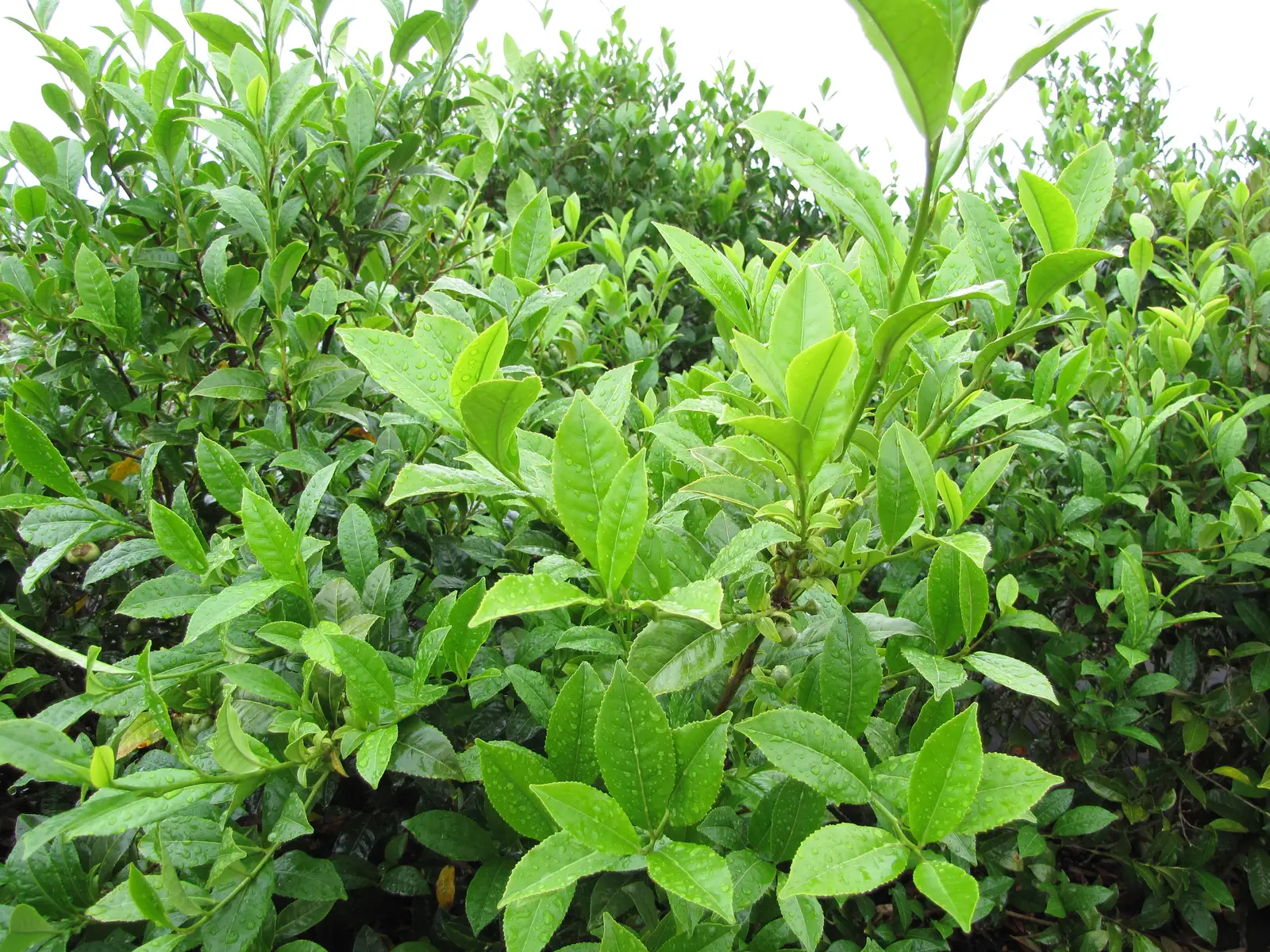
Leaves of Camellia sinensis at Kula Agriculture Station on Maui, Hawaii, photographed in June 2012, with small teeth along the margins.
"Starr-120620-7479-Camellia sinensis-leaves-Kula Agriculture Station-Maui (24850093120)" by Forest & Kim Starr — https://commons.wikimedia.org/wiki/File:Starr-120620-7479-Camellia_sinensis-leaves-Kula_Agriculture_Station-Maui_(24850093120).jpg — CC BY 3.0 US (https://creativecommons.org/licenses/by/3.0/us/)
Six paths on one chart
The six paths split on whether heat reaches the leaf before its enzymes have done much work. Green, yellow and dark tea are heated early, in a step called fixing (殺青 in Chinese), which inactivates the leaf's enzymes. White, oolong and black tea are not heated first, so their enzymes act on the leaf. That happens through a long withering in white tea (the picked leaves are left to lose water), part of the way in oolong before a later fixing, and fully in black tea.
After fixing, the heated group divides again. Green tea is rolled and dried, and in the 2023 trial its make-up changed little after fixing. Yellow tea is held warm and damp after rolling, and dark tea is piled so that microbes can grow. Fig. 1 lays out all six sequences, with each step marked by the kind of change that happens there.
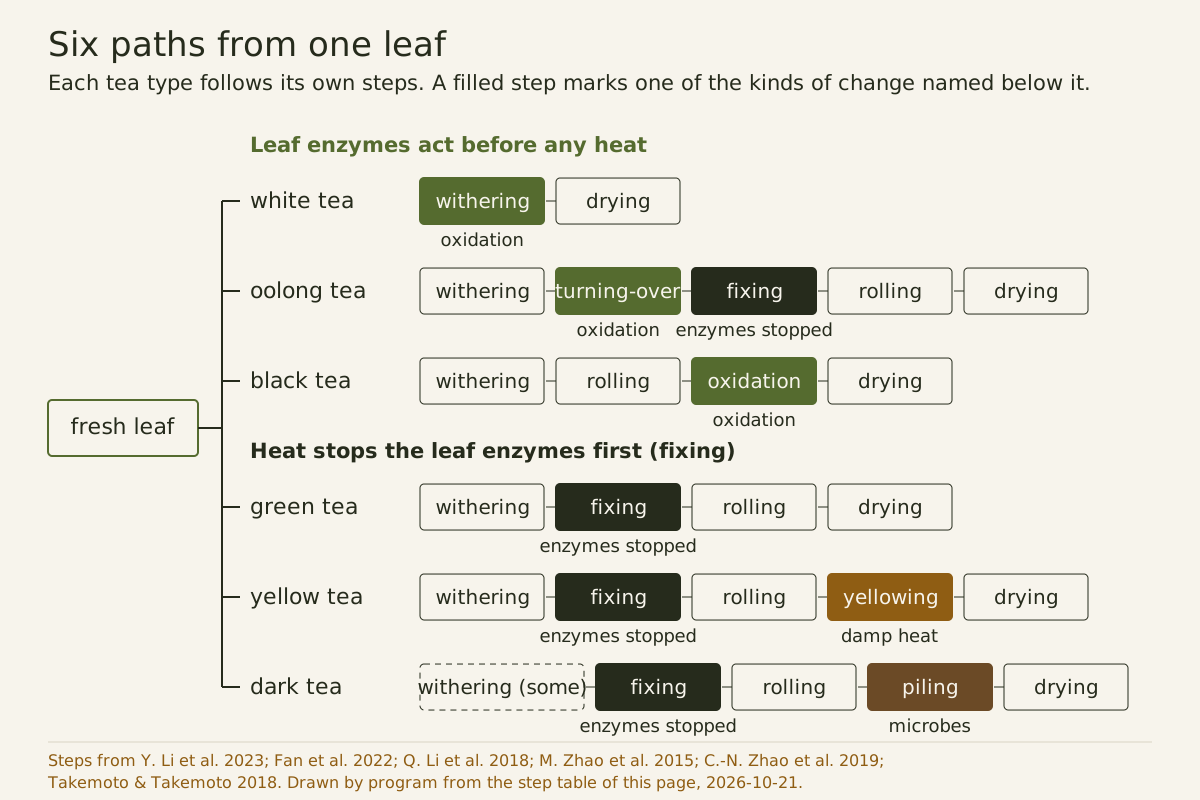
Fig. 1. The six tea types in two groups: three let the leaf enzymes work before any heat, and three are fixed first, then left as they are, yellowed in damp heat or piled with microbes.
"Six paths from one leaf" by Botany for the Curious, https://botanyforthecurious.com/tea-coffee/tea-processing/, licensed under CC BY 4.0 (https://creativecommons.org/licenses/by/4.0/)data: Y. Li et al. 2023, Food Chemistry: X 18: 100731 (step names only), retrieved 2026-10-21; Fan et al. 2022, Molecules 27: 940 (CC BY 4.0), retrieved 2026-10-21; Q. Li et al. 2018, Frontiers in Microbiology 9: 1509 (CC BY 4.0), retrieved 2026-10-21; M. Zhao et al. 2015, Scientific Reports 5: 10117 (CC BY 4.0), retrieved 2026-10-21; C.-N. Zhao et al. 2019, Antioxidants 8: 215 (CC BY 4.0), retrieved 2026-10-21; Takemoto & Takemoto 2018, Molecules 23: 918 (CC BY 4.0), retrieved 2026-10-21Two traps sit in the names. The step that makes black tea is called fermentation in many studies and, sometimes, in the tea trade. Yet its reactions are oxidations driven by the leaf's own enzymes, and English Wikipedia's summary of tea processing flags the word as a misnomer. In Chinese, black tea is 紅茶 (hong cha, "red tea"), and 黑茶 (hei cha, "black tea") is the microbial dark tea, as English Wikipedia's articles on black tea and fermented tea explain.
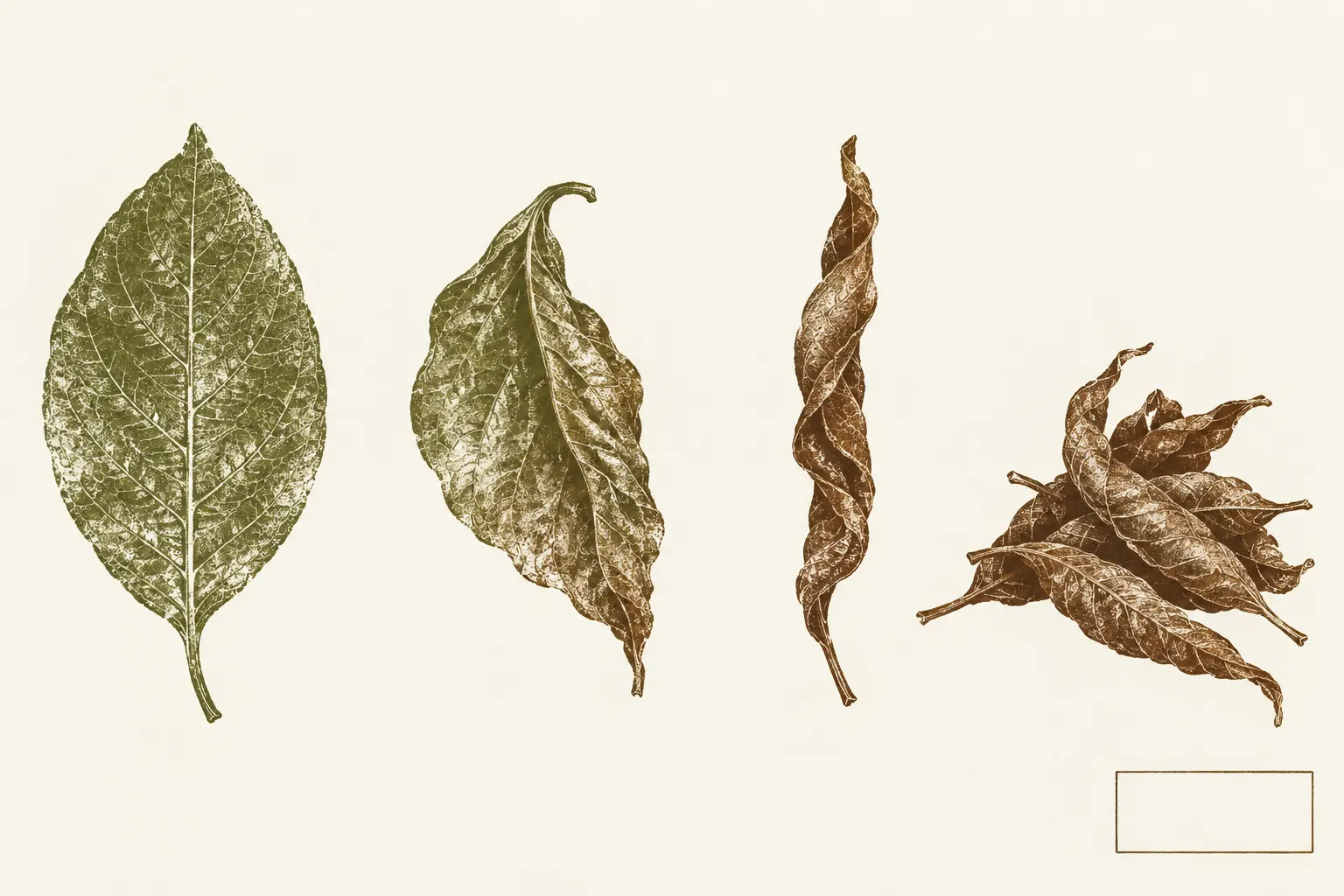
Four states a picked leaf can be in during processing: fresh, withered, rolled and piled.
Illustration: Botany for the Curious. Generated schematic image — not a photograph or botanical record. Reuse terms: no license is granted; any rights Botany for the Curious holds in this image are reserved.Change one: the leaf's enzymes meet oxygen
Fresh tea leaves carry two enzymes that oxidise catechins, a family of plant compounds called polyphenols. Polyphenol oxidase does this with oxygen and peroxidase with hydrogen peroxide, turning a catechin into a reactive quinone. The PubChem identifiers on the spec card and in Fig. 2 are the ones Wikidata records, and each reaction is cited to food-chemistry research, as Sources and Standards sets out.
In black tea, these enzymes turn pairs of catechins into theaflavins, the tea's main red pigments. A 2018 review by Masumi and Hiroaki Takemoto lists four pairings: (−)-epicatechin with (−)-epigallocatechin gives theaflavin itself, and the gallate forms of the two catechins give theaflavin 3-gallate, 3′-gallate and 3,3′-digallate. The same review reports earlier measurements: as the oxidation step was made longer, theaflavins fell and thearubigins, a group of larger, polymeric pigments, rose.
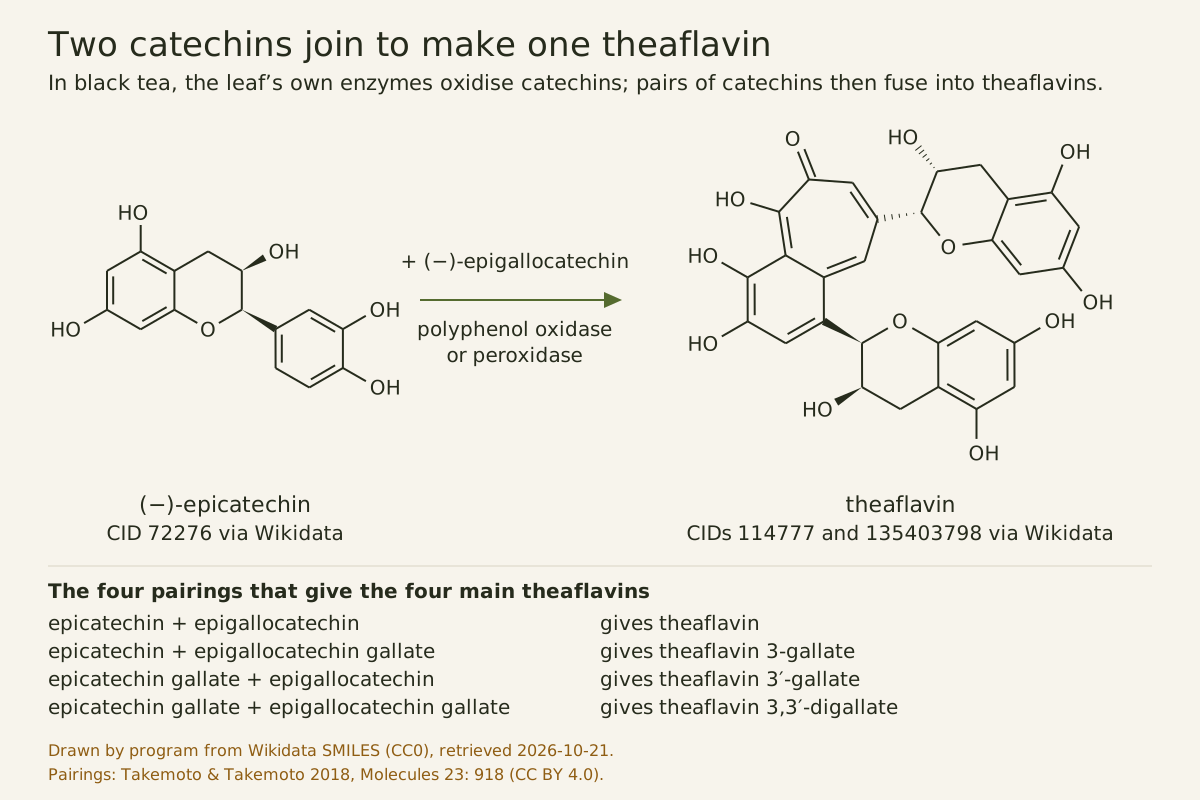
Fig. 2. (−)-Epicatechin and theaflavin, drawn from their Wikidata SMILES, with the four catechin pairings behind the main theaflavins; CID via Wikidata.
"Two catechins join to make one theaflavin" by Botany for the Curious, https://botanyforthecurious.com/tea-coffee/tea-processing/, licensed under CC BY 4.0 (https://creativecommons.org/licenses/by/4.0/)data: Wikidata (CC0), Q23050136 and Q415677, PubChem CIDs 72276, 114777 and 135403798 and isomeric SMILES, retrieved 2026-10-21; Takemoto & Takemoto 2018, Molecules 23: 918 (CC BY 4.0), retrieved 2026-10-21Download Compound identities used on this page (CSV) tea-processing-compounds.csv data: Wikidata (CC0), Q23050136, Q393339, Q415677, Q5944537, Q60235, Q909931, PubChem CIDs, isomeric SMILES and formulas, retrieved 2026-10-21; Takemoto & Takemoto 2018, Molecules 23: 918 (CC BY 4.0), retrieved 2026-10-21
Oolong stops this reaction part-way. Its leaves are withered and turned over several times, a step that works through mechanical damage and water loss. Li and colleagues, citing earlier work, place most of oolong's oxidation in the turning. Fixing then ends it by inactivating the enzymes.
Black tea has no fixing step: after withering and rolling, the leaves are held warm and humid while they oxidise, and then dried. In the 2023 trial, EGCG, (−)-epigallocatechin gallate, fell most during black tea's oxidation step. It fell less in dark tea's pile, oolong's turning, white tea's withering and yellow tea's yellowing. In green tea it did not change significantly.
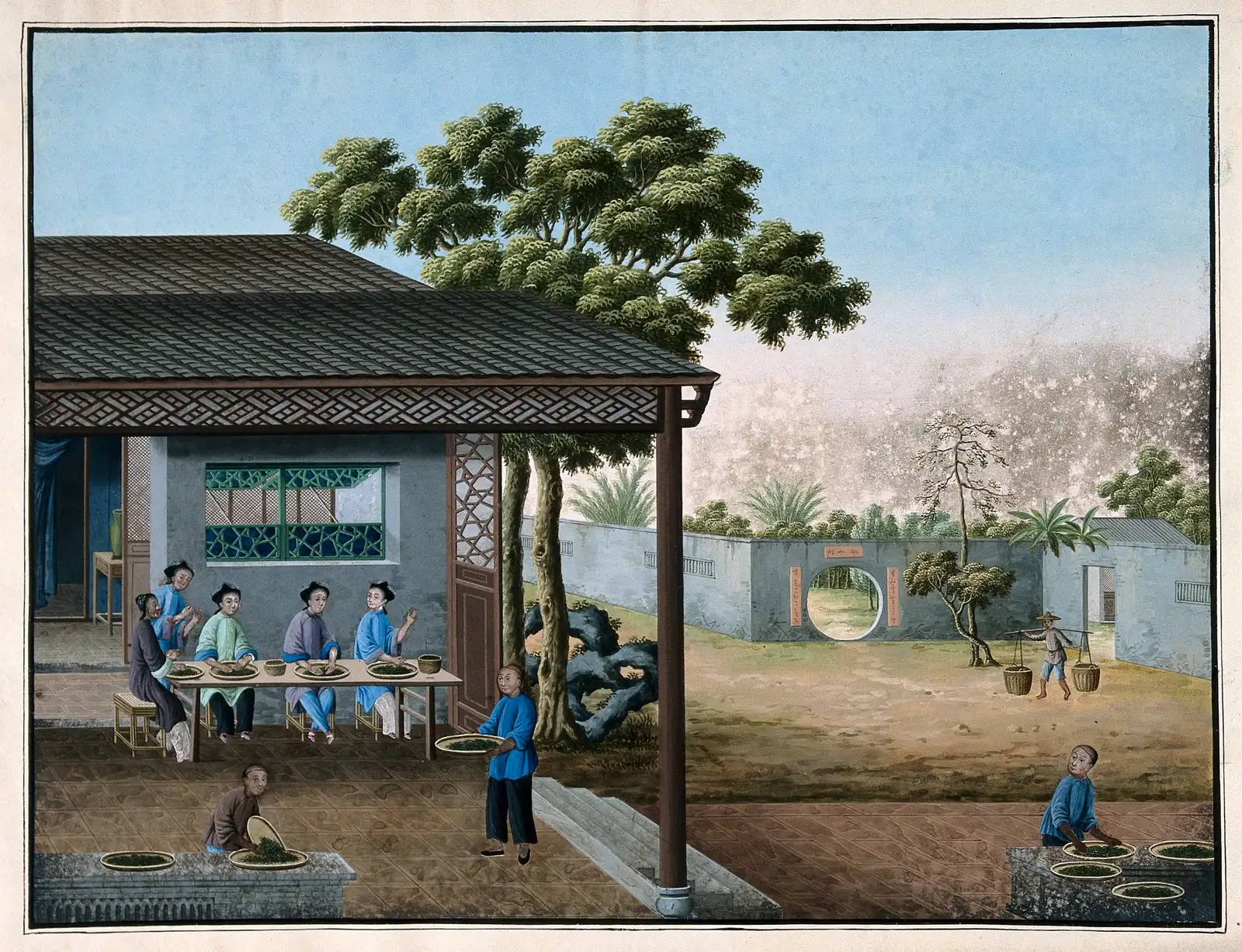
An undated gouache in the Wellcome Collection shows workers in China rolling and sifting tea leaves on round trays.
"A tea plantation in China with workers rolling and sifting t Wellcome V0019204" by Wellcome Collection — https://commons.wikimedia.org/wiki/File:A_tea_plantation_in_China_with_workers_rolling_and_sifting_t_Wellcome_V0019204.jpg — CC BY 4.0 (https://creativecommons.org/licenses/by/4.0/)
White tea is the slow case: in the processes these studies describe, it is withered and dried with no steaming or other heat step, so its enzymes stay active through the withering. A 2019 study by Cai-Ning Zhao and colleagues describes both enzymatic and non-enzymatic oxidation during that time. In the 2023 trial the white tea was withered for three days, and most of its change came in that step. Li and colleagues describe it, citing earlier work, as mainly hydrolysis, the splitting of molecules by water, so the two studies weigh the reactions differently and both are given here.
Fixing: heat stops the enzymes
Fixing decides how long the leaf's enzymes get to work. Takemoto and Takemoto list the ways it is done for unfermented teas: steaming, boiling, microwaving or electric heating, each used to inactivate the leaf's oxidases. In a 2018 study of primary dark tea in Hunan, China, fixing was done at 280 to 320 °C. It inactivated the leaf's polyphenol oxidase, cellulase and pectinase, though a little heat-resistant peroxidase survived.
Green tea shows fixing at its plainest. In Li and colleagues' analysis the finished green tea sat closest to the freshly fixed leaves, and they name fixing as the key step for green tea. Oolong uses the same heat later, to end its partial oxidation.
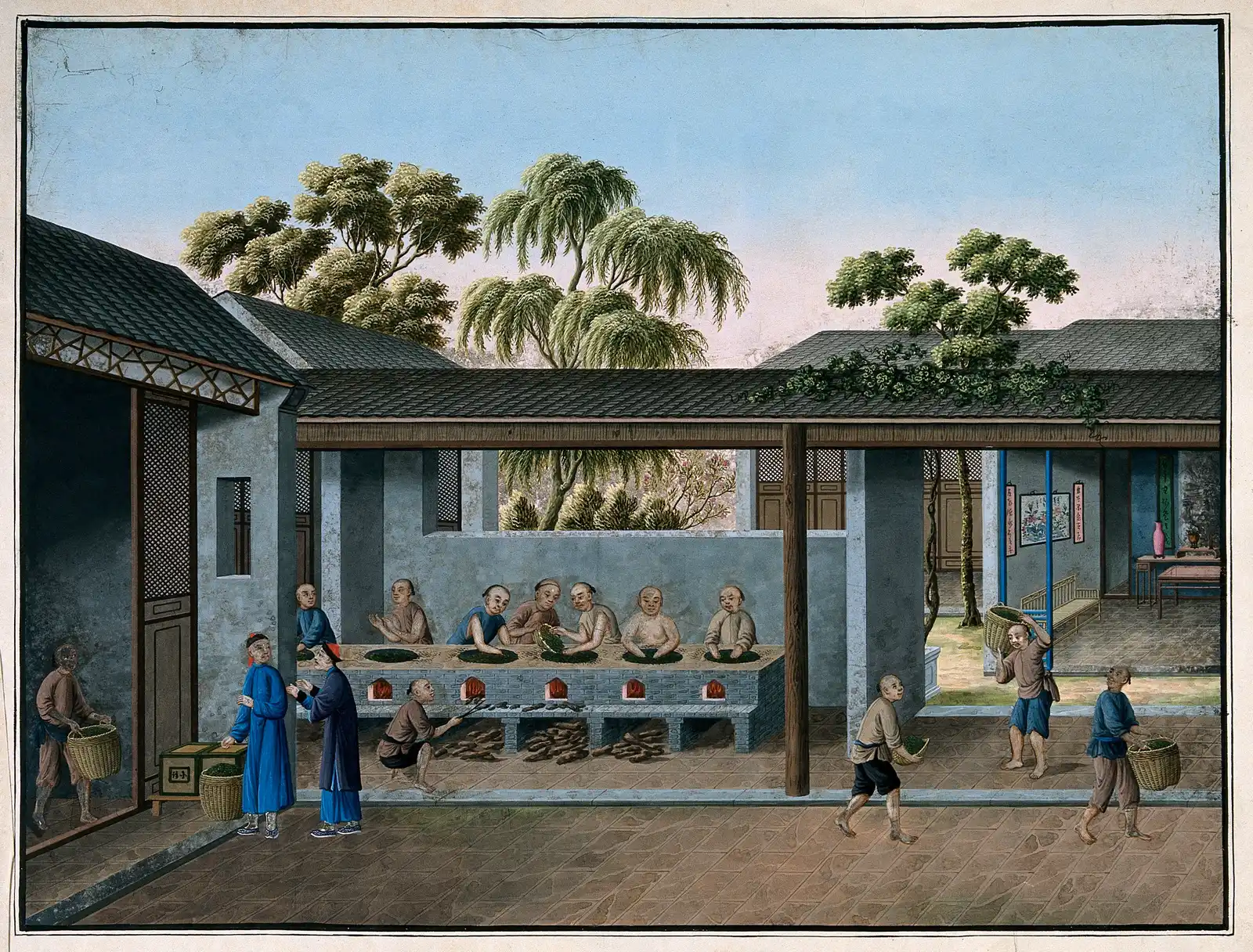
An undated gouache in the Wellcome Collection shows workers in China heating and drying tea leaves in pans set over a row of fires.
"A tea plantation in China with workers heating and drying te Wellcome V0019208" by Wellcome Collection — https://commons.wikimedia.org/wiki/File:A_tea_plantation_in_China_with_workers_heating_and_drying_te_Wellcome_V0019208.jpg — CC BY 4.0 (https://creativecommons.org/licenses/by/4.0/)
Heat on fresh leaves appears in the Cha Jing (茶經), the book on tea written by Lu Yu in the Tang dynasty. Its third chapter gives the making in a single line, 晴,採之,蒸之,擣之,拍之,焙之,穿之,封之,茶之乾矣: "On a clear day, pick it, steam it, pound it, pat it, bake it, string it and seal it, and the tea is dry" (Translation: Botany for the Curious). Steaming comes straight after picking.
The Cha Jing is a contemporary record, written at the time, of how tea was made in Lu Yu's day, and the earliest record of tea-making among the sources checked for this page. The line does not say which of the six modern types the result would match.
Change two: damp heat
Yellow tea begins like green tea: the leaves are spread, fixed and rolled. Then comes yellowing, in which the rolled leaves are kept warm and moist for hours before drying. Because fixing has already inactivated most of the enzymes, Li and colleagues describe the changes during yellowing as dominated by non-enzymatic reactions driven by heat and moisture. A 2022 study by Fang-Yuan Fan and colleagues calls them moisture-dependent thermochemical reactions.
In the trial by Fan's team, rolled leaves were held at a leaf temperature of about 45 °C, with about 37% leaf water and 80% air humidity, and sampled over 13 hours. As yellowing went on, the dry leaf turned from green to yellow and then to brown, and the catechin content fell, reaching its lowest after 13 hours. Citing earlier work, the same study names moisture, temperature, duration and ventilation as the main settings that steer these changes.
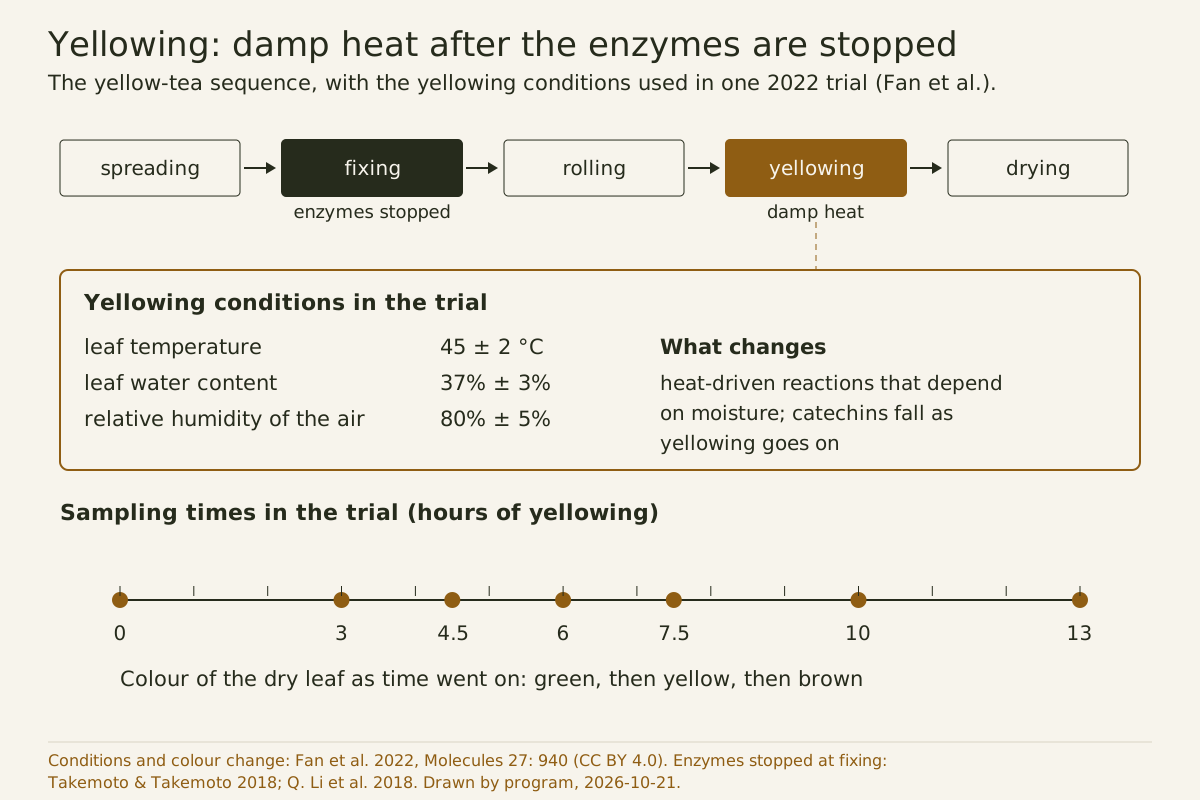
Fig. 3. Where yellowing sits in the yellow-tea sequence, with the leaf temperature, leaf water and air humidity used in one 2022 trial and the times it sampled.
"Yellowing: damp heat after the enzymes are stopped" by Botany for the Curious, https://botanyforthecurious.com/tea-coffee/tea-processing/, licensed under CC BY 4.0 (https://creativecommons.org/licenses/by/4.0/)data: Fan et al. 2022, Molecules 27: 940 (CC BY 4.0), retrieved 2026-10-21; Takemoto & Takemoto 2018, Molecules 23: 918 (CC BY 4.0), retrieved 2026-10-21; Q. Li et al. 2018, Frontiers in Microbiology 9: 1509 (CC BY 4.0), retrieved 2026-10-21Damp heat is not limited to yellow tea. Li and colleagues note that black tea's oxidation step and the dark-tea pile can also create it. In their trial, gallic acid rose most in the dark-tea pile, which they suggest may come from water splitting gallate groups off catechins in damp heat.
Change three: microbes in the pile
Dark tea is the microbial path. Its fixed and rolled leaves are piled while moist, a step called piling (渥堆 in Chinese), and bacteria and fungi grow in the warm, damp mass. Ming Zhao and colleagues call this solid-state fermentation, meaning microbes growing on solid material with little or no free water.
In a 2018 study by Qin Li and colleagues at a factory in Hunan, about 930 kg of rolled leaf was piled 1.1 m high for 12 hours. Polyphenol oxidase, inactivated by fixing, was undetectable when the pile was built. Its activity had appeared by the six-hour sample and then held steady. The team links it, and rising cellulase and pectinase, to the microbes.
Early on, the fungi Cyberlindnera and Aspergillus and the bacterium Klebsiella were among the commonest genera. Cyberlindnera and Klebsiella stayed dominant. The team concluded that fungi did more than bacteria to give the tea its characteristic properties.
Post-fermented pu-erh tea, as Ming Zhao and colleagues describe it in a 2015 study, comes from the same kind of fermentation of sun-dried green tea leaves of var. assamica. In their laboratory fermentation, sampled on day 21, Aspergillus made up 94.98% of the fungal DNA sequences and Proteobacteria 48.42% of the bacterial ones. Among the microbial proteins were enzymes that break down plant cell walls, which they link to the softening of the leaves. There were also catalases, a catalase-peroxidase and peroxiredoxins, which they suggest may oxidise catechins.
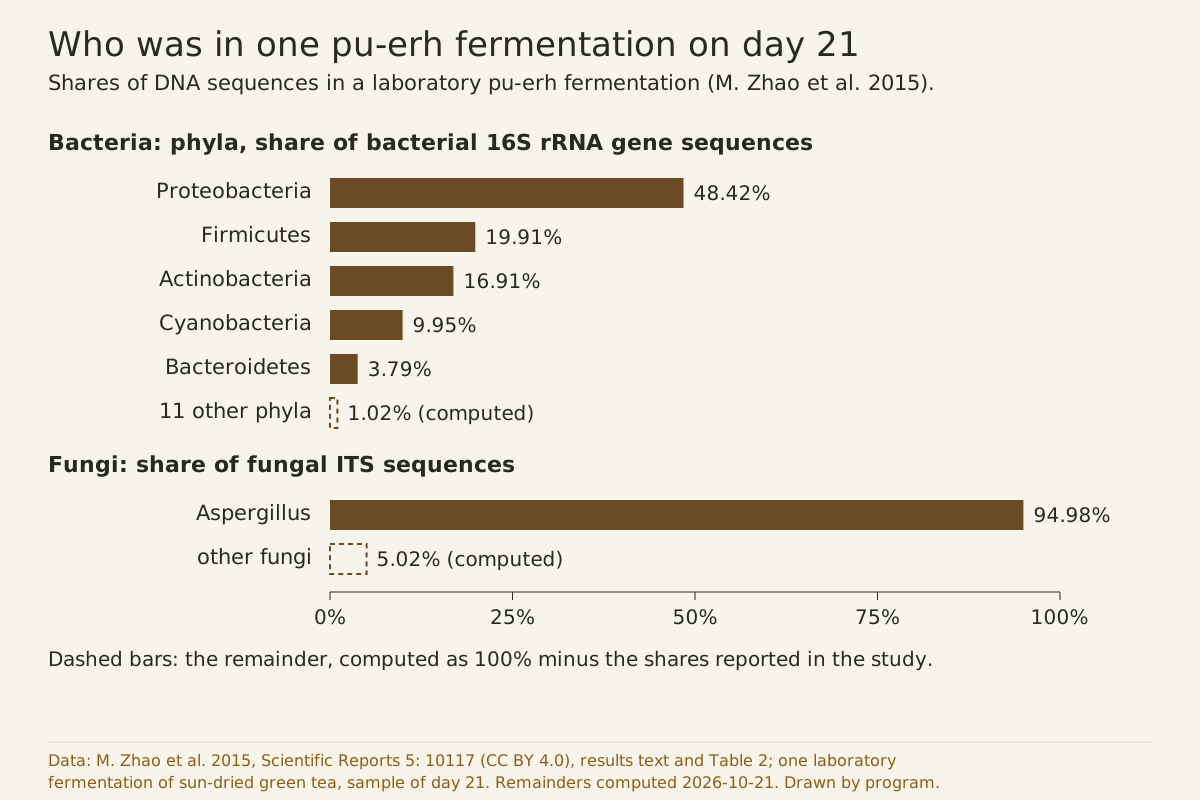
Fig. 4. Shares of bacterial and fungal DNA sequences in one laboratory pu-erh fermentation on day 21; the dashed remainders are computed from the shares the study reported.
"Who was in one pu-erh fermentation on day 21" by Botany for the Curious, https://botanyforthecurious.com/tea-coffee/tea-processing/, licensed under CC BY 4.0 (https://creativecommons.org/licenses/by/4.0/)data: M. Zhao et al. 2015, Scientific Reports 5: 10117 (CC BY 4.0), retrieved 2026-10-21; remainders computed 2026-10-21Download Pu-erh fermentation shares (CSV) tea-processing-pile-microbes.csv data: M. Zhao et al. 2015, Scientific Reports 5: 10117 (CC BY 4.0), retrieved 2026-10-21; remainders computed 2026-10-21
The two studies differ on one enzyme. Polyphenol oxidase activity rose in the Hunan pile, while the pu-erh study found no polyphenol oxidase among the microbial proteins it identified. In the 2023 trial, dark tea was made from finished green tea, wetted and piled for 30 days. Its finished make-up formed mainly in the pile.
Six types, step by step
| Tea type | Enzymes stopped early by heat? | Main kind of change | Key step named in the 2023 trial |
|---|---|---|---|
| Green tea | Yes: fixed early | Little after fixing | Fixing |
| White tea | No heat step before drying | Enzymatic and non-enzymatic oxidation, or mainly hydrolysis (sources differ) | Long withering |
| Yellow tea | Yes: fixed early | Damp heat | Yellowing |
| Oolong tea | Later: fixed after partial oxidation | Leaf-enzyme oxidation, partial | Turning-over |
| Black tea | No fixing step | Leaf-enzyme oxidation, full | Oxidation ("fermentation") |
| Dark tea | Yes: fixed early | Microbes, with damp heat | Piling |
Fig. 5 sets the eight steps against the six types. None of the six paths uses up caffeine: it rose or held steady across the processes in the 2023 trial, and rose only slightly, not significantly, in the pu-erh fermentation.
In the same trial the finished teas differed most in their amino acids after drying. Theanine, which makes up over 40% of tea's free amino acids according to a study they cite, was relatively high in the green and yellow teas and low in the white tea.
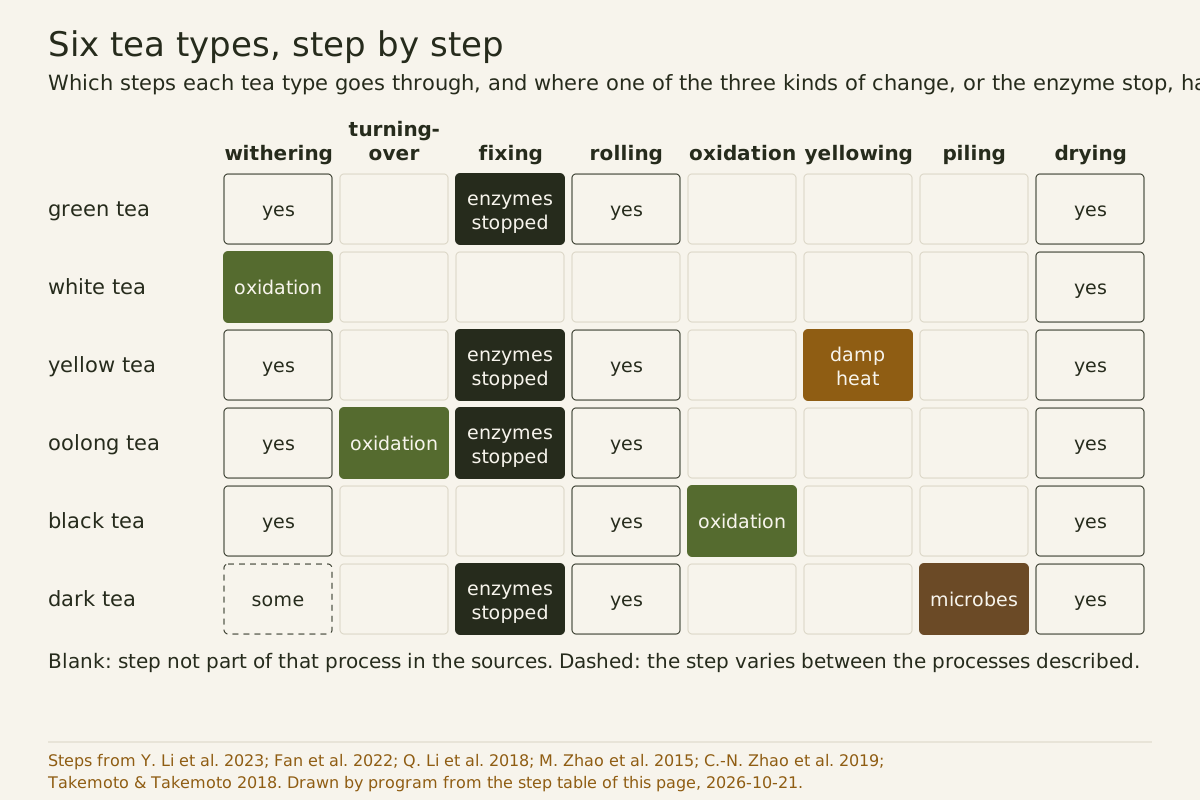
Fig. 5. Eight processing steps across the six tea types: blank cells are steps a type skips, and filled cells mark a kind of change or the enzyme stop.
"Six tea types, step by step" by Botany for the Curious, https://botanyforthecurious.com/tea-coffee/tea-processing/, licensed under CC BY 4.0 (https://creativecommons.org/licenses/by/4.0/)data: Y. Li et al. 2023, Food Chemistry: X 18: 100731 (step names only), retrieved 2026-10-21; Fan et al. 2022, Molecules 27: 940 (CC BY 4.0), retrieved 2026-10-21; Q. Li et al. 2018, Frontiers in Microbiology 9: 1509 (CC BY 4.0), retrieved 2026-10-21; M. Zhao et al. 2015, Scientific Reports 5: 10117 (CC BY 4.0), retrieved 2026-10-21; C.-N. Zhao et al. 2019, Antioxidants 8: 215 (CC BY 4.0), retrieved 2026-10-21; Takemoto & Takemoto 2018, Molecules 23: 918 (CC BY 4.0), retrieved 2026-10-21Download Steps for the six tea types (CSV) tea-processing-steps.csv data: Y. Li et al. 2023, Food Chemistry: X 18: 100731 (step names only), retrieved 2026-10-21; Fan et al. 2022, Molecules 27: 940 (CC BY 4.0), retrieved 2026-10-21; Q. Li et al. 2018, Frontiers in Microbiology 9: 1509 (CC BY 4.0), retrieved 2026-10-21; M. Zhao et al. 2015, Scientific Reports 5: 10117 (CC BY 4.0), retrieved 2026-10-21; C.-N. Zhao et al. 2019, Antioxidants 8: 215 (CC BY 4.0), retrieved 2026-10-21; Takemoto & Takemoto 2018, Molecules 23: 918 (CC BY 4.0), retrieved 2026-10-21
Questions about the six tea types
Do green tea and black tea come from the same plant?
Yes. Green tea and black tea both come from the tea plant, Camellia sinensis, and a 2023 trial made all six tea types from the leaves of one cultivar. Green tea is heated early, which stops the leaf's enzymes; black tea is not, so its catechins are oxidised into theaflavins and thearubigins before drying.
What does oxidation mean in tea?
In tea, oxidation means the leaf's own enzymes, polyphenol oxidase and peroxidase, converting catechins into larger pigments such as theaflavins. Many studies, and sometimes the tea trade, call this step fermentation, although the enzymes are the leaf's own. Fixing, a short burst of heat, inactivates the enzymes and stops it.
What makes dark tea, such as pu-erh, different from black tea?
Dark tea is fixed first, so the leaf's enzymes are stopped, and then the moist leaves are piled so that bacteria and fungi grow on them. Black tea has no fixing step, and its change comes from the leaf's own enzymes. The Chinese names cross over: Chinese calls black tea "red tea" and dark tea "black tea".
How is tea made?
Tea is made from the buds and young leaves of Camellia sinensis, and the steps depend on the type. Most types are withered, rolled and dried; green, yellow, oolong and dark tea also go through fixing, a heat step that stops the leaf's enzymes. Yellow tea adds a damp-heat step, oolong a turning step and dark tea a microbial pile.
Sources
- Li, Y., Yu, S., Yang, S., Ni, D., Jiang, X., Zhang, D., Zhou, J., Li, C. & Yu, Z. (2023). "Study on taste quality formation and leaf conducting tissue changes in six types of tea during their manufacturing processes." Food Chemistry: X 18: 100731. doi:10.1016/j.fochx.2023.100731. https://doi.org/10.1016/j.fochx.2023.100731 full text
- Takemoto, M. & Takemoto, H. (2018). "Synthesis of theaflavins and their functions." Molecules 23(4): 918. doi:10.3390/molecules23040918. https://doi.org/10.3390/molecules23040918 full text Text licence: CC BY 4.0
- Fan, F.-Y., Zhou, S.-J., Qian, H., Zong, B.-Z., Huang, C.-S., Zhu, R.-L., Guo, H.-W. & Gong, S.-Y. (2022). "Effect of yellowing duration on the chemical profile of yellow tea and the associations with sensory traits." Molecules 27(3): 940. doi:10.3390/molecules27030940. https://doi.org/10.3390/molecules27030940 full text Text licence: CC BY 4.0
- Li, Q., Chai, S., Li, Y., Huang, J., Luo, Y., Xiao, L. & Liu, Z. (2018). "Biochemical components associated with microbial community shift during the pile-fermentation of primary dark tea." Frontiers in Microbiology 9: 1509. doi:10.3389/fmicb.2018.01509. https://doi.org/10.3389/fmicb.2018.01509 full text Text licence: CC BY 4.0
- Zhao, M., Zhang, D.-L., Su, X.-Q., Duan, S.-M., Wan, J.-Q., Yuan, W.-X., Liu, B.-Y., Ma, Y. & Pan, Y.-H. (2015). "An integrated metagenomics/metaproteomics investigation of the microbial communities and enzymes in solid-state fermentation of Pu-erh tea." Scientific Reports 5: 10117. doi:10.1038/srep10117. https://doi.org/10.1038/srep10117 full text Text licence: CC BY 4.0
- Zhao, C.-N., Tang, G.-Y., Cao, S.-Y., Xu, X.-Y., Gan, R.-Y., Liu, Q., Mao, Q.-Q., Shang, A. & Li, H.-B. (2019). "Phenolic profiles and antioxidant activities of 30 tea infusions from green, black, oolong, white, yellow and dark teas." Antioxidants 8(7): 215. doi:10.3390/antiox8070215. https://doi.org/10.3390/antiox8070215 full text Text licence: CC BY 4.0
- Lu Yu (Tang dynasty). Cha Jing 茶經, chapter 3, 三之造. Chinese Wikisource text, with the catalogue note of the Siku Quanshu (read 2026-10-21). https://zh.wikisource.org/wiki/%E8%8C%B6%E7%B6%93/%E4%B8%89%E4%B9%8B%E9%80%A0 chapter 3 (三之造), Chinese Wikisource text
- World Checklist of Vascular Plants (WCVP), Royal Botanic Gardens, Kew, 2026-06 release (CC BY 3.0), doi:10.34885/egs6-cp24: Camellia sinensis (L.) Kuntze, its varieties and the name Camellia thea Link, retrieved 2026-10-21. https://doi.org/10.34885/egs6-cp24 name records for Camellia sinensis, var. sinensis, var. assamica and Camellia thea (2026-06 release)
- World Flora Online Plant List 2026-06 (CC0): Camellia sinensis (L.) Kuntze, wfo-0000582676, and var. assamica (J.W.Mast.) Kitam., wfo-0000582677, retrieved 2026-10-21. https://list.worldfloraonline.org/wfo-0000582676 name records for the species and var. assamica (2026-06 classification)
- Flora of China, Vol. 12 (Theaceae), pp. 373, 376–377: Camellia sinensis (taxon_id 200014043), eFloras, retrieved 2026-10-21. http://www.efloras.org/florataxon.aspx?flora_id=2&taxon_id=200014043 species account: leaf description and the note on the varieties used for tea
- Wikidata (CC0): items Q23050136 (−)-epicatechin, Q393339 epigallocatechin gallate, Q415677 theaflavin, Q5944537 thearubigin, Q60235 caffeine and Q909931 theanine, PubChem CID (P662), isomeric SMILES (P2017) and formula (P274) (read 2026-10-21). https://www.wikidata.org/wiki/Q415677 item pages: PubChem CID, isomeric SMILES and formula statements
- English Wikipedia, "Tea processing" (read 2026-10-21). https://en.wikipedia.org/wiki/Tea_processing summarized here through English Wikipedia
- English Wikipedia, "Black tea" (read 2026-10-21). https://en.wikipedia.org/wiki/Black_tea summarized here through English Wikipedia
- English Wikipedia, "Fermented tea" (read 2026-10-21). https://en.wikipedia.org/wiki/Fermented_tea summarized here through English Wikipedia
Related
- Caffeine: Coffee and Tea Evolved It Separately Specimen entry
- History of Coffee: The Goatherd Legend Traces to a 1671 Book Deep explainer
Cite this page
Botany for the Curious. “Types of Tea: One Leaf, Six Paths, Three Kinds of Change.” Published 2026-10-22; last substantive revision 2026-10-22. https://botanyforthecurious.com/tea-coffee/tea-processing/ (accessed: add the date you read it).
- Published
- Last substantive revision