Tea & CoffeeDeep explainer
History of Coffee: The Goatherd Legend Traces to a 1671 Book
- Published
- Last substantive revision
Spec card
- Subject
- History of coffeeSource: Dufour 1685; Ukers 1922
- Botanical name
- Coffea arabica L., Arabian coffee (Rubiaceae); native to SW Ethiopia, E South Sudan and N KenyaSource: WCVP (Kew) version 16, June 2026; World Flora Online Plant List 2026-06; common name: Ukers 1922
- Processing stage
- The seed, carried in trade and roasted for the drinkSource: Dufour 1685, pp. 10–13; Ukers 1922
- Key compounds (PubChem CID)
- caffeine (CID 2519, via Wikidata)Source: Wikidata Q60235
- Earliest record (evidence level)
- Goatherd story: legend; earliest version read: Dufour 1685, pp. 35–37, a French version taken from Nairon 1671 (later account). Coffee drinking in Yemen about 1454: later account (Ukers 1922, after a manuscript of 1587)Source: Dufour 1685; John Carter Brown Library catalogue; Ukers 1922
Download this card as CSV history-of-coffee-spec-card.csv data: Dufour 1685, "Traitez nouveaux & curieux du café, du thé et du chocolate", John Carter Brown Library copy, retrieved 2026-10-21; John Carter Brown Library catalogue record for Dufour 1685, retrieved 2026-10-21; Ukers 1922, "All About Coffee", Project Gutenberg 28500, retrieved 2026-10-21; WCVP (Kew), CC BY 3.0, doi:10.34885/egs6-cp24, retrieved 2026-10-21; World Flora Online Plant List 2026-06 (CC0), retrieved 2026-10-21; Wikidata (CC0), Q60235, PubChem CID 2519, retrieved 2026-10-21
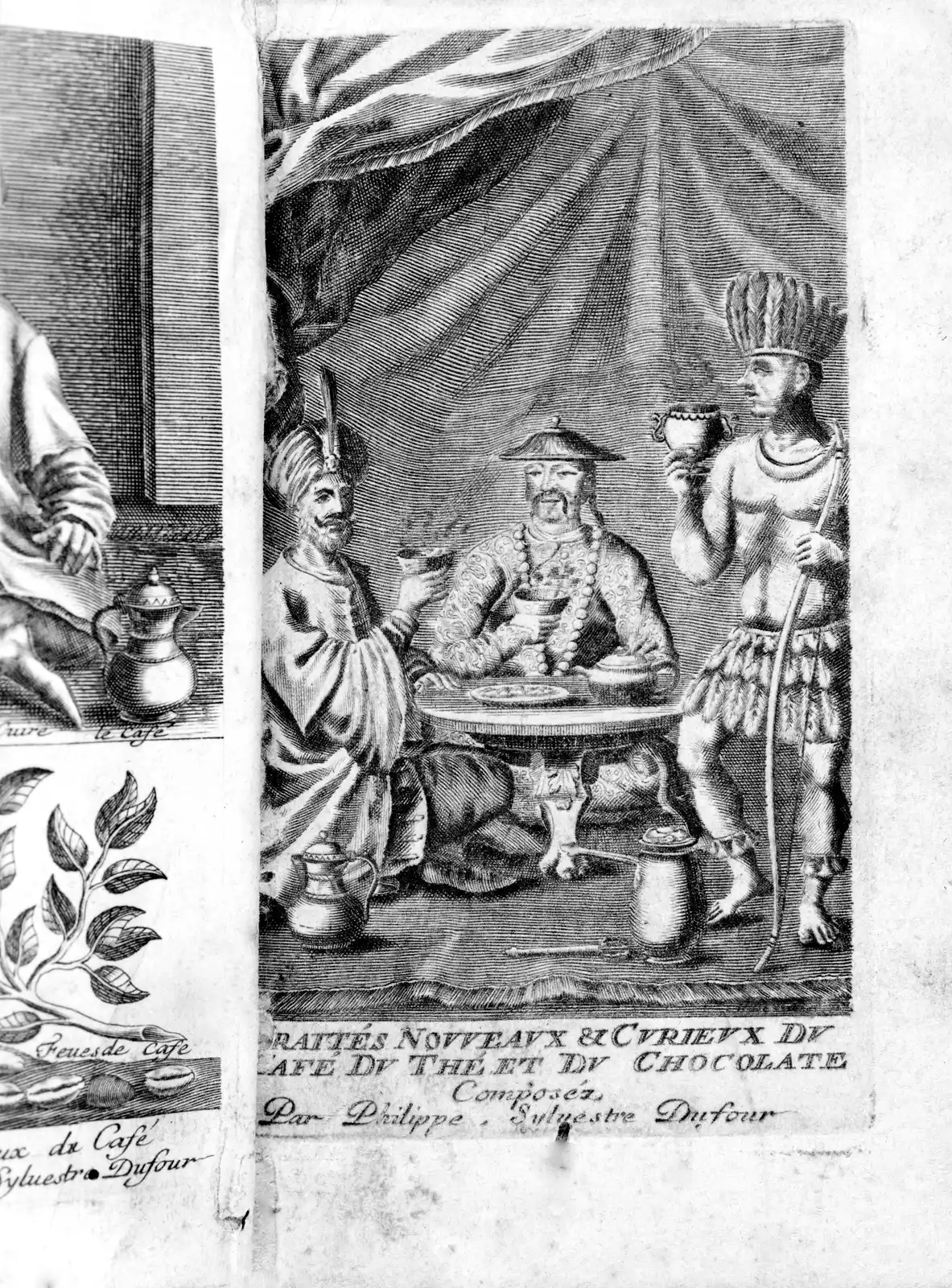
Three men hold coffee, tea and chocolate in the frontispiece of Dufour's "Traitez nouveaux & curieux du café, du thé et du chocolate" (Lyon, 1688); the 1685 printing has the same plate.
"P.S. Dufour, Traitez nouveaux et curieux... Wellcome L0026965" by Unknown engraver (Wellcome Collection) — https://commons.wikimedia.org/wiki/File:P.S._Dufour,_Traitez_nouveaux_et_curieux..._Wellcome_L0026965.jpg — CC BY 4.0 (https://creativecommons.org/licenses/by/4.0/)
In 1685 a Lyon coffee book credited the discovery of coffee to a herder's sleepless goats, or perhaps his camels. That goatherd story is a legend. The 1685 book, by Philippe Sylvestre Dufour, is the earliest version of it among the sources we checked, and its treatise on coffee is catalogued as taken from a Latin book printed in Rome in 1671. The documented history of coffee starts later and runs plainer.
According to William Ukers's account of 1922, coffee drinking spread from Yemen in the 1400s to Mecca, Cairo and Constantinople. Coffee houses opened across Europe in the 1600s. The plant itself was carried to Java, Amsterdam, Paris and the Caribbean between 1696 and 1723.
Where does the goatherd legend come from?
Dufour tells the story on pages 35 to 37 of his "Traité du café". A keeper of camels, or of goats in other tellings, complained to some monks that his animals stayed awake and leapt about all night. The prior went to their pasture, found shrubs whose fruit they had eaten, and boiled some in water. Drinking it kept him awake, so he gave it to his monks for the night offices.
The passage ends by naming Sciadli and Aydrus as the monks believed to have found the fruit. Neither the herder nor the place has a name. On page 35 Dufour says he took the account from a discourse by Fausto Nairone, a Maronite professor of Chaldaic and Syriac at the college in Rome. It had appeared in an Italian scholars' journal printed in 1671.
The John Carter Brown Library holds the copy of the 1685 book checked here. Its catalogue says that pages 1 to 221 are "taken from" Nairon's Latin "De saluberrima potione cahue seu cafe nuncupata discursus", which was "first printed in Rome" in 1671.
Nairon's book itself was not among the sources checked, so this page cannot say what his Latin text adds or leaves out. An older telling may exist. The same catalogue notes that the 1685 book enlarges "De l'usage du caphé, du thé et du chocolate", printed at Lyon in 1671, which was not checked either. Ukers's chronology credits that 1671 book to Dufour, while his bibliography lists a book of that title, dated Paris 1671, under J. Spon.
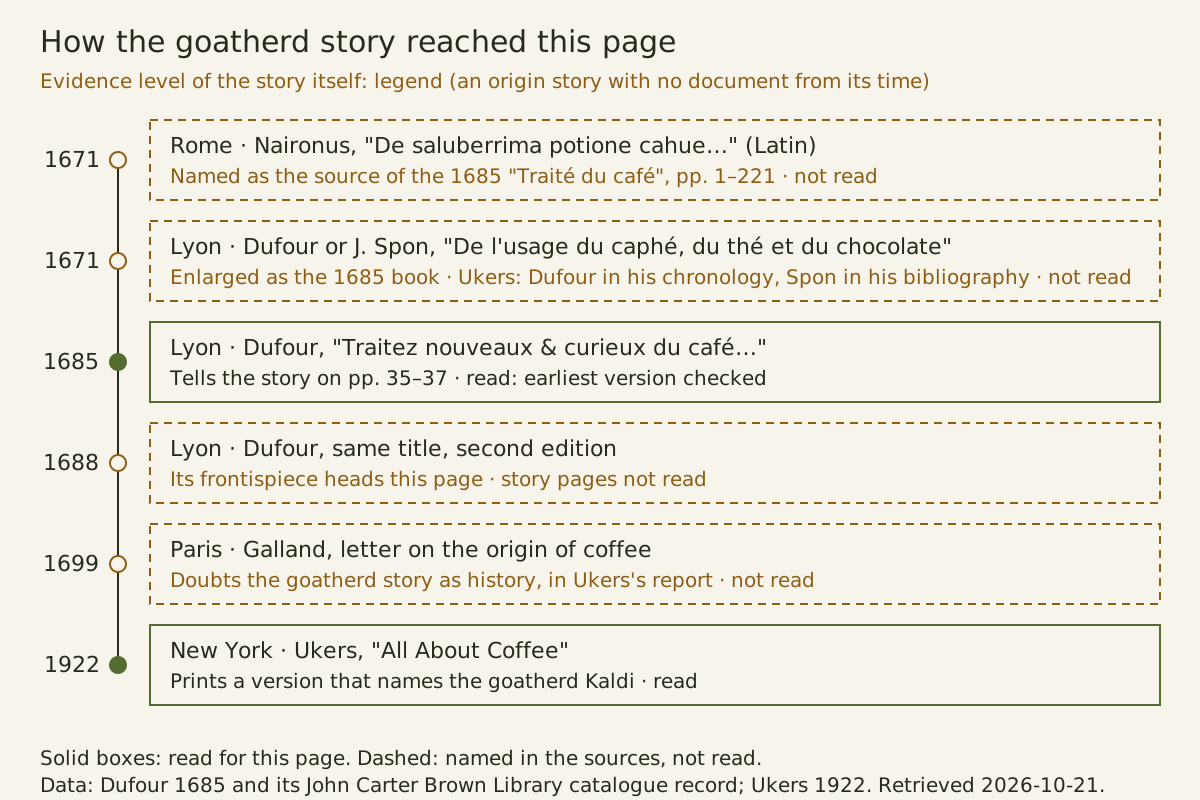
Fig. 1. How the goatherd legend reached this page: the printed versions named in the sources checked, with those read drawn as solid boxes.
"How the goatherd story reached this page" by Botany for the Curious, https://botanyforthecurious.com/tea-coffee/history-of-coffee/, licensed under CC BY 4.0 (https://creativecommons.org/licenses/by/4.0/)data: Dufour 1685, "Traitez nouveaux & curieux du café, du thé et du chocolate", John Carter Brown Library copy, retrieved 2026-10-21; John Carter Brown Library catalogue record for Dufour 1685, retrieved 2026-10-21; Ukers 1922, "All About Coffee", Project Gutenberg 28500, retrieved 2026-10-21Download Versions table (CSV) history-of-coffee-legend-versions.csv data: Dufour 1685, "Traitez nouveaux & curieux du café, du thé et du chocolate", John Carter Brown Library copy, retrieved 2026-10-21; John Carter Brown Library catalogue record for Dufour 1685, retrieved 2026-10-21; Ukers 1922, "All About Coffee", Project Gutenberg 28500, retrieved 2026-10-21; Rijksmuseum and Wellcome Collection object records on Wikimedia Commons, retrieved 2026-10-21
Kaldi's name appears much later in the sources checked. Ukers's 1922 book prints a version of the legend that it credits to French tradition. In it a young goatherd called Kaldi joins his goats in a dance and tells a passing monk about the fruit. Ukers gives no date or author for that version, and none of the sources checked shows when the name joined the story.
What do the earliest records of coffee drinking say?
Ukers calls an Arabic manuscript of 1587 the oldest surviving account of how coffee began. He describes it in his chapter on coffee in literature: its author is Abd-al-Kâdir, as Ukers spells the name, and it is kept in the Bibliothèque nationale in Paris as Arabe 4590. The manuscript was not among the sources checked, so its story reaches this page through Ukers, a later account printed 335 years after it.
In Ukers's telling, a scholar named Gemaleddin met coffee on a journey that Ukers places in Abyssinia. About 1454 he approved it for dervishes who prayed through the night. Ukers calls him a mufti of Aden in one chapter and of Mocha in another, and adds that the drink was probably known in Aden before Gemaleddin's time. Dervishes then carried it to Mecca and Medina between 1470 and 1500, and to Cairo about 1510, where they drank it before nights of prayer.
Fig. 2 sets these events beside the dates of the documents that report them. Each line runs from the year an event is said to have happened to the year of its earliest version among the sources checked. A ring marks an older document that the sources name but that was not read.
Most lines end in 1922, so this page labels them later accounts. The pictures at the bottom of the chart are records made in their own time.
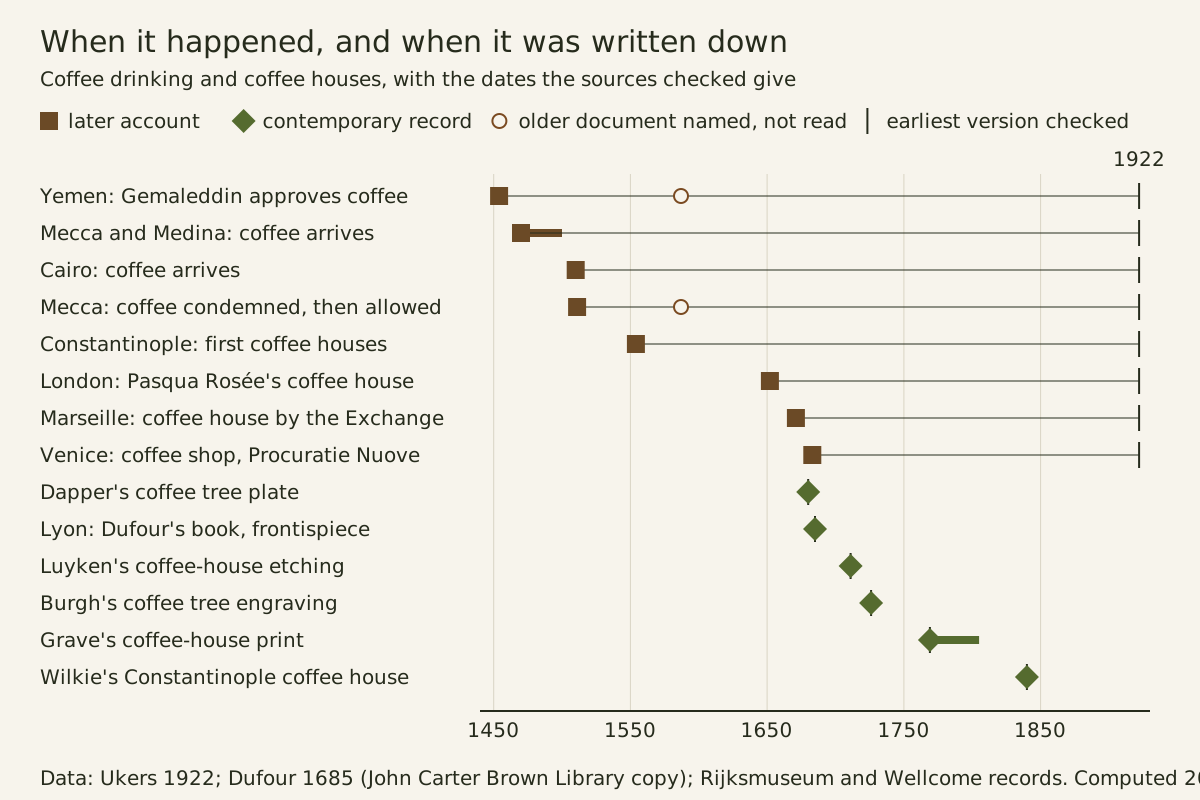
Fig. 2. Coffee drinking and coffee houses from Yemen to Venice, and the dated pictures on this page: when each event is said to have happened, and when its earliest version checked was written.
"When it happened, and when it was written down" by Botany for the Curious, https://botanyforthecurious.com/tea-coffee/history-of-coffee/, licensed under CC BY 4.0 (https://creativecommons.org/licenses/by/4.0/)data: Ukers 1922, "All About Coffee", Project Gutenberg 28500, retrieved 2026-10-21; Dufour 1685, "Traitez nouveaux & curieux du café, du thé et du chocolate", John Carter Brown Library copy, retrieved 2026-10-21; Rijksmuseum and Wellcome Collection object records on Wikimedia Commons, retrieved 2026-10-21; evidence-level timeline computed 2026-10-21Download Records table (CSV) history-of-coffee-records.csv data: Ukers 1922, "All About Coffee", Project Gutenberg 28500, retrieved 2026-10-21; Dufour 1685, "Traitez nouveaux & curieux du café, du thé et du chocolate", John Carter Brown Library copy, retrieved 2026-10-21; John Carter Brown Library catalogue record for Dufour 1685, retrieved 2026-10-21; Rijksmuseum and Wellcome Collection object records on Wikimedia Commons, retrieved 2026-10-21
Tea's documents run on a separate line in East Asia, and Types of Tea follows them from a manual of the Tang dynasty.
From Mecca to Istanbul
Coffee houses brought arguments with them in Ukers's account. In 1511 Kair Bey, governor of Mecca for the sultan of Egypt, had coffee condemned after a council of lawyers and physicians, and the sultan in Cairo ordered the ban revoked. Coffee is said to have been brought to Constantinople, now Istanbul, in 1517 by Selim I.
In 1554 two men, Schemsi of Damascus and Hekem of Aleppo, opened the city's first two coffee houses. Later bans there came and went without ending the custom.
The lithograph below shows a coffee house in the same city almost three centuries later. It is lettered "D Wilkie, Constantinople" with the year 1840, and the Wellcome Collection's record calls it a lithograph by Joseph Nash after David Wilkie. It is a record of 1840, not of the coffee houses of the 1500s.
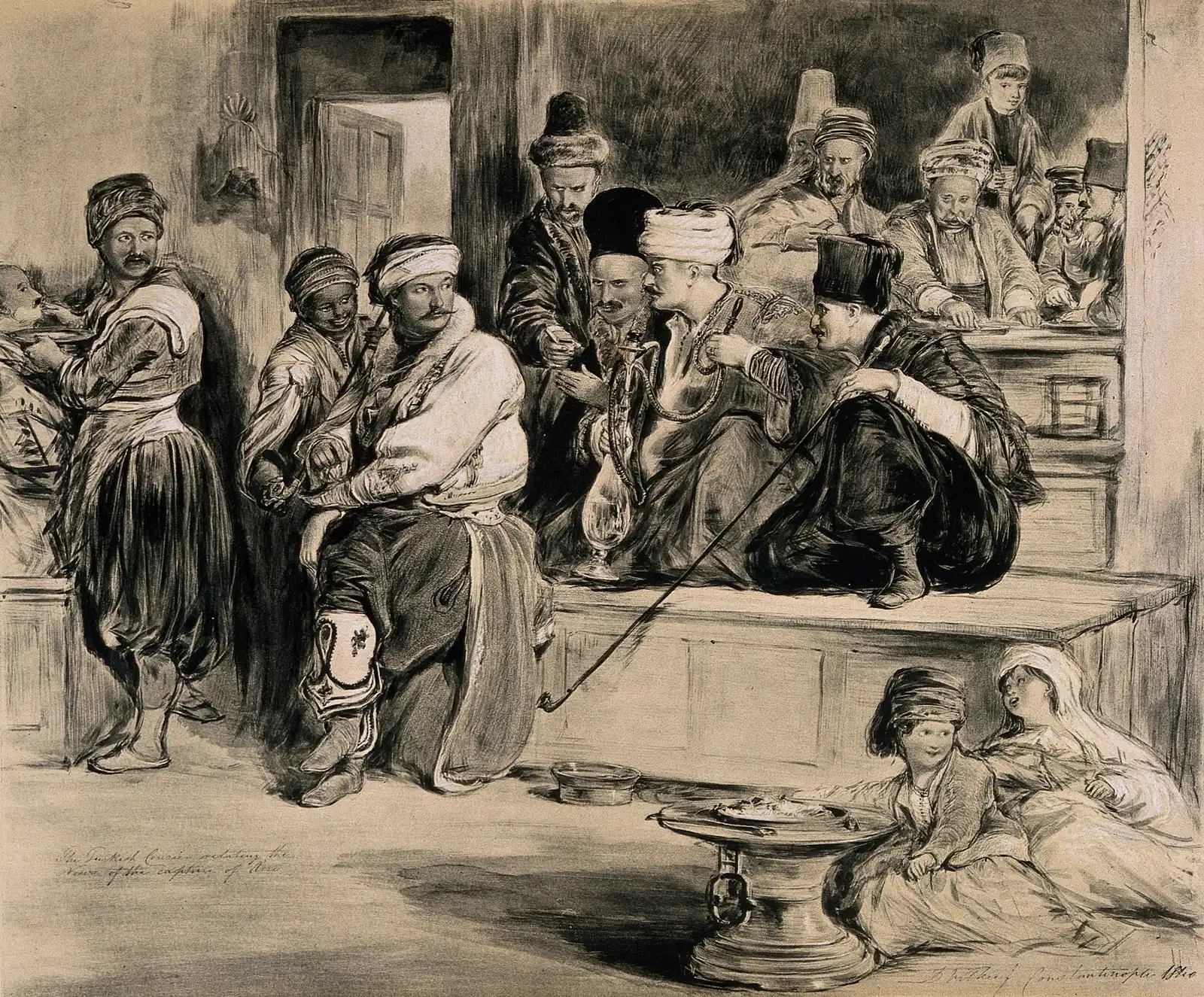
Smokers in a coffee house listen to a courier's news in a lithograph by Joseph Nash after David Wilkie, lettered Constantinople 1840, almost three centuries after the city's first coffee houses.
"Smokers in a Turkish coffee house listen eagerly to news bro Wellcome V0019283" by J. Nash after D. Wilkie (Wellcome Collection) — https://commons.wikimedia.org/wiki/File:Smokers_in_a_Turkish_coffee_house_listen_eagerly_to_news_bro_Wellcome_V0019283.jpg — CC BY 4.0 (https://creativecommons.org/licenses/by/4.0/)
When did coffeehouses reach Europe?
Europe met coffee first in travellers' reports. Ukers counts the German physician Leonhard Rauwolf as the first European to mention coffee. Rauwolf came across the drink at Aleppo in 1573 and described it in a book of 1582.
Coffee houses followed in the next century, all known here from Ukers's later account. Pasqua Rosée opened one in London in 1652, and another opened near the Exchange in Marseille in 1671. Ukers treats a coffee shop under the Procuratie Nuove in Venice in 1683 as certain, but says an Italian coffee house reported for 1645 lacks firm confirmation. He credits the Ottoman envoy Soliman Aga with introducing the drink publicly in Paris in 1669.
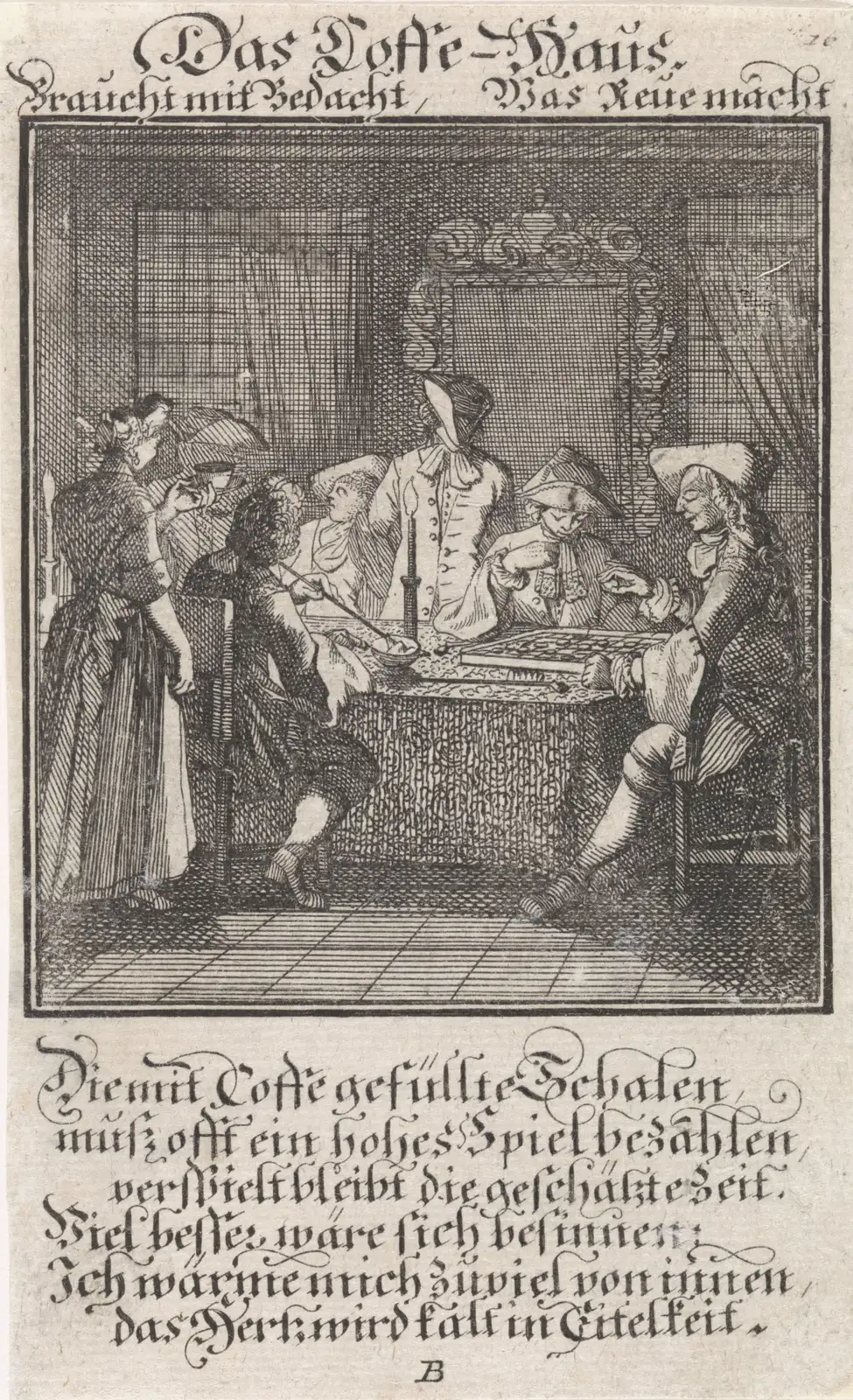
Caspar Luyken's etching "Das Coffe-Haus", from a 1711 printing of a German book of trades, shows a coffee-house table, with verses above and below.
"Koffiehuis, RP-P-1896-A-19368-1616" by Caspar Luyken (Rijksmuseum) — https://commons.wikimedia.org/wiki/File:Koffiehuis,_RP-P-1896-A-19368-1616.jpg — CC0 1.0 (https://creativecommons.org/publicdomain/zero/1.0/)
One contemporary record sits among these later accounts. Dufour's own book says, on pages 10 and 11, that no place but the Yemen produces coffee. It adds that coffee is shipped from Mocha along the Red Sea toward Jeddah and Suez. On page 13 it reports a claim that the beans were boiled or baked before sale so that nobody could sow them elsewhere, and sides with those who denied it.
That is what a Lyon book of 1685 knew, which is not the same as where the plant grew wild.
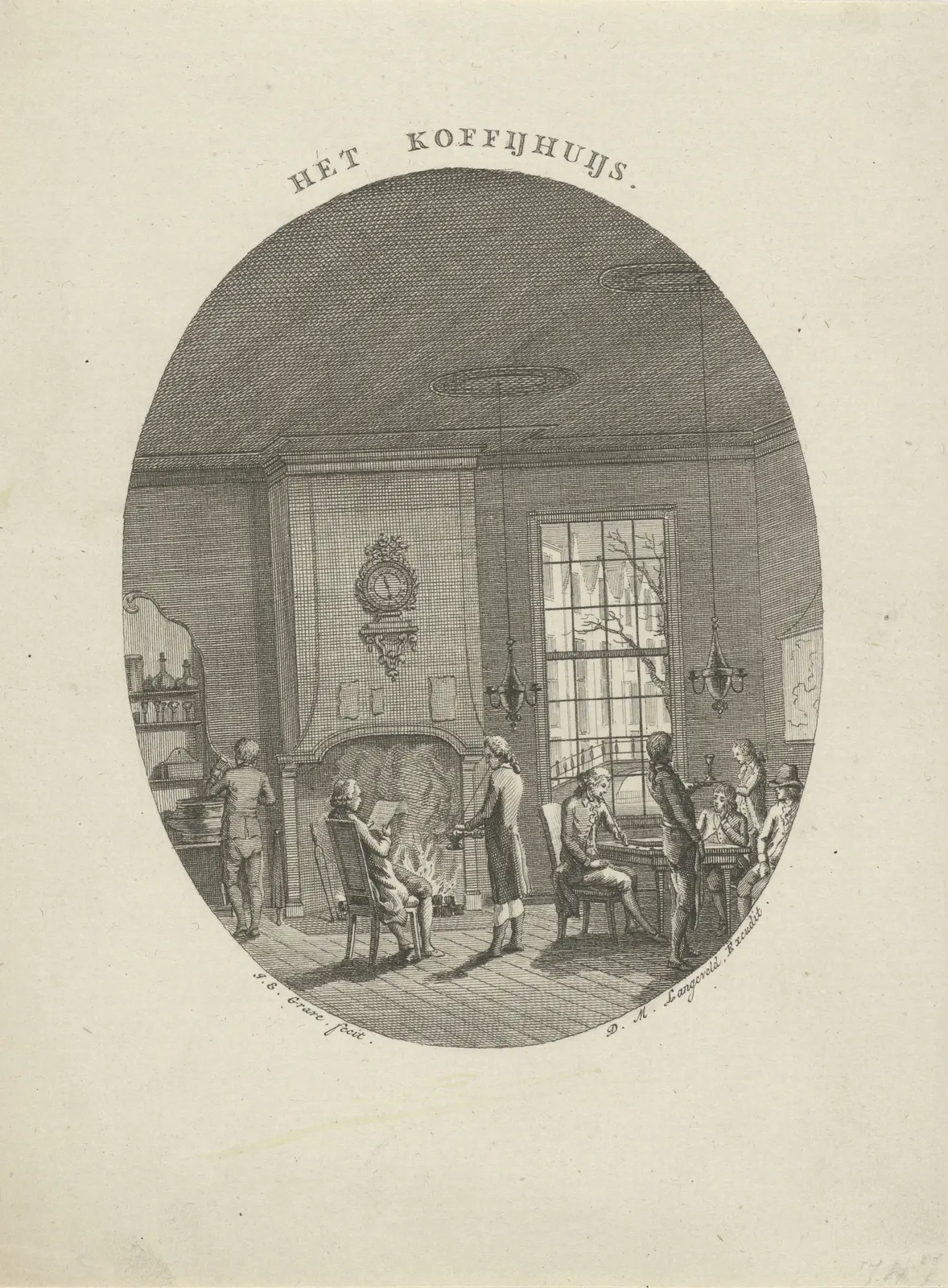
Men smoke, read the paper and drink by the fire in "Het Koffijhuijs", a coffee-house print by Jan Evert Grave made in Amsterdam about 1769 to 1805.
"Koffiehuis Het Koffijhuijs (titel op object), RP-P-1889-A-14935" by Jan Evert Grave (Rijksmuseum) — https://commons.wikimedia.org/wiki/File:Koffiehuis_Het_Koffijhuijs_(titel_op_object),_RP-P-1889-A-14935.jpg — CC0 1.0 (https://creativecommons.org/publicdomain/zero/1.0/)
Where is the coffee plant native?
The plant has a geography of its own, apart from the stories. The World Checklist of Vascular Plants (WCVP), version 16 of June 2026, covers the coffee plant, Coffea arabica L., which Ukers calls Arabian coffee. It records the species as native only to south-west Ethiopia, eastern South Sudan and northern Kenya, and as introduced in 68 other botanical regions, from Brazil to Hawaii. The World Flora Online Plant List (2026-06) accepts the same name with the same author.
Yemen is not among the native regions. Dufour in 1685 thought coffee grew nowhere else, and Ukers in 1922 wrote that most authorities held the plant native to Abyssinia and probably Arabia.
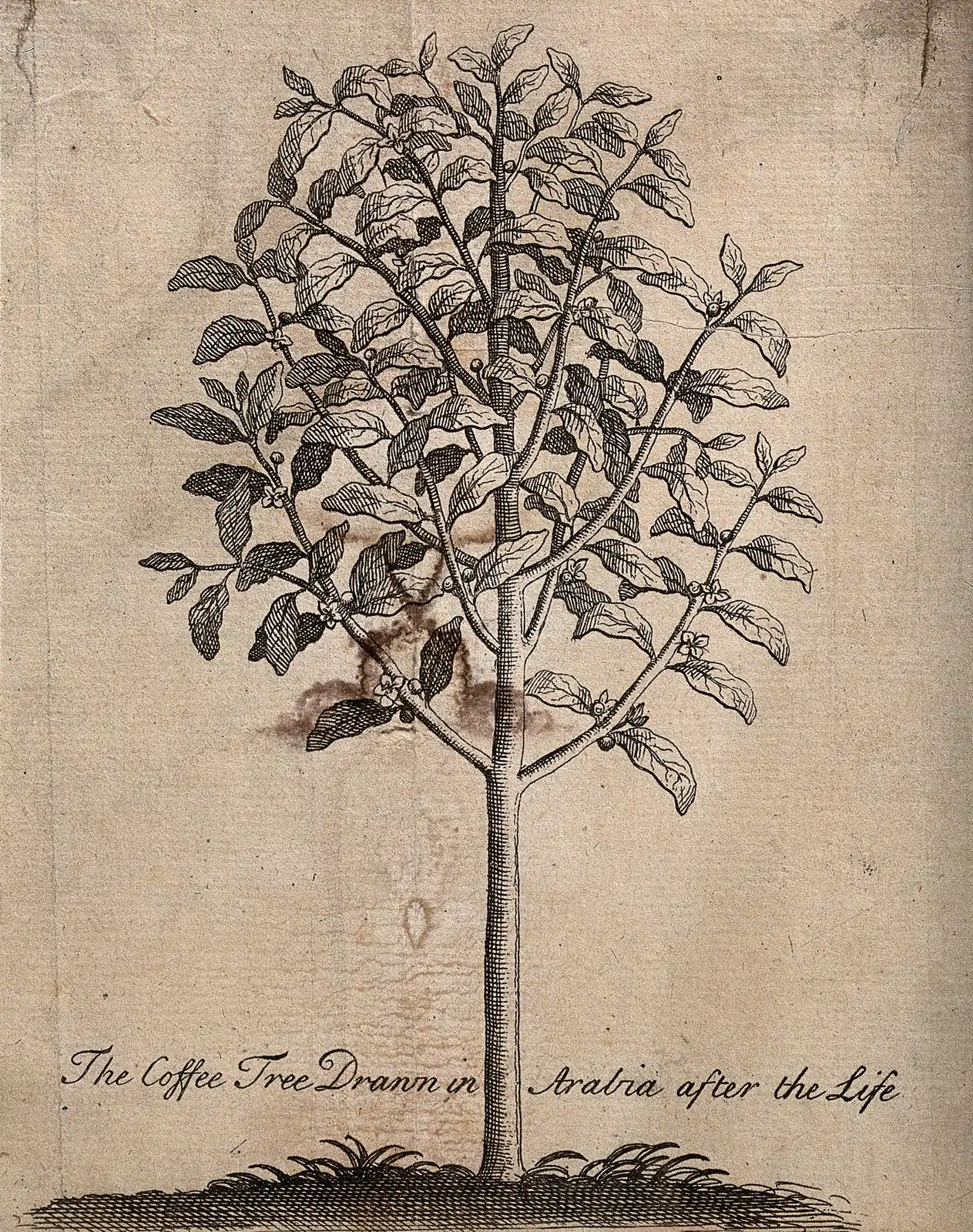
A coffee tree, Coffea arabica, in a line engraving by Burgh of about 1726, lettered as drawn in Arabia from life.
"Coffee tree (Coffea arabica). Line engraving by H. Burgh, c. Wellcome V0043220" by H. Burgh (Wellcome Collection) — https://commons.wikimedia.org/wiki/File:Coffee_tree_(Coffea_arabica)._Line_engraving_by_H._Burgh,_c._Wellcome_V0043220.jpg — CC BY 4.0 (https://creativecommons.org/licenses/by/4.0/)
How did the coffee plant travel?
Ukers writes that the Arabs for a time guarded the trade by letting no seed leave unless it had been boiled or parched. Dufour had reported that only as a disputed claim. The Dutch moved the plant by way of India.
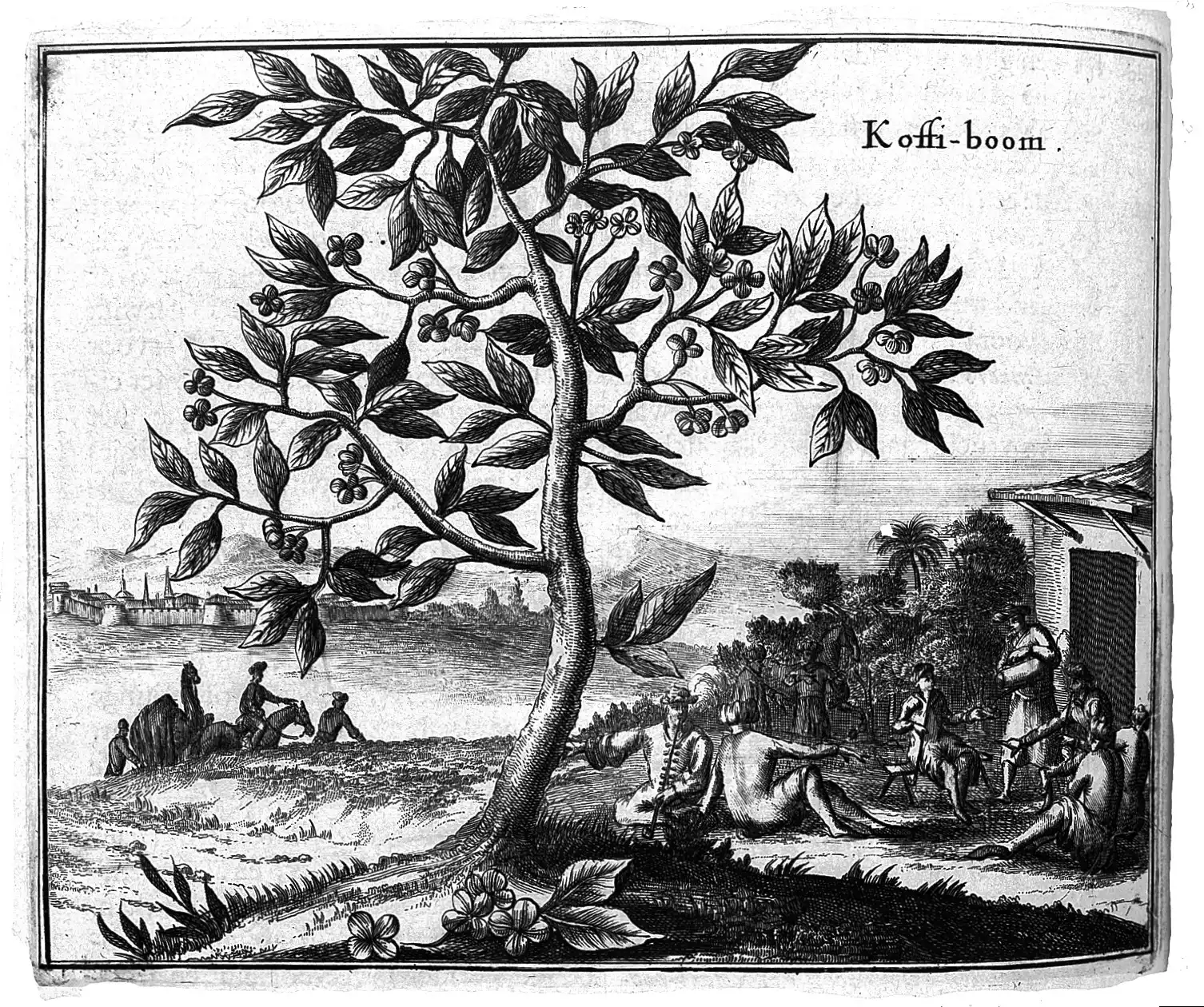
A coffee tree, lettered "Koffi-boom", stands over resting men, with a camel and a walled town behind, in a plate from Olfert Dapper's Dutch book "Naukeurige beschryving van Asie" of 1680.
"Coffee Tree, in Olfert Dapper Wellcome L0011012" by Unknown engraver (Wellcome Collection) — https://commons.wikimedia.org/wiki/File:Coffee_Tree,_in_Olfert_Dapper_Wellcome_L0011012.jpg — CC BY 4.0 (https://creativecommons.org/licenses/by/4.0/)
Seedlings raised on the Malabar coast from Arabian seed were shipped to Java in 1696, then lost to earthquake and flood. In 1699 cuttings from Malabar took root there. In 1706 a plant grown in Java reached the botanical garden in Amsterdam, and plants raised from its seed went to other gardens in Europe.
Ukers's 1922 book, a later account, tells of a coffee plant about five feet tall that was sent from Amsterdam to Louis XIV at Marly in 1714. The sender was the burgomaster of Amsterdam. The next day it was moved to the Jardin des Plantes in Paris, where Antoine de Jussieu received it. Ukers calls that tree the ancestor of most coffee in the French colonies and in Mexico, Central and South America, a claim this page does not test.
The same later account has Gabriel de Clieu sailing to Martinique in 1723 with a plant raised from that tree, though Ukers notes that some accounts give 1720. The first harvest there came in 1726, in his dates. He quotes a letter of 1774 that he attributes to de Clieu, but that letter was not among the sources checked.
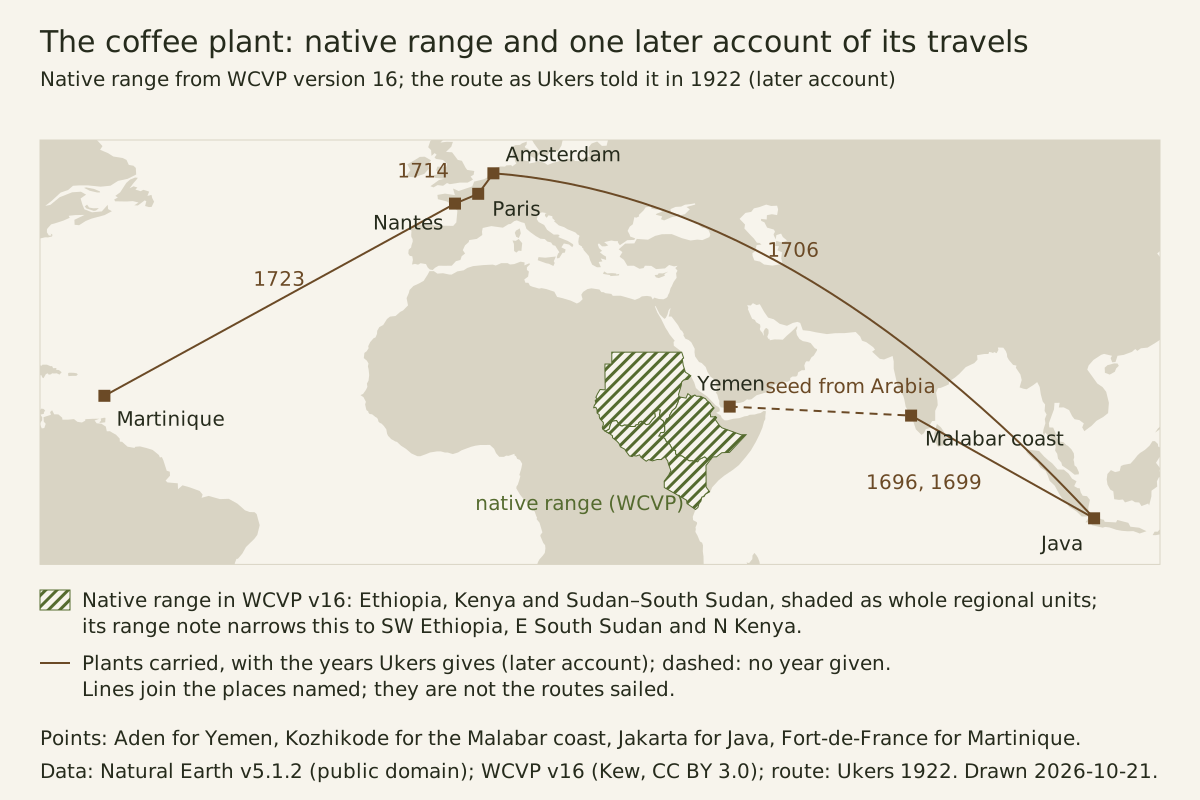
Fig. 3. Where WCVP places the coffee plant's native range, and the plant's route to Java, Amsterdam, Paris and Martinique in Ukers's 1922 account, a later account.
"The coffee plant: native range and one later account of its travels" by Botany for the Curious, https://botanyforthecurious.com/tea-coffee/history-of-coffee/, licensed under CC BY 4.0 (https://creativecommons.org/licenses/by/4.0/)data: Natural Earth (public domain), v5.1.2, retrieved 2026-10-21; WCVP (Kew), CC BY 3.0, doi:10.34885/egs6-cp24, retrieved 2026-10-21; Ukers 1922, "All About Coffee", Project Gutenberg 28500, retrieved 2026-10-21Carrying a plant from Amsterdam to Paris was transport. It changed where one plant grew, and it did not breed a new kind. Selection is a different process, the choosing of plants to breed from over generations. The sources checked here say nothing about how the first plantation growers chose their trees.
Ukers does record forced work in the plant's spread. He writes that coffee in Java became a forced industry under compulsory delivery. His telling of de Clieu's voyage, a later account, also says that enslaved people guarded the first Martinique plant day and night.
Which stories are legends?
The table lists the coffee stories met on this page, the earliest version of each among the sources checked, and the evidence level that version supports.
On Botany for the Curious an origin story with no document from the time of its events is labelled a legend (how evidence levels are set). An account written down after the events it reports is a later account; Ukers's telling of the 1714 tree, in the table below, is one. The goatherd story is a legend, and its earliest version here is a later account, printed fourteen years after the book it leans on.
| Story | What the story says | Earliest version among the sources checked | Evidence level |
|---|---|---|---|
| The goatherd and the monks | A herder's goats, or camels, stay awake after eating a shrub's fruit, and a prior brews it for his monks | Dufour 1685, pp. 35–37, taken from Nairon 1671 | legend |
| Kaldi's dancing goats | The goatherd has a name, Kaldi, and dances with his goats | Ukers 1922, from a French version he does not date | legend |
| Sheik Omar | An exile from Mocha boils wild berries for food, about 1258 | Ukers 1922, who traces it to Arabic writings kept in Paris | legend |
| Kolschitzky in Vienna | After the siege of 1683 a former interpreter takes the Ottoman army's coffee and teaches the city to make it | Ukers 1922, who calls the tale a legend | legend |
| The 1714 tree | A plant about five feet tall goes from Amsterdam to Louis XIV at Marly, then to Paris | Ukers 1922 | later account |
| De Clieu's voyage | A naval officer shares his water with a coffee plant on the way to Martinique, 1723 | Ukers 1922, quoting a 1774 letter not checked here | later account |
| Dufour's book and its frontispiece | A Lyon book of 1685 on coffee, tea and chocolate | the 1685 book itself | contemporary record |
Doubt about the goatherd legend is old. Ukers reports that the French orientalist Antoine Galland, in 1699, called the Omar and goatherd stories unworthy of belief as history. Galland also suggested that the prior and his monks stood for Gemaleddin and the dervishes. His own text was not among the sources checked.
Retellings also drift on small points. Ukers credits the names of two discovering monks, Scialdi and Ayduis, to an Italian scholars' journal of 1760. Yet Dufour's book had already named them Sciadli and Aydrus in 1685, citing an Italian journal printed in 1671.
Fig. 4 puts the stories on the same kind of timeline as Fig. 2. The 1714 tree and de Clieu's voyage have dates, and each is a later account known here from Ukers. The goatherd and Kaldi have no date at all. Their earliest versions here were printed in 1685 and 1922.
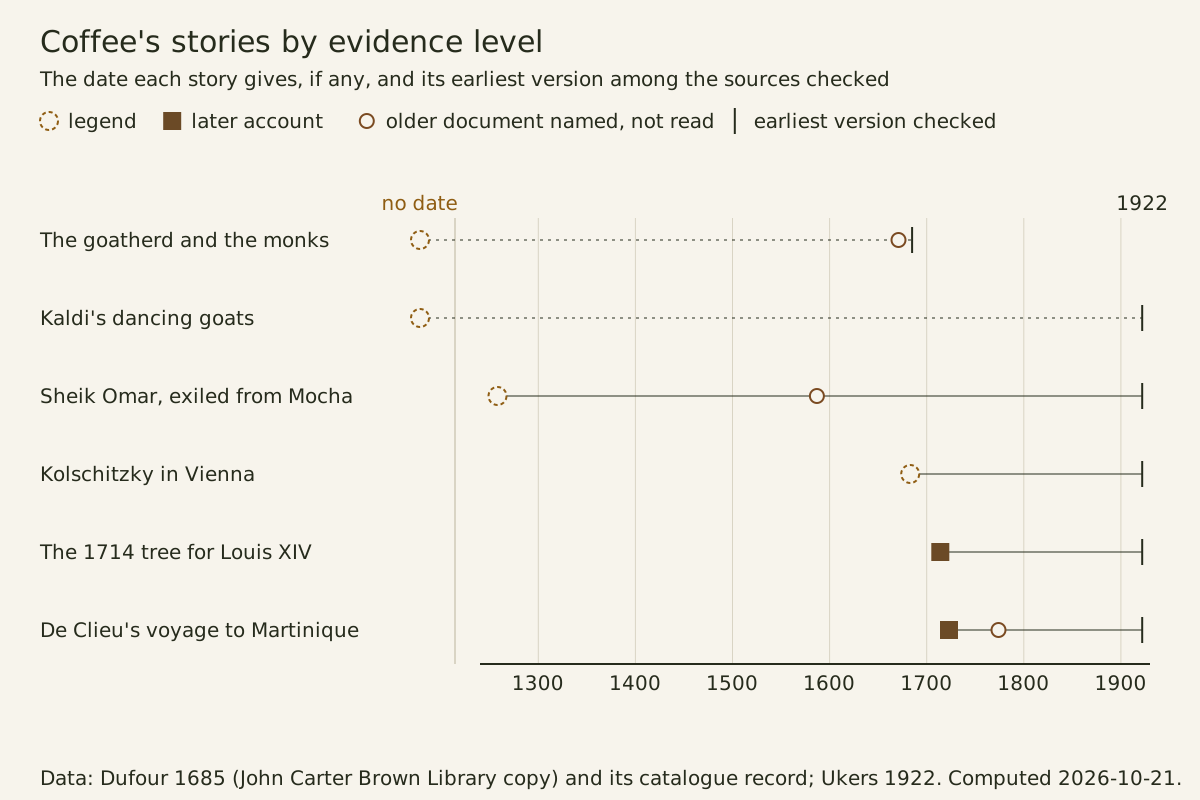
Fig. 4. Coffee's stories by evidence level: the date each story gives, if any, and the year of its earliest version among the sources checked.
"Coffee's stories by evidence level" by Botany for the Curious, https://botanyforthecurious.com/tea-coffee/history-of-coffee/, licensed under CC BY 4.0 (https://creativecommons.org/licenses/by/4.0/)data: Dufour 1685, "Traitez nouveaux & curieux du café, du thé et du chocolate", John Carter Brown Library copy, retrieved 2026-10-21; John Carter Brown Library catalogue record for Dufour 1685, retrieved 2026-10-21; Ukers 1922, "All About Coffee", Project Gutenberg 28500, retrieved 2026-10-21; evidence-level timeline computed 2026-10-21
An unnamed seedling in a plain pot; the coffee plants sent to Louis XIV in 1714 and carried to Martinique in 1723 are each known here from a later account by Ukers.
Illustration: Botany for the Curious. Generated schematic image — not a photograph or botanical record. Reuse terms: no license is granted; any rights Botany for the Curious holds in this image are reserved.Questions people ask about the history of coffee
Where did coffee originate?
The coffee plant, Coffea arabica, is native to south-west Ethiopia, eastern South Sudan and northern Kenya, according to WCVP version 16 (2026). Coffee drinking is a separate question. Ukers's 1922 book calls an Arabic manuscript of 1587 the oldest surviving account of how coffee began, and in his telling coffee drinking started in Yemen in the 1400s.
Who discovered coffee?
No discoverer of coffee is documented in the sources checked. The goatherd and his monks, Kaldi and Sheik Omar are legends. The first date that Ukers's later account treats as reliable is about 1454, when a scholar called Gemaleddin approved coffee for night prayers. Ukers thought the drink was probably known in Aden before him.
Is the story of Kaldi and the goats true?
The Kaldi story is a legend. The earliest version among the sources checked, Dufour's book of 1685, gives the herder no name and says he kept camels or goats. The name Kaldi appears in Ukers's 1922 book, in a version he credits to French tradition without a date.
How did coffee reach Europe and the Americas?
In Ukers's 1922 account, a later account, coffee houses spread from Constantinople in 1554 to London in 1652, Marseille in 1671 and Venice by 1683. The plant went from Java to Amsterdam in 1706, to Paris in 1714 and to Martinique in 1723. Among the sources checked, those dates rest on that later account, not on records made at the time.
Sources
- Dufour, Philippe Sylvestre (1685). "Traitez nouveaux & curieux du café, du thé et du chocolate". Lyon: Jean Girin & B. Rivière. John Carter Brown Library copy, with the library's catalogue notes. https://archive.org/details/traiteznouveauxc00dufo pp. 10–13, 33–37 and 221 and the frontispiece of the 1685 printing, checked against page images; catalogue notes in full
- Naironus, Antonius Faustus (1671). "De saluberrima potione cahue seu cafe nuncupata discursus". Rome. https://archive.org/details/traiteznouveauxc00dufo bibliographic record only, from the John Carter Brown Library catalogue entry for Dufour 1685
- Abd-al-Kâdir ibn Mohammad al Ansâri al Jazari al Hanbali (1587). Arabic manuscript on the lawful use of coffee. Bibliothèque nationale, Paris, Arabe 4590. As described in Ukers 1922. https://www.gutenberg.org/ebooks/28500 bibliographic record only, as described in Ukers 1922, chapter XXXII
- Ukers, William H. (1922). "All About Coffee". New York: The Tea and Coffee Trade Journal Company. First edition. https://www.gutenberg.org/ebooks/28500 full text, chapters II–V, VII, IX, XV and XXXII, "A Coffee Chronology" and the Spon and Dufour entries of "A Coffee Bibliography" (1922 first edition)
- Govaerts, R. (ed.) (2026). WCVP: World Checklist of Vascular Plants, version 16 (extracted 2026-06-04). Royal Botanic Gardens, Kew. CC BY 3.0. doi:10.34885/egs6-cp24. Record 45400, Coffea arabica L., and its distribution, retrieved 2026-10-21. https://doi.org/10.34885/egs6-cp24 name record and distribution records for Coffea arabica (version 16)
- World Flora Online Plant List, version 2026-06 (CC0). Coffea arabica L., wfo-0000910097, retrieved 2026-10-21. https://list.worldfloraonline.org/wfo-0000910097 name record
- Wikidata, "caffeine" (Q60235), PubChem CID property (read 2026-10-21). CC0. https://www.wikidata.org/wiki/Q60235 item page
- Natural Earth vector data, version 5.1.2 (public domain): 1:110m land, 1:110m countries and 1:50m populated places, retrieved 2026-10-21. https://github.com/nvkelso/natural-earth-vector/releases/tag/v5.1.2 map layers used for Fig. 3
Related
- Types of Tea: One Leaf, Six Paths, Three Kinds of Change Deep explainer
- Caffeine: Coffee and Tea Evolved It Separately Specimen entry
Cite this page
Botany for the Curious. “History of Coffee: The Goatherd Legend Traces to a 1671 Book.” Published 2026-10-22; last substantive revision 2026-10-22. https://botanyforthecurious.com/tea-coffee/history-of-coffee/ (accessed: add the date you read it).
- Published
- Last substantive revision