Tea & CoffeeSpecimen entry
Caffeine: Coffee and Tea Evolved It Separately
- Published
- Last substantive revision
Spec card
- Subject
- Caffeine in plantsSource: Huang et al. 2016; Denoeud et al. 2014
- Botanical name
- Coffea arabica L. and Coffea canephora Pierre ex A.Froehner (coffee); Camellia sinensis (L.) Kuntze (tea); Theobroma cacao L. (cacao)Source: WCVP (Kew) v16; World Flora Online Plant List 2026-06
- Processing stage
- Made by the living plant through its own biosynthetic pathway, before any processingSource: Huang et al. 2016; Denoeud et al. 2014 (abstracts)
- Key compounds (PubChem CID)
- caffeine (CID 2519, via Wikidata)Source: Wikidata Q60235
- Earliest record (evidence level)
- Theine named identical with caffeine: Carl Jobst 1838, "Thein identisch mit Caffein", known here from the bibliography of Ukers 1922 (later account)Source: Ukers 1922, All About Coffee, bibliography (Chemistry: Caffein)
Download this card as CSV caffeine-spec-card.csv data: Huang et al. 2016 and Denoeud et al. 2014 (abstracts), retrieved 2026-10-21; WCVP (Kew), CC BY 3.0, doi:10.34885/egs6-cp24, retrieved 2026-10-21; World Flora Online Plant List 2026-06 (CC0), retrieved 2026-10-21; Wikidata (CC0), Q60235, PubChem CID 2519, retrieved 2026-10-21; Ukers 1922, All About Coffee, bibliography (public domain in the USA), retrieved 2026-10-21
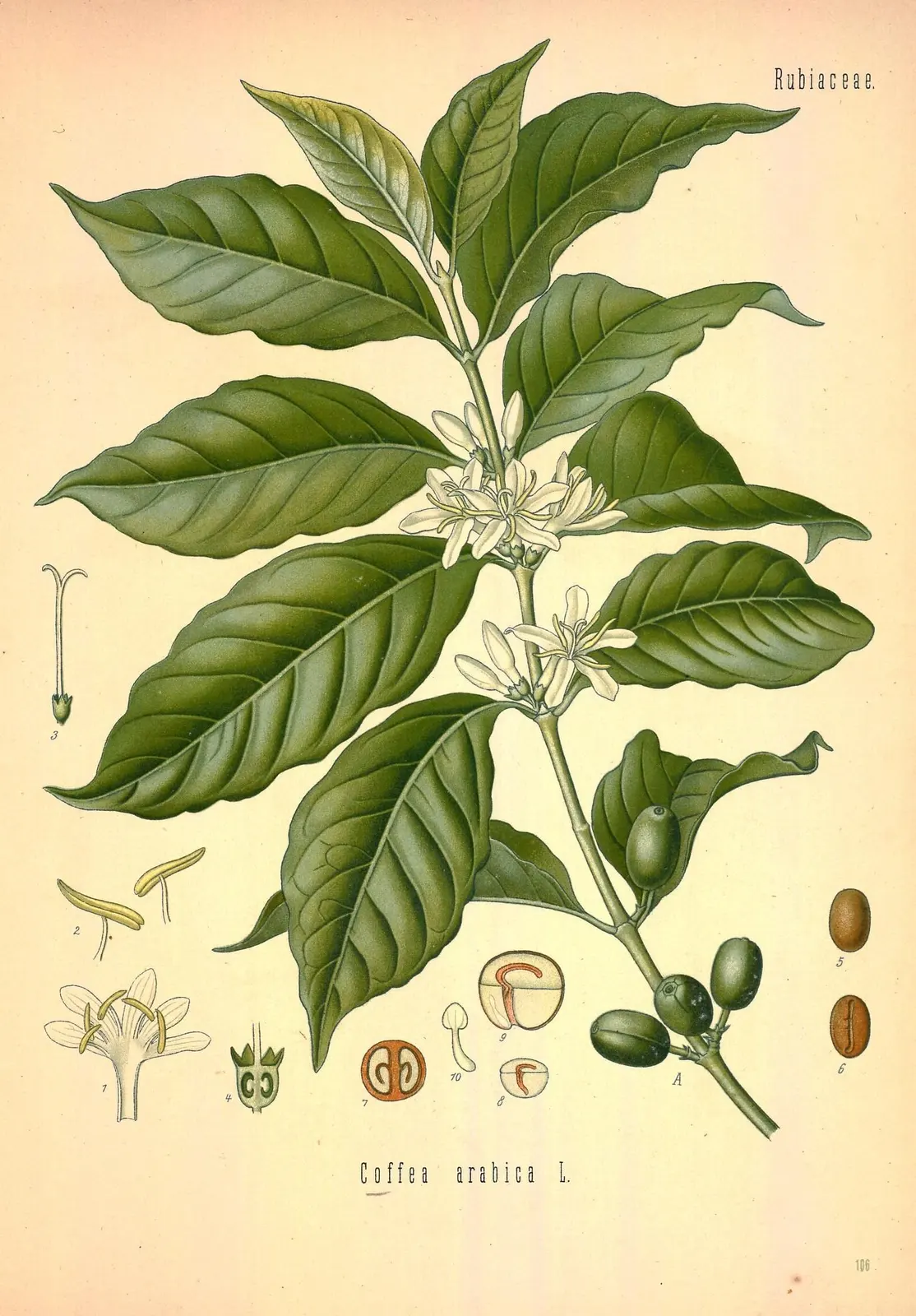
Plate 106 of Köhler's "Medizinal-Pflanzen" (1890) shows Arabian coffee, Coffea arabica, with flowers, unripe fruit and its seeds drawn from both sides and in section.
Credit and licence
"Köhler's Medizinal-Pflanzen in naturgetreuen Abbildungen mit kurz erläuterndem Texte (Plate 106) (8231719251)" by Köhler's Medizinal-Pflanzen (Biodiversity Heritage Library) — https://commons.wikimedia.org/wiki/File:K%C3%B6hler's_Medizinal-Pflanzen_in_naturgetreuen_Abbildungen_mit_kurz_erl%C3%A4uterndem_Texte_(Plate_106)_(8231719251).jpg — Public domain (Plate 106, published in vol. 2 of "Köhler's Medizinal-Pflanzen" in 1890; the plate artist is not named, so the plate is treated as an anonymous work; US: published before 1931; EU: an anonymous work made public more than 70 years ago; the Biodiversity Heritage Library scan is a faithful reproduction)
Coffee and tea make the same caffeine molecule, yet neither inherited it from a caffeine-making ancestor they share. Caffeine is a methylxanthine (a xanthine with methyl groups attached), C8H10N4O2, and a 2016 study of five plant lineages (cacao, citrus, guaraná, coffee and tea) reports that the molecule is the same in all of them but that different pathways make it. Coffee and tea sit in different orders of flowering plants, and each evolved its own way to make the compound. The 2014 coffee genome study points the same way: coffee's caffeine genes multiplied on their own, and tea and cacao show similar but separate gains.
One molecule, several plants
Fig. 1 draws caffeine from the chemical record that Wikidata keeps for it. Count the groups marked CH3: there are three methyl groups, two on the six-sided ring and one on the five-sided ring. Its single PubChem identifier is CID 2519 via Wikidata, and Wikidata classes it as a methylxanthine. That identifier names one compound, whichever plant the sample came from.
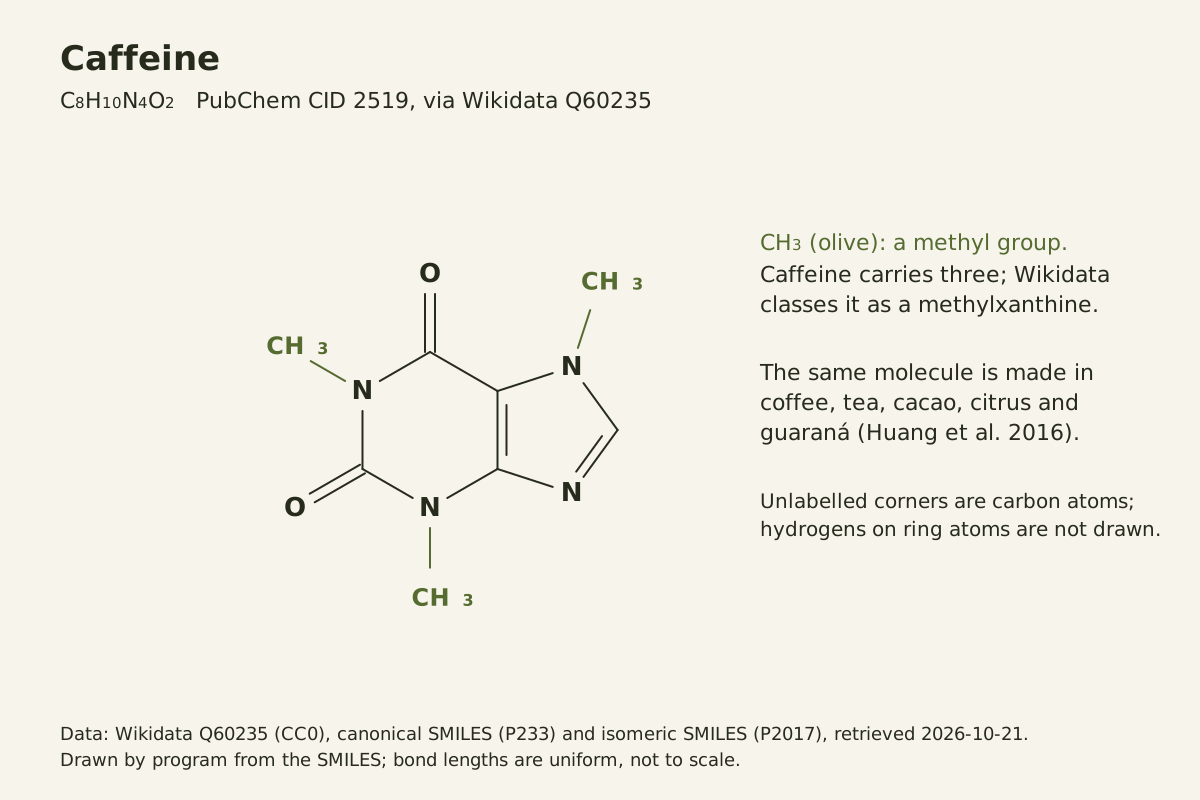
Fig. 1. Caffeine drawn from its Wikidata SMILES, with its three methyl groups marked; CID via Wikidata.
"Caffeine, drawn from its Wikidata SMILES" by Botany for the Curious, https://botanyforthecurious.com/tea-coffee/caffeine/, licensed under CC BY 4.0 (https://creativecommons.org/licenses/by/4.0/)data: Wikidata (CC0), Q60235, PubChem CID 2519, canonical and isomeric SMILES and formula, retrieved 2026-10-21; Huang et al. 2016, PNAS 113: 10613 (abstract), retrieved 2026-10-21The 2016 study by Ruiqi Huang and colleagues names five lineages of plants that contain caffeine. Besides coffee and tea, they are cacao (the tree Theobroma cacao L.), citrus (the genus Citrus L.) and guaraná (Paullinia cupana Kunth, family Sapindaceae). The study's summary adds that caffeine production evolved independently in numerous species, so the five are a sample of the caffeine plants. A 2013 study of bees locates some of it: caffeine occurs in the floral nectar of Coffea and Citrus plants.
The downloadable table below lists only plants named in the study summaries checked for this page. Families follow WCVP (Kew) version 16. Orders follow the World Flora Online Plant List of June 2026.
Download Caffeine plants named in the studies, with family, order and source (CSV) caffeine-plants.csv data: Huang et al. 2016, PNAS 113: 10613; Denoeud et al. 2014, Science 345: 1181; Wright et al. 2013, Science 339: 1202 (abstracts), retrieved 2026-10-21; WCVP (Kew), CC BY 3.0, doi:10.34885/egs6-cp24, retrieved 2026-10-21; World Flora Online Plant List 2026-06 (CC0), retrieved 2026-10-21; Wikidata (CC0), Q101815, Q47685, Q47532, Q42385, Q209089, English common names, retrieved 2026-10-21
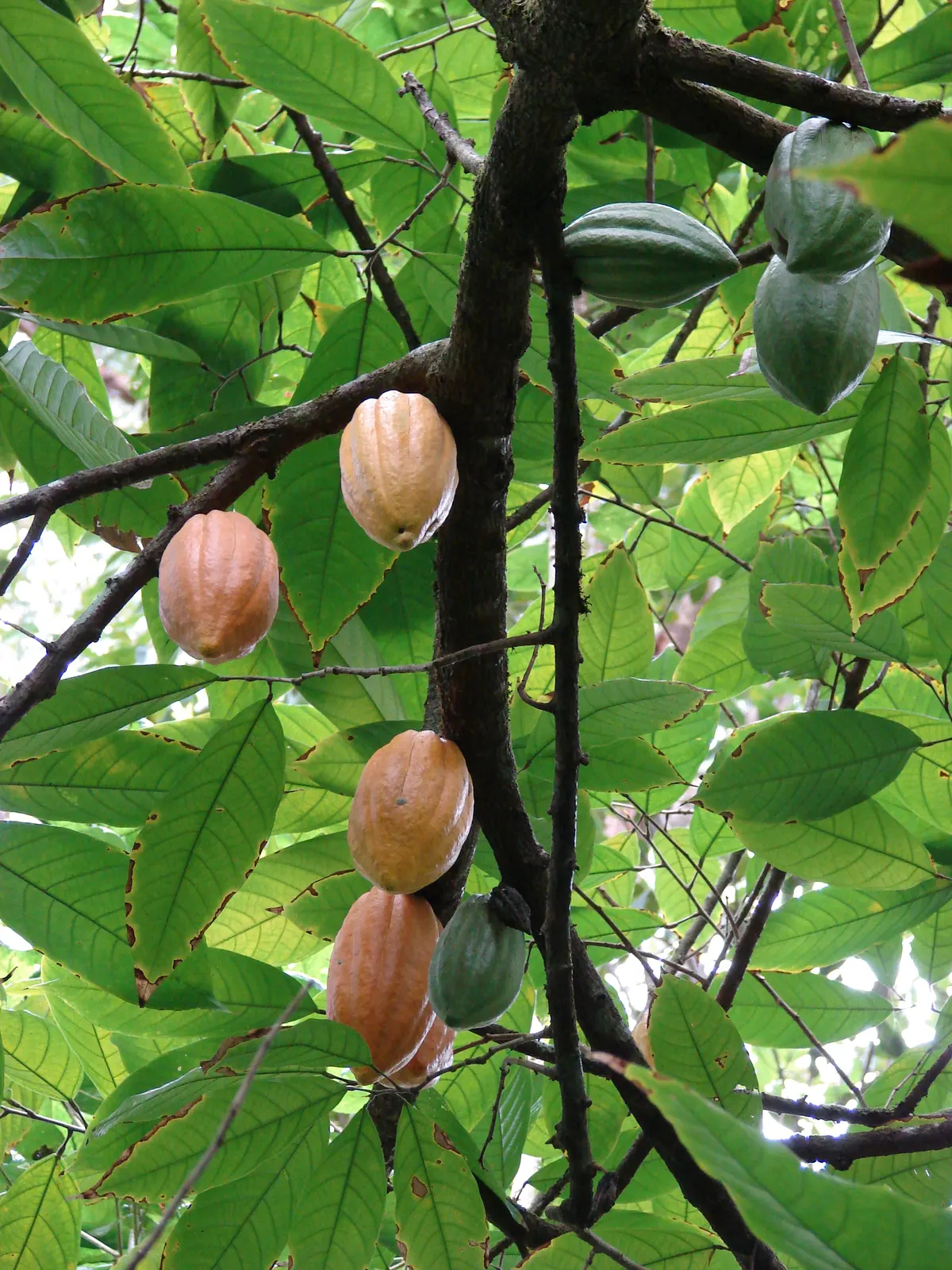
Fruit of the cacao tree, Theobroma cacao, hanging from the trunk and branches beside the Hana Highway on Maui, Hawaii, in March 2007.
"Starr-070321-6121-Theobroma cacao-fruit-Hana Hwy-Maui (24518210199)" by Forest & Kim Starr — https://commons.wikimedia.org/wiki/File:Starr-070321-6121-Theobroma_cacao-fruit-Hana_Hwy-Maui_(24518210199).jpg — CC BY 3.0 US (https://creativecommons.org/licenses/by/3.0/us/)
Is tea's caffeine the same molecule as coffee's?
Yes: Huang and colleagues (2016) state that the caffeine molecule is identical in the tea and coffee lineages. Tea here is the tea plant, Camellia sinensis (L.) Kuntze; coffee is the genus Coffea, which includes Arabian coffee, Coffea arabica L., the species in the plate and the flower photograph on this page. Other names turn up in the chemical databases. Wikidata lists theine and guaranine as aliases of caffeine, and ChEBI, a chemistry database of the European Bioinformatics Institute, gives both as synonyms.
The match was made long before genomes. William Ukers's 1922 book "All About Coffee" treats caffein and thein as names for one alkaloid. Its bibliography lists an 1838 paper by Carl Jobst, "Thein identisch mit Caffein", which translates as "Theine identical with caffeine" (Translation: Botany for the Curious). That entry is the earliest dated statement of the match among the sources checked for this page, and it reaches this page as a later account, since the 1838 paper itself was not among the sources read.
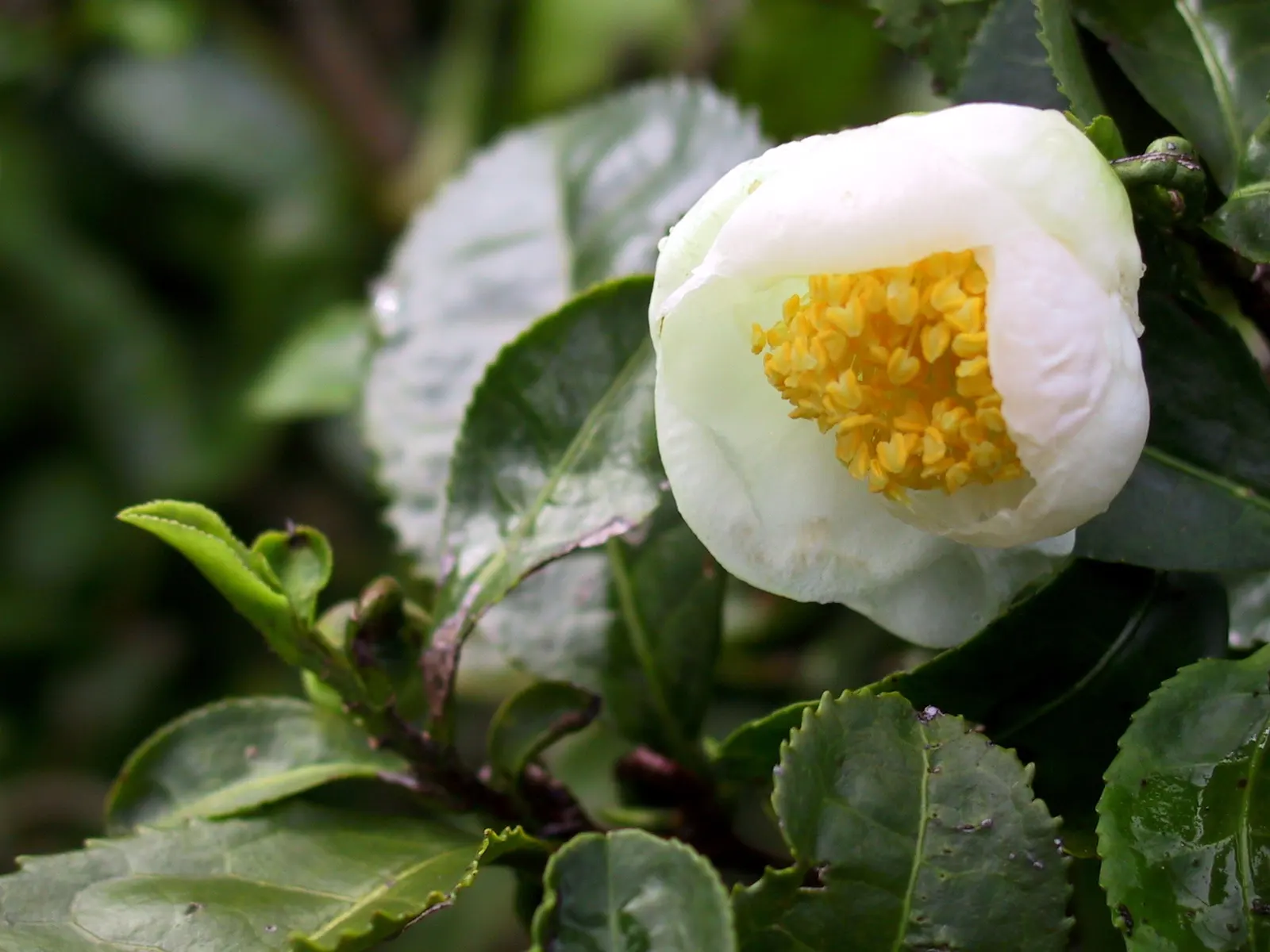
A flower of the tea plant, Camellia sinensis, with a dense ring of yellow stamens; photographed in November 2004.
"Thea sinensis" by Juni — https://commons.wikimedia.org/wiki/File:Thea_sinensis.jpg — CC BY 2.0 (https://creativecommons.org/licenses/by/2.0/)
What processing then does to the tea leaf's other compounds is a separate story, told on Types of Tea.
Far apart on the tree
In Fig. 2, follow the coffee tip and the tea tip back until their lines meet. Both sit in the asterids, one branch of the flowering plants in APweb version 14, but coffee belongs to the order Gentianales (family Rubiaceae) and tea to the order Ericales (family Theaceae). Now follow cacao: its line meets the rose's line at the rosids branch point, and meets coffee's only at the root. On this tree, cacao is closer kin to a rose than to coffee.
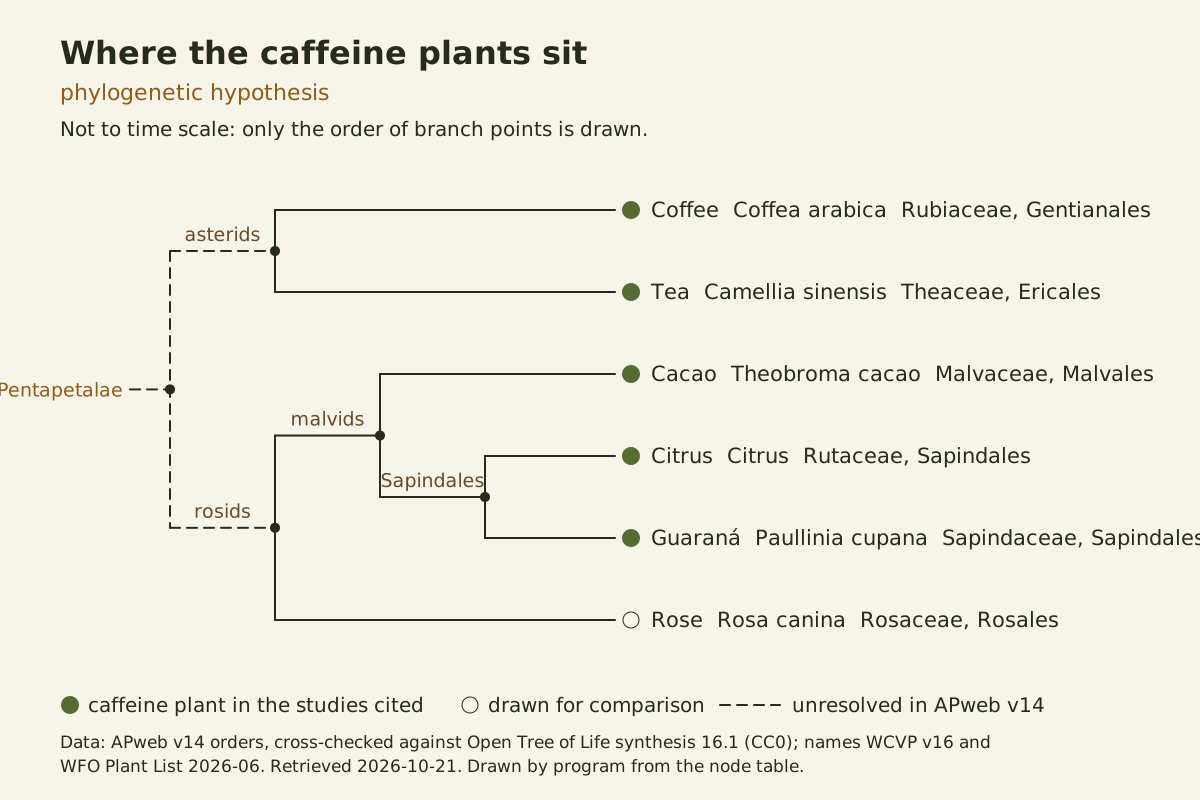
Fig. 2. Phylogenetic hypothesis of six plants: five named as caffeine plants and a rose for comparison; the dashed root marks an unresolved branching order.
"Where the caffeine plants sit on the tree" by Botany for the Curious, https://botanyforthecurious.com/tea-coffee/caffeine/, licensed under CC BY 4.0 (https://creativecommons.org/licenses/by/4.0/)data: APweb version 14 (P. F. Stevens), order and clade placement, retrieved 2026-10-21; Open Tree of Life synthetic tree v16.1 (CC0), https://doi.org/10.5281/zenodo.3937741, with Open Tree Taxonomy 3.7 (draft 3) (CC0), https://doi.org/10.5281/zenodo.3937750, retrieved 2026-10-21; WCVP (Kew), CC BY 3.0, doi:10.34885/egs6-cp24, retrieved 2026-10-21; World Flora Online Plant List 2026-06 (CC0), retrieved 2026-10-21; Huang et al. 2016, PNAS 113: 10613; Denoeud et al. 2014, Science 345: 1181; Wright et al. 2013, Science 339: 1202 (abstracts), retrieved 2026-10-21The rose is drawn for comparison only. None of the studies cited here names it as a caffeine plant. The tree alone cannot show that caffeine arose more than once. In principle one early ancestor could have made it and many of its descendants could have lost it, and the five filled dots at the tips would sit in the same places.
The root is drawn dashed. APweb, the Angiosperm Phylogeny Website, treats the order in which the asterids, the rosids and several other lineages split as unresolved. For where the flowering plants sit among all land plants, see Plant Tree of Life.
Two routes to one molecule
The genes and enzymes supply what the tree cannot. France Denoeud and colleagues sequenced the genome of robusta coffee, Coffea canephora Pierre ex A.Froehner. Its caffeine genes had multiplied by tandem duplication, in which a gene is copied beside the original. The journal's summary of that 2014 paper adds that similar but independent gains had been seen in tea and cacao, which are distantly related to coffee.
Huang and colleagues found that the routes themselves differ. In cacao, citrus, guaraná, coffee and tea, the same molecule is made by different biosynthetic pathways, and the study reports previously unknown ones. The team rebuilt enzymes that ancient plants once had, and from them they conclude that the new pathways would have evolved quickly, because older enzymes were co-opted, or borrowed, from other jobs for making caffeine. When this page says coffee and tea evolved caffeine separately, it means each evolved its own way to make a molecule that ends up the same.
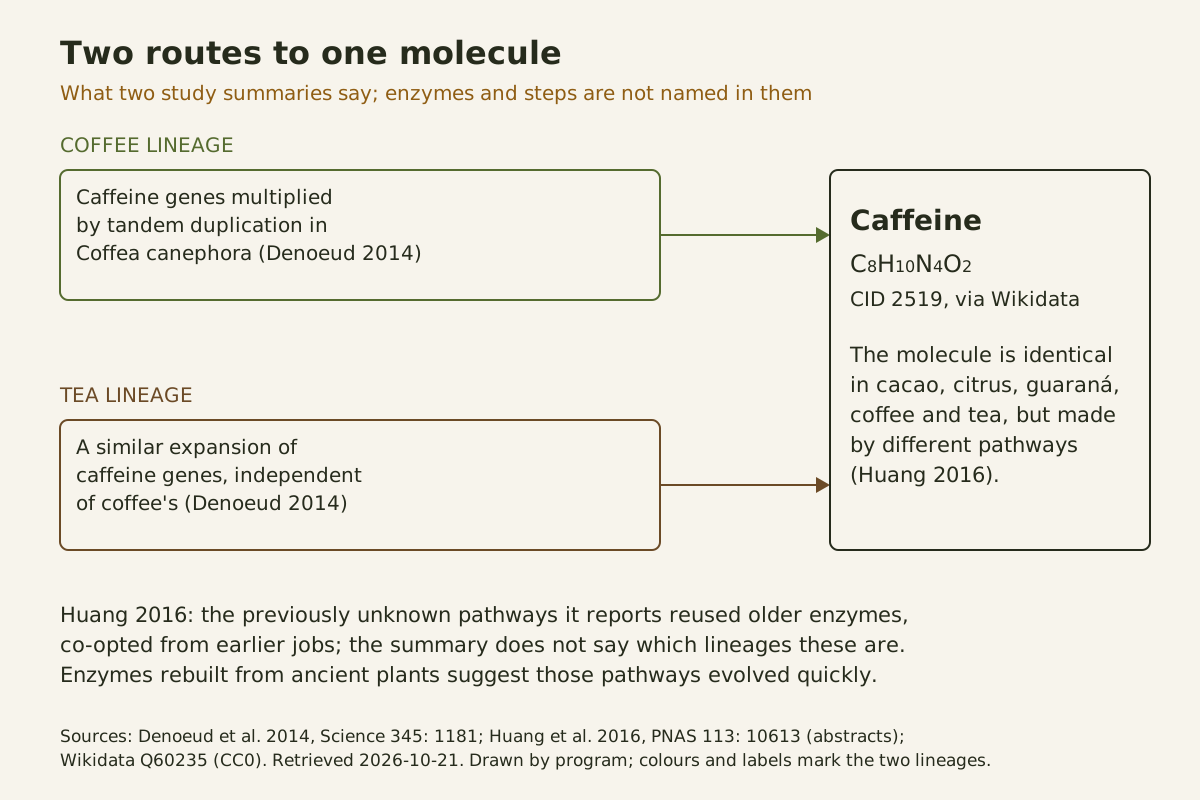
Fig. 3. What two study summaries say about the coffee and tea routes to caffeine; the enzymes and intermediate steps are not named in them.
"Two routes to one molecule" by Botany for the Curious, https://botanyforthecurious.com/tea-coffee/caffeine/, licensed under CC BY 4.0 (https://creativecommons.org/licenses/by/4.0/)data: Denoeud et al. 2014, Science 345: 1181 (abstract), retrieved 2026-10-21; Huang et al. 2016, PNAS 113: 10613 (abstract), retrieved 2026-10-21; Wikidata (CC0), Q60235, PubChem CID 2519 and formula, retrieved 2026-10-21Neither summary names the enzymes or the steps on the way to caffeine. Fig. 3 stops there too. On Botany for the Curious, a compound's identifier shows only which molecule it is. How a plant makes it has to come from a study (how compounds are checked).
Why would a plant make it?
Think of it as part of the sessile wager, a metaphor and not a theory. A rooted plant placed a bet when it germinated, and from then on it mostly stays where it is. Defence against insects that eat it, and the visits of insects that move pollen, have to be handled without moving. Caffeine turns up on both sides of that bet in the research, and the research decides how far the metaphor holds.
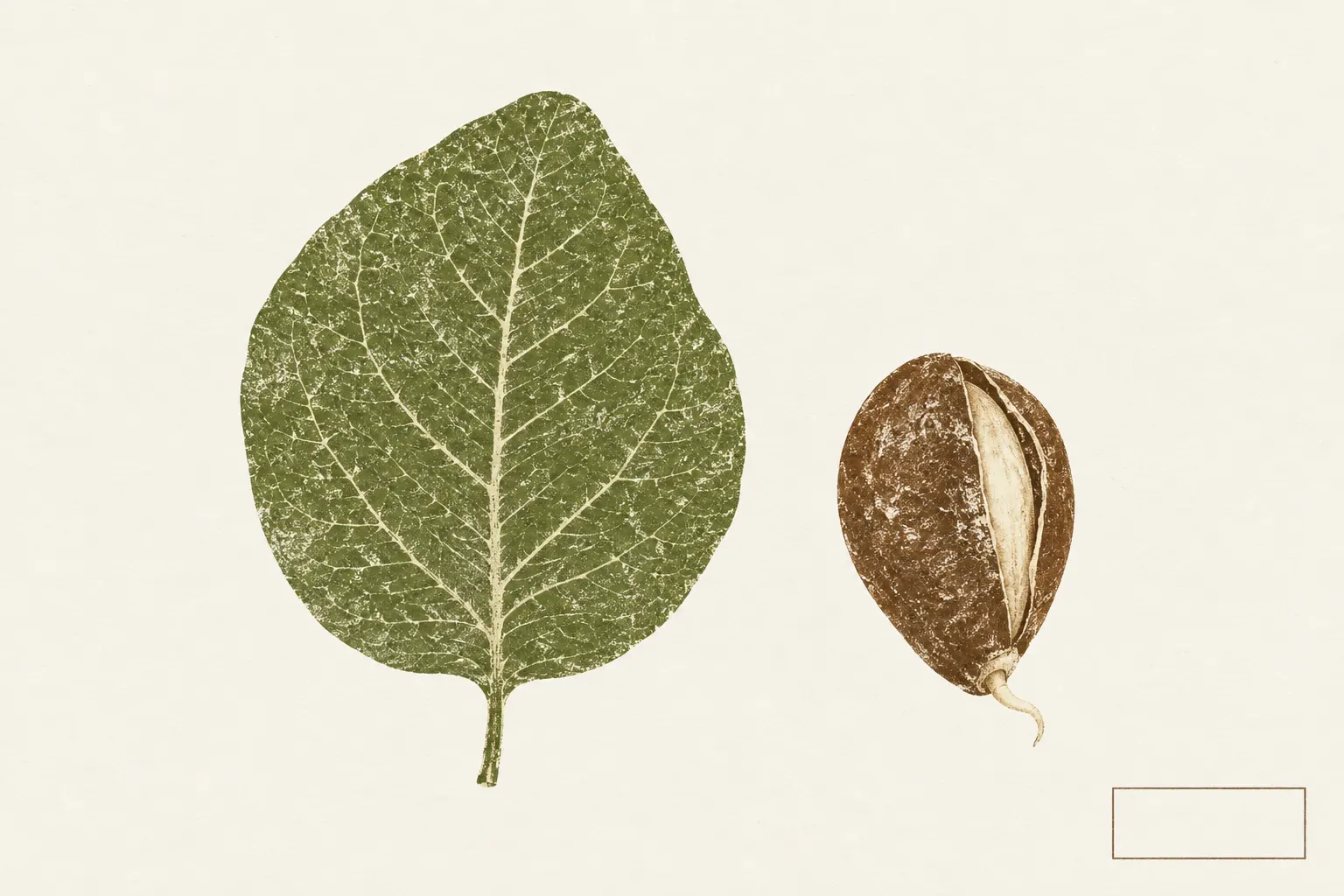
A split seed beside a leaf: once a seed germinates, the rooted plant mostly stays where it is.
Illustration: Botany for the Curious. Generated schematic image — not a photograph or botanical record. Reuse terms: no license is granted; any rights Botany for the Curious holds in this image are reserved.On defence, James Nathanson reported in 1984 on methylxanthines, natural and synthetic, the group that includes caffeine. At levels known to occur in plants, they inhibit insect feeding and act as pesticides. His summary suggests that they may work as natural insecticides. It does not report how plants with and without caffeine fare against insects.
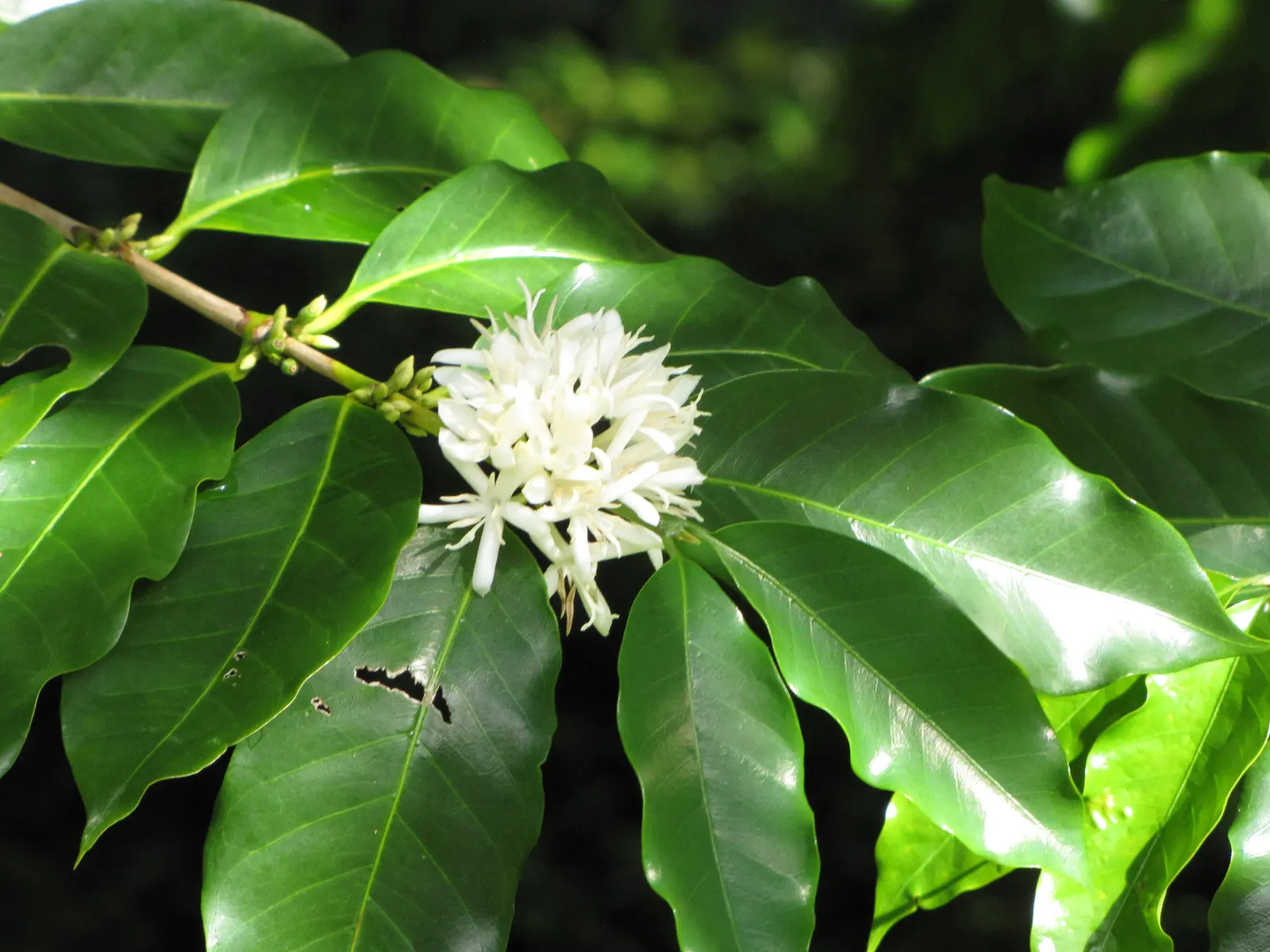
Flowers and leaves of Arabian coffee, Coffea arabica, at Garden of Eden, Keanae, on Maui, Hawaii, in March 2011.
"Starr-110330-3814-Coffea arabica-flowers and leaves-Garden of Eden Keanae-Maui (24713108189)" by Forest & Kim Starr — https://commons.wikimedia.org/wiki/File:Starr-110330-3814-Coffea_arabica-flowers_and_leaves-Garden_of_Eden_Keanae-Maui_(24713108189).jpg — CC BY 3.0 US (https://creativecommons.org/licenses/by/3.0/us/)
The pollination evidence comes from G. A. Wright and colleagues in 2013. Bees given caffeine at naturalistic levels were better at remembering and finding a floral scent they had learned. Caffeine also strengthened the responses of nerve cells involved in learning smells. The summary reports bee memory, not whether coffee or citrus flowers set more seed.
None of these summaries tests the other explanations this site keeps open for any trait, such as a limit set by development or plain historical accident. The coffee genome summary itself goes only as far as saying that caffeine might have played an adaptive role in coffee evolution.
Sources
- Denoeud, F., Carretero-Paulet, L., Dereeper, A., Droc, G., Guyot, R., Pietrella, M., Zheng, C., Alberti, A., et al. (2014). "The coffee genome provides insight into the convergent evolution of caffeine biosynthesis." Science 345(6201): 1181–1184. doi:10.1126/science.1255274. https://doi.org/10.1126/science.1255274 abstract only (journal summary)
- Huang, R., O’Donnell, A. J., Barboline, J. J. & Barkman, T. J. (2016). "Convergent evolution of caffeine in plants by co-option of exapted ancestral enzymes." Proceedings of the National Academy of Sciences of the USA 113(38): 10613–10618. doi:10.1073/pnas.1602575113. https://doi.org/10.1073/pnas.1602575113 abstract only (significance statement)
- Nathanson, J. A. (1984). "Caffeine and related methylxanthines: possible naturally occurring pesticides." Science 226(4671): 184–187. doi:10.1126/science.6207592. https://doi.org/10.1126/science.6207592 abstract only
- Wright, G. A., Baker, D. D., Palmer, M. J., Stabler, D., Mustard, J. A., Power, E. F., Borland, A. M. & Stevenson, P. C. (2013). "Caffeine in floral nectar enhances a pollinator's memory of reward." Science 339(6124): 1202–1204. doi:10.1126/science.1228806. https://doi.org/10.1126/science.1228806 abstract only (journal summary)
- Ukers, W. H. (1922). All About Coffee. New York: The Tea and Coffee Trade Journal Company. Project Gutenberg eBook 28500. https://www.gutenberg.org/ebooks/28500 Chapter XVII and the bibliography section on caffein (1922 edition)
- Govaerts, R. (ed.) (2026). WCVP: World Checklist of Vascular Plants, version 16 (2026-06-04). Facilitated by the Royal Botanic Gardens, Kew. CC BY 3.0. doi:10.34885/egs6-cp24. https://doi.org/10.34885/egs6-cp24 names file: accepted status, authors, families and IPNI identifiers for the plants named on this page Text licence: CC BY 3.0
- World Flora Online Plant List, classification 2026-06 (CC0). World Flora Online Consortium. doi:10.5281/zenodo.7460141. https://doi.org/10.5281/zenodo.7460141 name records and placements for the six plants named on this page
- Stevens, P. F. (2001 onwards). Angiosperm Phylogeny Website. Version 14, July 2017 [and more or less continuously updated since]. http://www.mobot.org/MOBOT/research/APweb/ pages for Gentianales, Ericales, Malvales, Sapindales, Rosales and Dilleniales (Pentapetalae), read 2026-10-21
- OpenTree et al. "Open Tree of Life Synthetic Tree", release opentree16.1 (built 2025-12-20), with Open Tree Taxonomy 3.7 (draft 3) identifiers (CC0). doi:10.5281/zenodo.3937741; taxonomy doi:10.5281/zenodo.3937750. https://doi.org/10.5281/zenodo.3937741 subtree and branch-point support for the six tips of this page
- Wikidata, "caffeine" (Q60235), with the items for Camellia sinensis (Q101815), Coffea arabica (Q47685), Coffea canephora (Q47532), Theobroma cacao (Q42385) and Paullinia cupana (Q209089) (CC0) (read 2026-10-21). https://www.wikidata.org/wiki/Q60235 PubChem CID, SMILES, formula, class and other names of caffeine; English common names of five plants
- ChEBI, "caffeine" (CHEBI:27732). European Bioinformatics Institute (EMBL-EBI) (read 2026-10-21). https://www.ebi.ac.uk/chebi/CHEBI:27732 synonyms in the entry, used to check the names theine and guaranine
Related
- Types of Tea: One Leaf, Six Paths, Three Kinds of Change Deep explainer
- History of Coffee: The Goatherd Legend Traces to a 1671 Book Deep explainer
Cite this page
Botany for the Curious. “Caffeine: Coffee and Tea Evolved It Separately.” Published 2026-10-22; last substantive revision 2026-10-22. https://botanyforthecurious.com/tea-coffee/caffeine/ (accessed: add the date you read it).
- Published
- Last substantive revision